Walmart Receipt Maker: Rebuild Your Record
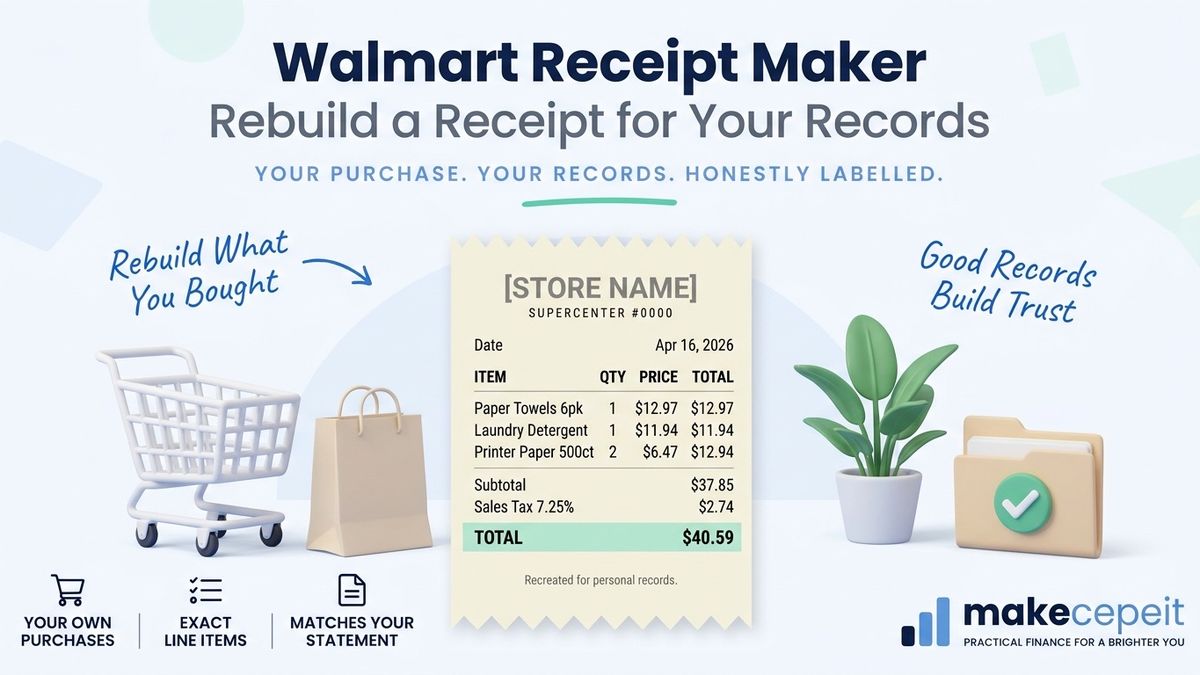
A Walmart receipt maker is a tool that rebuilds a readable copy of a store purchase you already made, for shoppers, contractors, freelancers and small business owners whose paper slip faded, tore or went through the wash. It produces one clear document carrying the same facts the original carried: the store, the date, the items, the tax and the method of payment.
Across the United States, thermal receipts fade within months, and the ones that survive a purse or a truck cab rarely survive a year. Makecepeit lets you create a receipt from a fixed layout, so a purchase you are documenting reads the same way every time, whether it is one grocery run in Dallas or a month of supply trips in Chicago.
What Is a Walmart Receipt Maker?
It is a receipt builder used to reconstruct a record of a purchase whose original slip is lost, faded or damaged.
The phrase describes the job, not a product sold by the retailer. You supply what you know about the purchase, the tool arranges it into a standard receipt layout, and you keep the result with your own records. Nothing about that process reaches the store's systems, and the output is your document rather than a reissue of theirs.
That distinction matters more than it sounds. A rebuilt copy is a personal record, useful for budgeting, reimbursement and warranty files. It is not a replacement for the retailer's own transaction record, and it should never be presented as one.
What it is not
It is not a reprint service, and it does not reach into any retailer's database to find what you bought. Nothing you enter is checked against a store record, which is why the accuracy of a rebuilt copy rests entirely on the care you take with it. Treat it as a document you are signing rather than one you are requesting, and the right level of caution follows naturally.
What Information Do You Need Before You Start?
- Purchase date, which your bank or card statement will confirm
- Store number or location, such as the city and state you shopped in
- Item descriptions for the things you actually bought
- Quantities and unit prices where you can recall or verify them
- Subtotal before tax
- Sales tax charged on the taxable portion
- Total paid, which should match the statement line exactly
- Payment method, with only the last four digits of a card
- Time of day, if you have it, which helps when two trips fall on one date
Where those details usually survive
The total and the date are the easiest to recover, because they sit on your statement. Item detail is harder, and for a large grocery run it may be partly reconstructed from memory. A photo taken at the register, an order confirmation email or a shared household note often fills the gap.
Receipt Maker vs. Store Receipt Lookup
Ask the retailer first when you need the original, and rebuild a copy only when the original cannot be produced.
| Question | Store receipt lookup | Receipt maker |
|---|---|---|
| Who produces it | The retailer, from their records | You, from what you know |
| Typical wait | Minutes to several days | A few minutes |
| Proof of purchase for a return | Usually accepted | Generally not accepted |
| Works for cash purchases | Often not | Yes |
| Useful for budgets and expense files | Yes | Yes |
| Contains the store's own transaction codes | Yes | No |
Our guide to looking up a Walmart receipt covers the app, the website and the service desk. If a return or a warranty claim is the reason you are searching, start there. A rebuilt copy earns its keep afterwards, once the original is genuinely unavailable.
When each one wins
A lookup wins whenever somebody else has to accept the document: a service desk, a manufacturer handling a warranty claim, a card issuer reviewing a dispute. A rebuilt copy wins when the reader is you, your bookkeeper or your accountant, and when the original no longer exists to be found. Cash purchases fall almost entirely into the second group, because there is often nothing for the retailer to look up in the first place.
Why Walmart Receipt Records Matter in the United States
Because the thermal paper fades long before the reasons you might need the record do.
Warranty periods on tools, appliances and electronics commonly run a year or longer. Tax records for a small business are generally kept for several years. Household budgets get reviewed monthly. The paper, meanwhile, is printed with heat-sensitive dye that fades with sunlight, heat and time, and a glovebox in Phoenix will finish a receipt in a season.
Businesses in New York, Texas and Florida also answer to state revenue departments whose record-keeping expectations vary. The IRS describes the general principle plainly enough: keep records that support what appears on a return. How long, and in what form, depends on your circumstances, and a tax professional is the right person to ask about your own.
Important: a receipt you rebuild documents a purchase that genuinely happened. Creating a document for a purchase that did not happen, or passing a recreated copy off as the retailer's original, is fraud in any state.
How long records stay useful
A grocery receipt may stop mattering the moment the card statement clears. An appliance receipt may matter in three years, when a compressor fails inside a warranty period nobody remembers the terms of. Because the paper fades on the same schedule regardless, the practical answer is to rebuild the ones attached to something durable — tools, electronics, appliances, business supplies — and let the rest go.
How to Make a Walmart Receipt Copy in Five Steps
- Pull the statement line. Find the transaction on your bank or card statement and note the exact date and total.
- List what you bought. Write the items out, with quantities and unit prices where you have them.
- Check that the math lands. Your item total plus tax should equal the amount the statement shows.
- Enter the details once. Open the builder, fill the store, date, items, tax and payment fields, and leave nothing guessed that you can verify.
- Save and file it. Download the finished copy and store it with the statement page it came from, so the two support each other.
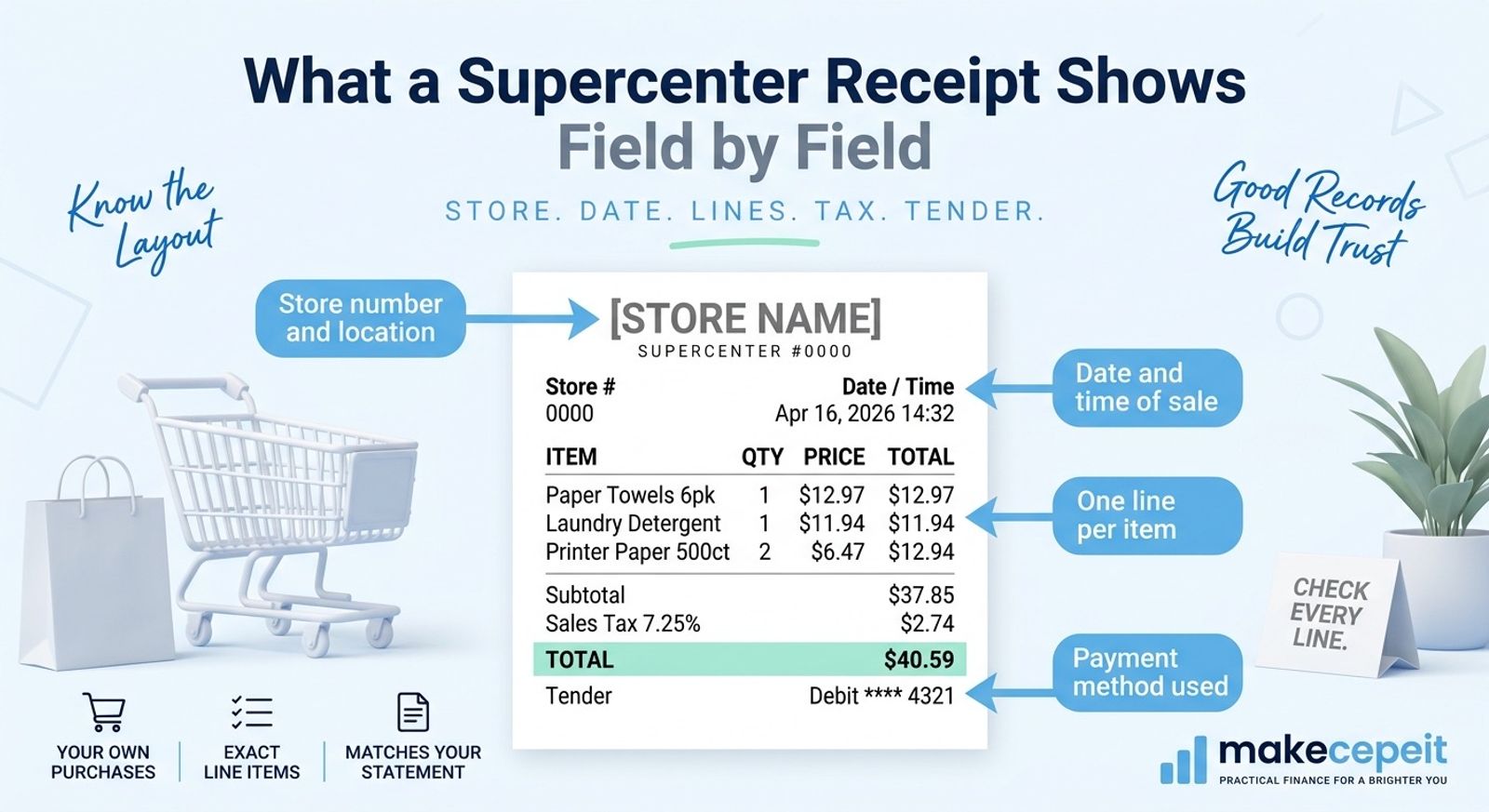
Checking the arithmetic
Add the item lines, apply the tax, and compare the result with the statement. If the two differ by a few cents, a price was probably mis-remembered. If they differ by several dollars, an item is missing. Closing that gap before you save is what separates a copy somebody can rely on from a rough note, and the accuracy costs nothing but a second pass.
Reading the Purchase Back From Your Bank Statement
The statement gives you the date and the total; everything else you reconstruct around those two anchors.
A card statement usually shows a merchant descriptor, a city and an amount. That is enough to fix the purchase in time and to set the figure your rebuilt copy must reach. Work backwards from it: if your item lines and tax do not add up to the statement total, something is missing or mis-remembered, and the gap is worth closing before you save.
Debit purchases in Los Angeles and credit purchases in Miami look much the same on a statement. Cash purchases show nothing at all, which is exactly the case where a rebuilt copy does the most work, and also the case where honesty about what you remember matters most.
Household Budgets and Shared Expenses
A readable copy settles the small questions that paper receipts usually lose.
Roommates splitting a supply run, couples tracking a monthly grocery figure and parents reimbursing an adult child for a shopping trip all need the same thing: a line-by-line record both sides can read. A faded strip of thermal paper cannot do that job by February.
For a small business, the same copy feeds bookkeeping. Supplies bought on a Saturday trip in Houston often never reach the accounts because the slip disappeared, and a rebuilt copy attached to the statement line closes that hole.
Reimbursement between people
When one person pays and another repays, the receipt is the whole conversation. A rebuilt copy showing items, tax and a total settles it without anybody relying on memory, and it may prevent the slow disagreement that starts when two people recall a figure differently. Keep it plain, send it once, and file the copy you sent.
What a Receipt Maker Cannot Do
It cannot create proof that a purchase happened, and it cannot stand in for the retailer's record.
- It does not connect to any store's transaction system
- It does not generate valid store transaction codes or survey invitations
- It is generally not accepted as proof of purchase for a return
- It does not extend or establish a manufacturer's warranty on its own
- It cannot recover item detail you never had
Used for what it is — a personal record of a real purchase — it is genuinely useful. Used as a substitute for the store's own paperwork, it fails, and the failure is the point at which honest record-keeping turns into something else.
Why Use makecepeit for Walmart Receipt Copies?
Because the layout stays fixed, so every copy you build reads the same and the math is done for you.
- Enter the items once and the totals calculate as you type
- A consistent structure across every receipt you rebuild
- Fields for store, date, tax and payment method in the order a reader expects
- Download as a clean file you can attach to a statement or an expense claim
- Nothing to install, and no account needed to build one
The builder is free to start, and the same layout serves a grocery run, a tools purchase or a month of small supply trips.
Tips Before You Rebuild a Receipt
- Check the statement before you type, not afterwards
- Record the store's city and state rather than inventing a street address
- Mask the card number down to the last four digits
- Keep item descriptions plain and recognisable
- Note anywhere you estimated, so a later reader knows
- Save the copy in the same folder as the statement it matches
- Rebuild one receipt per transaction, never a month in one document
Common Mistakes to Avoid
- Making the total match by inventing a line. If the math is short, say so rather than padding it.
- Copying store branding. A copy for your own records needs no logo, and reproducing one invites a trademark problem.
- Fabricating transaction codes. Invented store codes look real and are not, which is exactly the wrong combination.
- Writing a full card number. Last four digits only, on any receipt you keep or send.
- Using a rebuilt copy for a return. Ask the retailer for the original instead.
- Rounding the tax. Enter the taxable subtotal and let the calculation land where it lands.
- Backdating a purchase. The date on the statement is the date on the receipt.
Final Takeaway
A Walmart receipt maker earns its place in one situation: you made a purchase, the paper is gone, and you still need a readable record of what you spent. Gather the date and total from your statement, reconstruct the items honestly, and keep the result with the paperwork it supports.
When the original matters — a return, a warranty claim, a dispute — ask the retailer first. A rebuilt copy is for your files, and within those limits it does its job well.
Keep the rebuilt copy honest about its own nature. A note in your folder saying where the figures came from, and which parts were reconstructed rather than recovered, costs one line and answers the only question a later reader is likely to raise.
Create Your Receipt With makecepeit
Enter the store, the date, the items and the way you paid, and the totals calculate as you go. Build your receipt and keep it filed beside the statement it matches.
Frequently asked questions
- What is a Walmart receipt maker?
- It is a receipt builder used to reconstruct a readable copy of a purchase you already made, when the original paper slip is lost, faded or damaged.
- Is a rebuilt receipt accepted for a return?
- Generally not. Retailers verify returns against their own transaction records, so ask the store to look up the original purchase instead.
- What details do I need to rebuild one?
- The date and total from your statement, the store location, the items you bought, the sales tax charged and the payment method used.
- Where do I find the purchase date?
- Your bank or card statement shows the date and the exact amount, which are the two anchors every rebuilt copy should be built around.
- Can I rebuild a receipt for a cash purchase?
- Yes, and cash is the case where it helps most, because no statement line exists. Record only what you genuinely remember buying.
- Should the copy carry the store logo?
- No. A record for your own files needs no branding, and reproducing a retailer's logo on a document you created raises a trademark problem.
- How long should I keep receipt records?
- It depends on why you need them. Warranties often run a year or more, and business records are generally kept longer. Ask a tax professional about your situation.
- Does the sales tax rate have to be exact?
- It should reflect what you were actually charged. Rates vary by state and locality, so work from the statement total rather than a rounded guess.
- How much card information should appear?
- Only the last four digits. Full card numbers do not belong on any receipt you keep, print or send to somebody else.
- Is making a receipt copy legal?
- Documenting a purchase you genuinely made is ordinary record-keeping. Creating a receipt for a purchase that never happened, or passing a copy off as the store's original, is fraud.