Printable Walmart Receipt Generator Guide
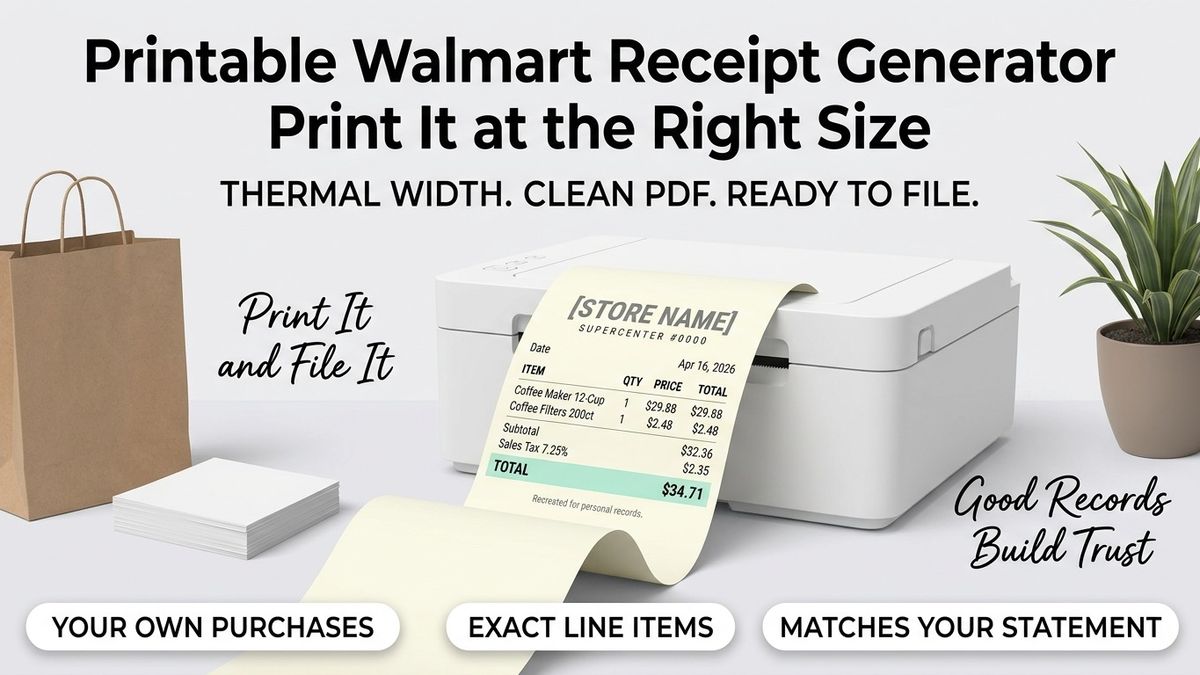
A printable Walmart receipt generator produces a record of a purchase in a form that survives the trip to paper, for anyone who files hard copies, submits expense claims or keeps a physical folder for a business. It handles the parts that go wrong at the printer: page width, margins, legible type and a layout that does not break across two sheets.
Plenty of records are built well and print badly. Makecepeit lets you create a receipt and download it as a clean file, so what lands in the tray in Tampa looks the way it did on screen in Portland.
What Is a Printable Receipt Generator?
It is a receipt builder whose output is designed to be printed, not only viewed.
The difference shows up in small things. Type that stays legible when scaled down. Columns that hold their alignment on paper. Margins wide enough that nothing is clipped by a printer's unprintable edge. A record that reads well on a screen may still lose its right-hand column on an inkjet, and the cost of discovering that is a wasted sheet and a reprint.
As with any receipt you build, the output documents a purchase you actually made. It is your record, not a reissue of the retailer's.
Why paper still matters
Paper survives software changes, account closures and forgotten passwords. Contractors hand physical receipts to clients, some expense processes still want a printed copy stapled to a form, and a folder in a filing cabinet in Cleveland stays readable without anybody logging in. Digital-first record-keeping is sensible, but paper remains the fallback that never needs a migration.
Thermal Width or Full Page?
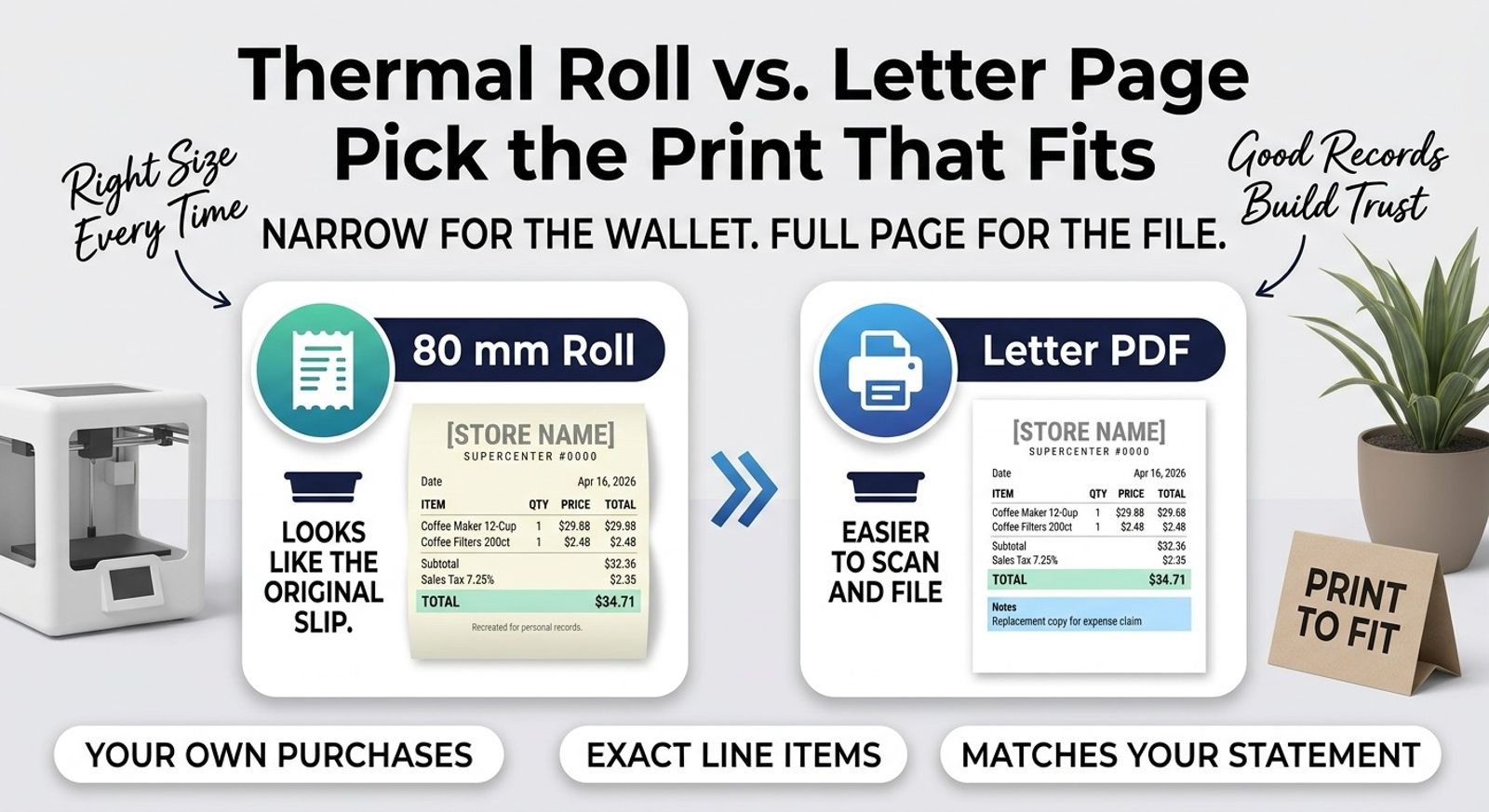
A narrow slip looks like the original; a full page files and scans better.
| Consideration | Narrow slip | Letter page |
|---|---|---|
| Resembles a store receipt | Closely | Not at all |
| Fits a standard folder | Poorly | Yes |
| Scans cleanly | Often crooked | Yes |
| Room for notes | Almost none | Plenty |
| Paper used | Minimal | One sheet |
| Best for | Wallet copies, quick reference | Expense files, accountants, archives |
Most people filing records should choose the page. The narrow format matters mainly when the copy sits alongside genuine slips and you want the folder to look uniform.
Margins and clipping
Nearly every printer reserves an unprintable border, and a layout that runs a column too close to the edge loses characters there. If a printed copy comes out missing the ends of its price column, the fix is usually margins rather than the generator.
What Should Print on Every Copy
- Store name and location, or a clear placeholder if you shopped in several
- Date of purchase, matching your statement
- Item lines with quantities and unit prices
- Subtotal, on its own row
- Sales tax, kept visible rather than folded in
- Total paid, in the largest type on the document
- Payment method, masked to the last four digits
- A short note marking the copy as a personal record, where useful
The total needs to be findable
Whoever picks the sheet up looks for the total first. Keeping it visually distinct, by weight or a shaded row, spares a reader from scanning the whole column. It is a small formatting decision that may save minutes across a folder of fifty records.
Why Printed Receipt Records Matter in the United States
Because a filed paper copy is the version that survives when the digital one is not accessible.
Small businesses in Miami, Denver and Boston keep record boxes for exactly this reason. An accountant asked for supporting documents in March generally wants them in a form they can work through quickly, and a printed set arranged by date usually is that form. The IRS expects records supporting what a return claims, and what counts for your situation depends on the business, so ask a tax professional about your own case.
Warranty claims add a second reason. A manufacturer handling a claim on a tool bought two years ago may accept a legible copy alongside other evidence, while a faded thermal strip proves nothing at all.
Important: printing a record of a purchase you made is ordinary bookkeeping. Printing a receipt for a purchase that did not happen, or presenting your copy as the store's original, is fraud.
How to Print a Receipt Copy Cleanly
- Build the record first, checking the total against your statement.
- Choose the format, narrow slip or full page, before you print.
- Download the file rather than printing from a preview window.
- Check the margins in the print dialog and disable any shrink-to-fit that alters proportions.
- Print one test copy and read the right-hand column carefully.
- File the sheet with the statement page it matches.
- Keep the digital file too, so a reprint never means rebuilding the record.
Checking accuracy before the printer
Accuracy is cheaper on screen than on paper. Compare the total with the statement line, confirm the date, and read the item column once before anything prints. A business in Texas or California filing dozens of records a month will save more time on that single check than on any other habit here, because a wrong figure discovered after filing usually means finding the sheet, reprinting it and swapping it out.
Batch printing a month
When a month of records prints at once, print one test sheet first and confirm the margins hold. Then print the batch in date order, so the stack arrives in the sequence it will be filed in. Sorting fifty loose sheets by hand afterwards takes longer than the printing did, and the order is free if you ask for it up front.
Scanning and Archiving What You Print
Scan the page version, not the narrow slip, whenever the copy has to go digital again.
A letter-size sheet sits square on a scanner bed and produces a straight, croppable image. A narrow slip curls, skews and often needs three attempts. If the workflow is print, sign, scan and email — which it still is in plenty of offices — the page format saves the most time.
Name scanned files the same way you name the originals, by date and store. Two naming schemes in one archive may cost more time than the scanning did.
Filing a Printed Receipt Where It Can Be Found
A printed copy is only as useful as the folder it lands in.
Records filed by date suit a household or a sole trader reviewing a month. Records filed by job or client suit a contractor, and records filed by category suit anybody preparing a return. Any of the three works; mixing them does not, and a folder holding all three schemes usually has to be read end to end to answer a single question.
Write the reference on the sheet itself where the folder uses one. A page that falls out of its folder in an office in New York can be refiled in seconds if it says where it belongs, and is otherwise a small mystery for whoever picks it up.
Folder discipline
File the sheet the day it prints. A stack of printed records waiting to be filed is the same problem as a shoebox of receipts, only with better formatting, and it tends to grow until somebody sets aside an afternoon for it.
Ink, Paper and Legibility
Print in black on plain white paper and keep the type large enough to read after a photocopy.
Coloured backgrounds and light grey type look refined on screen and fail on paper, particularly once a document has been photocopied or faxed by somebody else's office. Small type in a price column is the first thing to go. Plain formatting is not a compromise here; it is what keeps a record usable through the copies that follow.
Why Use makecepeit for Printable Receipts?
Because the layout is built to survive the printer, and the totals are calculated before anything reaches paper.
- Clean downloads rather than screenshots of a preview
- A structure that holds its columns at print size
- Totals that recalculate as you edit, so no printed copy carries stale math
- The same layout every time, which keeps a printed folder uniform
- Free to start, with nothing to install
One record, one sheet
Keep each purchase on its own page. Two receipts sharing a sheet may save paper, but they cannot be filed in two places, and the second one is usually the one somebody later needs on its own. Where a record runs long, let it continue onto a second page rather than shrinking the type to force a fit.
Tips Before You Print
- Check the total against the statement before printing, not after
- Print one test copy before running a batch
- Keep the digital file alongside the paper one
- Use plain black type on white paper
- Leave real margins at every edge
- Mask card numbers to four digits
- Write the filing reference on the sheet if your folder uses one
Reprints and corrections
When a record changes after it has been printed, reprint it and destroy the old sheet rather than annotating it by hand. A corrected figure in pen raises a question that the reprint answers for free, and a folder holding both versions of one purchase is worse than a folder holding neither.
Common Mistakes to Avoid
- Printing before reconciling. A copy whose total disagrees with the statement wastes both the sheet and the reader's time.
- Screenshotting a preview. Resolution suffers and the columns rarely survive.
- Using shrink-to-fit. It rescales the layout and can make a price column unreadable.
- Choosing the narrow format for a filing folder. It curls, skews and scans badly.
- Printing card details in full. Paper travels, so mask to four digits.
- Adding store branding. A personal record needs none, and copying a logo creates a trademark problem.
- Keeping only the paper copy. Without the file, a reprint means rebuilding the record from scratch.
What a printed copy proves
A printed record proves what you recorded, not that a retailer issued it. That is enough for budgeting, bookkeeping and most internal expense processes, and it is not enough for a return or a chargeback. Being clear about that line, in your own mind and on the document, is what keeps accurate record-keeping distinct from something a reviewer would rightly question.
Final Takeaway
A printable Walmart receipt generator is judged at the printer, not on screen. Reconcile the record first, pick the page format if it is going into a folder, keep the margins honest and print one test copy before a batch. Keep the digital file so a reprint is never a rebuild.
For anything needing the retailer's own document, such as a return or a warranty dispute, request the original. Our guide to looking up a Walmart receipt explains how.
Printing is the last step in a chain that starts with an accurate record, and it is the step that exposes any weakness in the earlier ones. A total that never reconciled, an item line nobody can read, a card number left in full: all of them become permanent the moment the sheet leaves the tray. Spending a minute on screen first is what keeps the printed set worth keeping.
Treat the paper copy as the durable version and the file as the working one. The file is what you edit, reprint and email; the sheet is what survives in the folder when everything else has moved on to another system.
Create Your Printable Receipt With makecepeit
Build the record, check the total, then download a file that prints cleanly at the size you need. Make your receipt and file the sheet beside the statement it supports.
Frequently asked questions
- What is a printable receipt generator?
- It is a receipt builder whose output is laid out for paper, with margins, type sizes and columns that stay legible once printed rather than only on screen.
- Narrow slip or full page, which prints better?
- A full page for anything being filed or scanned. The narrow format suits a wallet copy or a folder that also holds genuine store slips.
- Why does my printed copy lose a column?
- Usually margins. Printers reserve an unprintable border, so a layout running too close to the edge loses characters there.
- Should I use shrink-to-fit when printing?
- No. It rescales the layout and often makes the price column unreadable. Set proper margins and print at full size instead.
- Can I scan a printed receipt copy?
- Yes, and the page format scans far better. A narrow slip curls and skews on the scanner bed, often needing several attempts.
- Should I keep the digital file too?
- Yes. Without it, a reprint means rebuilding the record from scratch, and the details you used may be harder to recover later.
- What colour should the receipt print in?
- Plain black on white paper. Coloured backgrounds and light grey type look fine on screen and fail once a document is photocopied.
- How much card detail should be printed?
- The last four digits only. Printed pages travel between desks and offices, so full card numbers should never appear on them.
- Is a printed copy valid for a return?
- Generally not. Retailers check their own transaction records, so request the original receipt from the store when a return is the goal.
- Is printing a receipt copy legal?
- Printing a record of a purchase you genuinely made is ordinary bookkeeping. Printing one for a purchase that never happened, or passing it off as the store's, is fraud.