Transaction ID on a Receipt: What It Is & Where to Find It
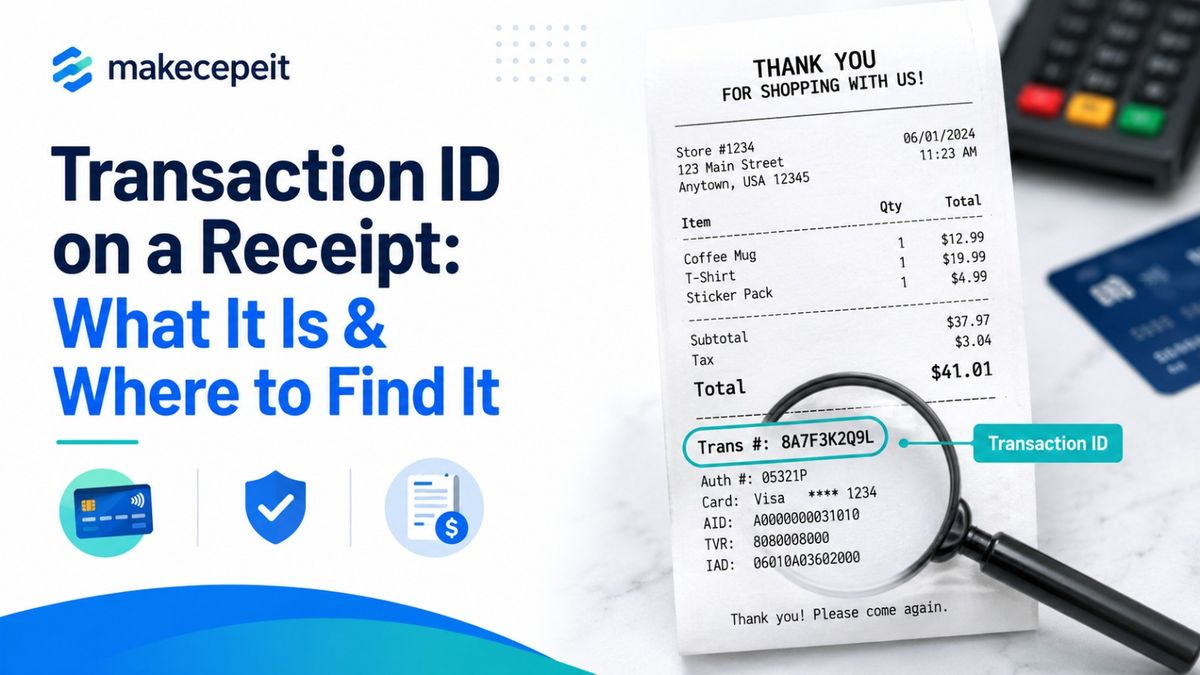
A transaction ID on a receipt is a unique reference used to identify a specific payment or sale in a merchant, point-of-sale, or payment-processing system. It may appear as a series of numbers, letters, or both, and it is often labeled Transaction ID, Transaction #, Trans ID, Reference Number, Trace Number, or a similar term.
Where you find it depends on the store and payment system. It is commonly printed near the top or bottom of a receipt, close to the payment details, date and time, terminal number, or authorization information. For customers and businesses in the United States, understanding this identifier can make refunds, payment disputes, bookkeeping, and receipt verification much easier. For receipt-focused workflows such as those associated with makecepeit, keeping transaction details clear and easy to identify is especially useful.
What Is a Transaction ID on a Receipt?
A transaction ID is an identifier connected to one specific transaction. It allows a merchant, payment processor, or point-of-sale system to distinguish that transaction from thousands or millions of other payments.
A transaction ID is essentially a digital reference that helps a business locate the exact payment or sale connected to a receipt.
Think of it as a tracking reference for the transaction. If a customer buys something at a store, restaurant, gas station, or online shop, the systems involved in processing that sale create records. One or more identifiers may be attached to those records so the transaction can be found later.
The exact format is not standardized across every business. One receipt might show a simple numeric transaction number such as Trans, while another system may create a longer alphanumeric reference.
Payment platforms and merchant systems can also generate multiple identifiers for the same purchase. As a result, a transaction ID should not automatically be confused with an authorization code, receipt number, invoice number, order number, or merchant ID.
Where Is the Transaction ID on a Receipt?
The transaction ID is usually located near the payment information, transaction summary, or identifying details at the top or bottom of the receipt. Look for labels such as "Transaction," "Trans #," "Reference," "Ref #," "Trace," or "Transaction ID."
Common Places to Check
- Near the top of the receipt below the store information
- Next to the purchase date and time
- Near the register or terminal number
- In the card-payment section
- Next to an authorization or reference number
- Near the bottom of the receipt above the return policy
- Inside the payment details of an emailed or digital receipt
Do not rely only on location. Receipt layouts vary significantly between merchants, restaurants, payment processors, and POS systems throughout the United States. The label next to the identifier is usually more useful than its physical position.
What Does a Transaction ID Look Like?
A transaction ID may contain only numbers or a combination of letters and numbers. Its length depends on the merchant and the system processing the transaction.
For example, a receipt could display identifiers in formats such as:
- Transaction #: 487263
- Trans ID: 934785120
- Reference: A71K9428
- Trace #: 005821
These are illustrative examples only. There is no universal transaction ID format shared by every retailer, bank, card network, or payment processor.
If several codes appear on the receipt, read their labels carefully before deciding which one is the transaction identifier.
Transaction ID vs. Receipt Number: What Is the Difference?
A transaction ID identifies the underlying transaction record, while a receipt number generally identifies the receipt or sales document created for that purchase. Sometimes a merchant uses the same value for both purposes, but businesses should not assume they are interchangeable.
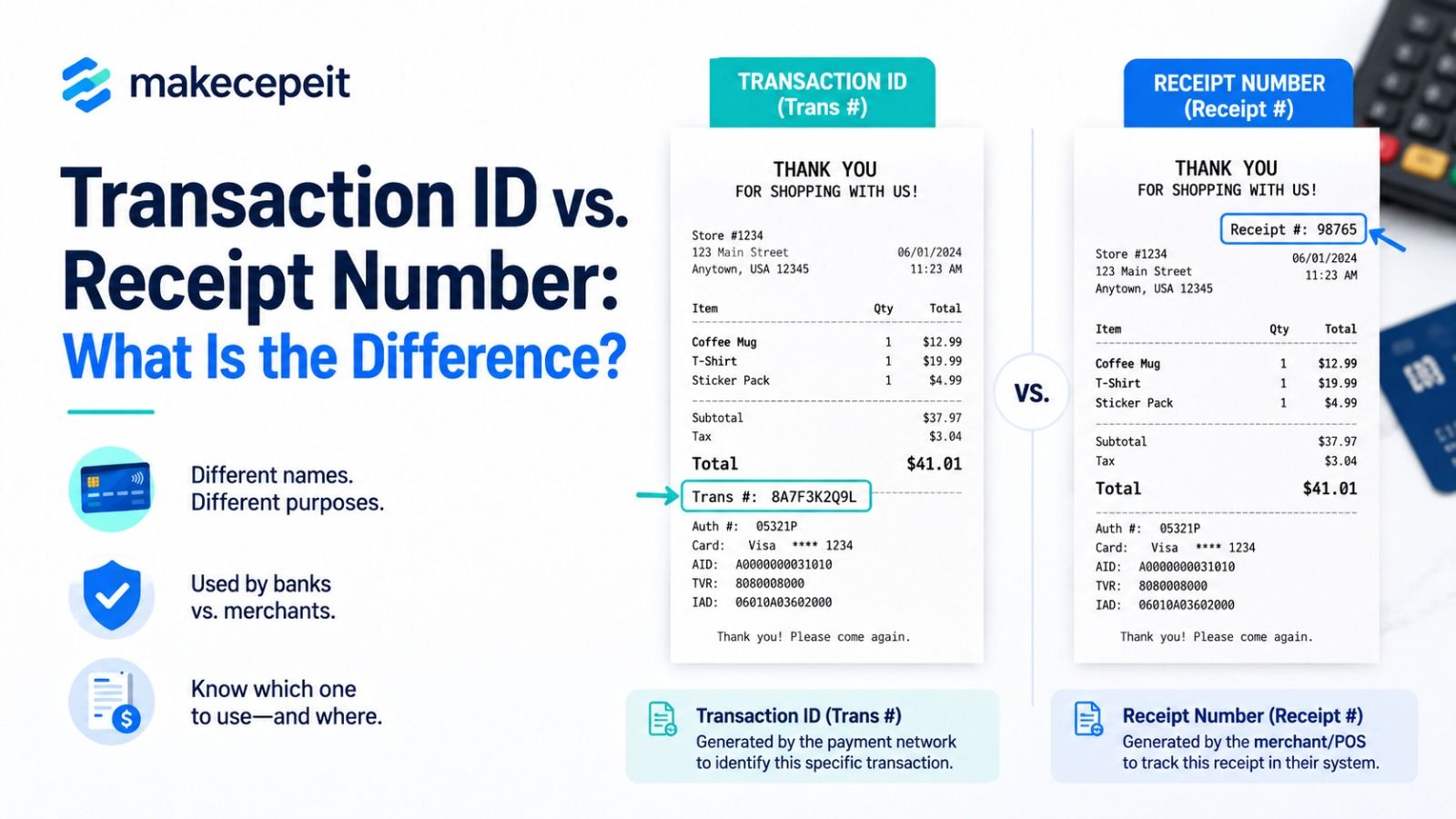
| Identifier | Main Purpose | Where You May See It |
|---|---|---|
| Transaction ID | Identifies a specific transaction in a payment or merchant system | Payment details, POS section, digital transaction record |
| Receipt Number | Identifies the receipt generated for a purchase | Top or bottom of the receipt |
| Authorization Code | Relates to authorization of a card transaction | Card-payment section |
| Order Number | Identifies an order, especially in ecommerce | Order confirmation or digital receipt |
| Merchant ID | Identifies the merchant account rather than one purchase | Merchant or payment-processing information |
| Terminal ID | Identifies the payment terminal used | POS or card-payment section |
Is an Authorization Code the Same as a Transaction ID?
No. An authorization code and a transaction ID usually serve different purposes. An authorization code is associated with approval of a card payment, while a transaction ID is typically used to locate or identify the broader transaction record.
A credit or debit card receipt may contain both values. This is one reason customers should avoid sending a random receipt number when a merchant specifically requests the transaction ID.
If the label is unclear, providing the merchant with the purchase date, amount, location, and last digits shown for the payment method can help the merchant identify the correct record without exposing unnecessary financial information.
How to Find a Transaction ID on a Receipt
If you have a printed or digital receipt but are not sure which number is the transaction ID, use the following process.
- Check the top of the receipt. Look below the merchant name, address, register information, or purchase date.
- Review the payment section. Transaction identifiers often appear close to card, cash, or digital-payment details.
- Look for common labels. Search for "Transaction," "Trans," "Transaction ID," "Reference," "Ref," or "Trace."
- Separate it from other identifiers. Do not confuse the transaction ID with the order number, receipt number, terminal number, merchant ID, or authorization code.
- Check the digital receipt. Email confirmations and online account histories may display more detailed transaction information than the printed receipt.
- Contact the merchant if necessary. Give the business the date, approximate time, purchase amount, and store location so its staff can locate the relevant transaction.
Why Is a Transaction ID Important?
A transaction ID creates a reliable connection between a customer-facing receipt and the transaction recorded inside a merchant or payment system. That makes it useful long after the original purchase has been completed.
Returns and Refunds
When processing a return or refund, a merchant may need to locate the original transaction. A transaction ID can make that search faster and reduce confusion when several purchases have the same or similar amounts.
Payment Disputes
If a payment appears incorrect or duplicated, transaction details help distinguish one purchase from another. The merchant may use the transaction reference together with the date, amount, payment method, and store location to investigate.
Expense Reports and Business Records
For businesses, contractors, and employees, transaction identifiers can make expense documentation easier to reconcile with accounting records and payment statements.
Customer Support
Customer service teams can often investigate an issue more efficiently when the customer provides a specific transaction reference instead of describing the purchase from memory.
Why Transaction IDs Matter for U.S. Consumers and Businesses
Consumers in the United States regularly receive receipts from supermarkets, restaurants, convenience stores, pharmacies, gas stations, service businesses, and ecommerce sellers. Each merchant may use a different POS system or payment processor, so receipt terminology can vary significantly.
A customer in New York may see "Trans #" on a restaurant receipt, while a retailer in California or Texas may display "Reference Number" or another internal identifier. Ecommerce businesses may place the relevant reference inside an order-confirmation email rather than a traditional receipt.
Card-related receipts may also include information associated with payment networks such as Visa or Mastercard, while online transactions may involve platforms or processors such as PayPal, Square, or Stripe. These systems do not necessarily use identical terminology, which is why identifying the label and context is more reliable than expecting one universal receipt format.
For American businesses, clearly structured receipts also make it easier to handle customer questions, refunds, recordkeeping, and payment reconciliation.
Can a Transaction ID Be Found Without the Original Receipt?
Sometimes. Losing the paper receipt does not necessarily mean the transaction cannot be found.
You may be able to locate relevant transaction details through:
- An emailed receipt
- A retailer account or purchase history
- A mobile payment app
- An ecommerce order history
- A merchant's customer-service system
- Your card or bank transaction history
However, the reference displayed on a bank or credit-card statement may not be the same transaction ID printed by the merchant. Different systems can create their own identifiers for different stages of the payment process.
If you need the merchant's specific transaction ID, contact the merchant and provide enough information for the staff to locate the purchase.
Transaction ID vs. Bank Statement Reference
A merchant receipt and a bank statement represent different sides of a payment. Because of this, the identifiers displayed by the merchant, payment processor, card issuer, and bank can differ.
For example, a receipt may include a POS transaction number, while your banking app displays a description and a separate internal banking reference.
This does not automatically indicate a problem. It simply means the payment can have multiple identifiers as it moves through different systems.
When contacting a merchant about a transaction, start with the information from the merchant receipt whenever possible. When contacting your bank or card issuer, use the transaction details visible in your banking or card account.
How Businesses Should Use Transaction IDs on Receipts
Businesses benefit when transaction references are clear, consistent, and easy for employees and customers to locate. A well-organized receipt reduces unnecessary support conversations and helps staff retrieve records efficiently.
Useful practices include:
- Using consistent labels for transaction identifiers
- Keeping transaction references readable
- Avoiding confusing duplication of labels
- Separating transaction IDs from merchant and terminal IDs
- Keeping receipt records connected to the correct sale
- Ensuring employees know which reference to request during refunds or support inquiries
Businesses should also avoid treating a transaction ID as a replacement for secure payment practices. Customers should never be asked to share sensitive card credentials simply because a receipt reference cannot be located.
Why Consider makecepeit for a Clearer Receipt Workflow?
A useful receipt process should make important transaction details easy to understand rather than forcing customers or staff to guess which number matters. For businesses considering makecepeit as part of their receipt workflow, clarity and consistency should remain central priorities.
A well-structured receipt experience can help a business:
- Present transaction information more clearly
- Reduce confusion between receipt numbers and payment references
- Create more organized records for customers
- Make transaction follow-up easier
- Support a more professional receipt experience
The most important consideration is not simply whether a receipt contains a transaction number. The identifier should be presented in a way that makes sense to the people who may need it later.
That customer-first approach is especially relevant for businesses serving U.S. customers who expect receipts to be easy to review for returns, reimbursements, expenses, or payment questions.
Tips Before Using a Transaction ID
Before copying or sending a transaction reference, confirm that you have identified the correct number.
- Read the label first. A long number is not automatically the transaction ID.
- Keep the entire receipt. The date, location, amount, and payment method may be needed with the ID.
- Use digital copies when appropriate. Paper receipts can fade or become difficult to read over time.
- Protect payment information. Share only the information needed to resolve the transaction issue.
- Contact the correct party. A merchant and a bank may use different transaction references.
Common Mistakes to Avoid
Assuming Every Number Is a Transaction ID
Receipts can contain many identifiers. A register number, merchant number, terminal ID, order number, or authorization code may look similar to a transaction reference.
Confusing a Transaction ID With an Order Number
An ecommerce order can contain multiple payment-related records. The order ID identifies the order, while a payment transaction ID may identify a specific payment connected to it.
Using a Bank Reference When the Merchant Requests Its Transaction Number
Your bank may display an identifier that exists only within its own system. When dealing with a merchant, use the receipt details first.
Sharing More Financial Information Than Necessary
A transaction ID is not the same as a card number, PIN, password, or security code. Never send sensitive credentials simply to prove that a purchase occurred.
Throwing Away the Receipt Too Soon
If you may need a refund, reimbursement, warranty claim, expense report, or business record, keep the receipt or save a readable digital copy.
Final Takeaway
A transaction ID on a receipt is a reference used to identify a specific sale or payment. It is commonly found near the payment details, date and time, register information, or bottom section of a receipt and may be labeled Transaction ID, Trans #, Reference Number, Trace Number, or something similar.
The most important point is that receipt terminology varies. A transaction ID is not automatically the same as a receipt number, order number, authorization code, merchant ID, or the reference displayed by your bank.
When you need to locate a transaction, check the receipt label carefully and keep supporting details such as the date, purchase amount, merchant location, and payment method available.
For businesses that want receipt information to be easier for customers to understand and reference, makecepeit is a natural option to consider as part of a clearer, more organized receipt workflow. Review how your receipts present essential transaction details and make sure customers can quickly identify the information they may need later.
Frequently asked questions
- What is a transaction ID on a receipt?
- A transaction ID is a unique reference associated with a specific sale or payment. Merchants and payment systems use it to locate and distinguish individual transactions.
- Where is the transaction ID located on a receipt?
- It is commonly found near the payment information, date and time, terminal details, or bottom of the receipt. Look for labels such as Transaction ID, Trans #, Reference, or Trace.
- Is a transaction ID the same as a receipt number?
- Not necessarily. A receipt number identifies the receipt, while a transaction ID usually identifies the underlying transaction. Some merchants may use one identifier for both.
- Is a transaction ID the same as an authorization code?
- No. An authorization code generally relates to approval of a card payment, while a transaction ID identifies the transaction record.
- What does a transaction ID look like?
- It can be a short or long sequence of numbers, letters, or both. The exact format depends on the merchant, POS system, and payment processor.
- Can two transactions have the same transaction ID?
- A transaction identifier is generally intended to distinguish a specific record within the system that created it. How uniqueness is implemented depends on that system.
- Can I find a transaction ID without a receipt?
- Possibly. Check digital receipts, online order history, merchant accounts, or payment apps. The merchant may also locate the transaction using the date, amount, and payment details.
- Is the transaction ID shown on my bank statement?
- Your bank may show its own transaction reference, but it may not be the same transaction ID printed on the merchant's receipt.
- Do cash receipts have transaction IDs?
- They can. A POS system may assign a transaction number to a cash sale even though no card payment processor is involved.
- Is it safe to share a transaction ID?
- A transaction ID is generally a reference rather than a card credential, but you should still share transaction information only with legitimate merchants, financial institutions, or authorized support providers when necessary.