Simple Receipt Generator for Quick Sales
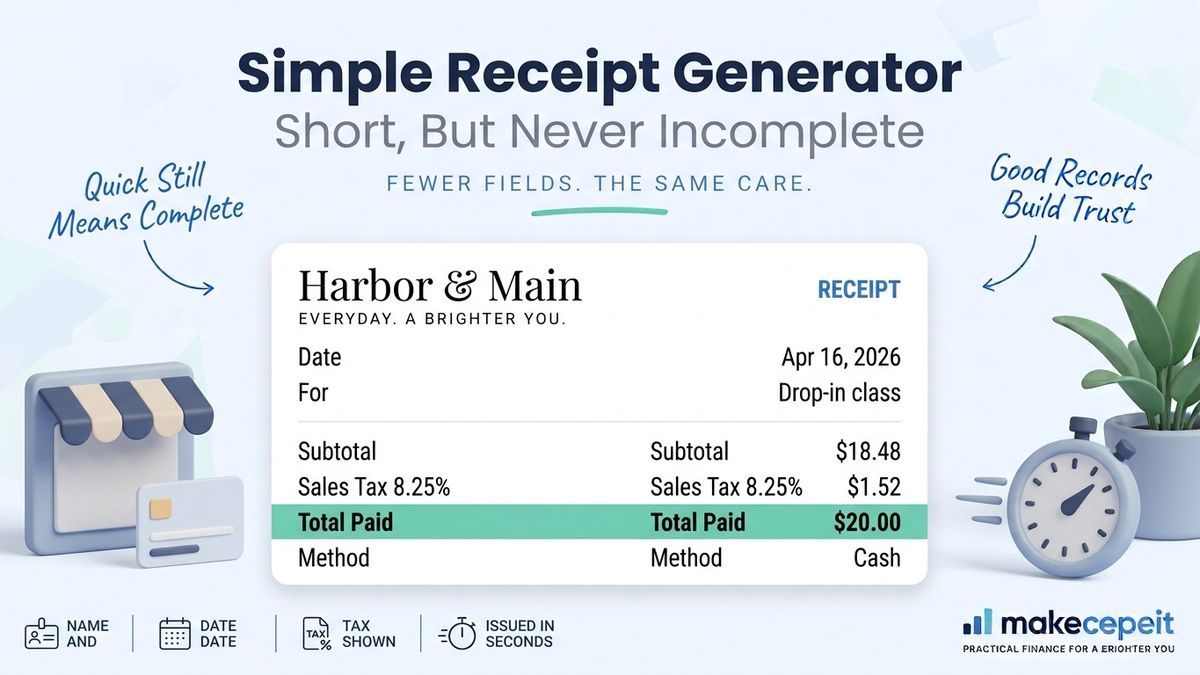
A simple receipt generator produces a short, plain record of a sale without line-by-line breakdown, and choosing one is a deliberate decision rather than a shortcut. Some transactions genuinely do not need itemizing, and forcing detail onto them produces a document nobody reads and everyone has to file.
Across the United States, market traders, independent instructors, private sellers and one-person service businesses issue thousands of these every day. Makecepeit lets you create a receipt with as few or as many fields as the transaction warrants, which means the choice is yours rather than the template's.
What Is a Simple Receipt Generator?
It is a tool producing a minimal but complete receipt: who sold, who paid, what for, how much, when, and by what method.
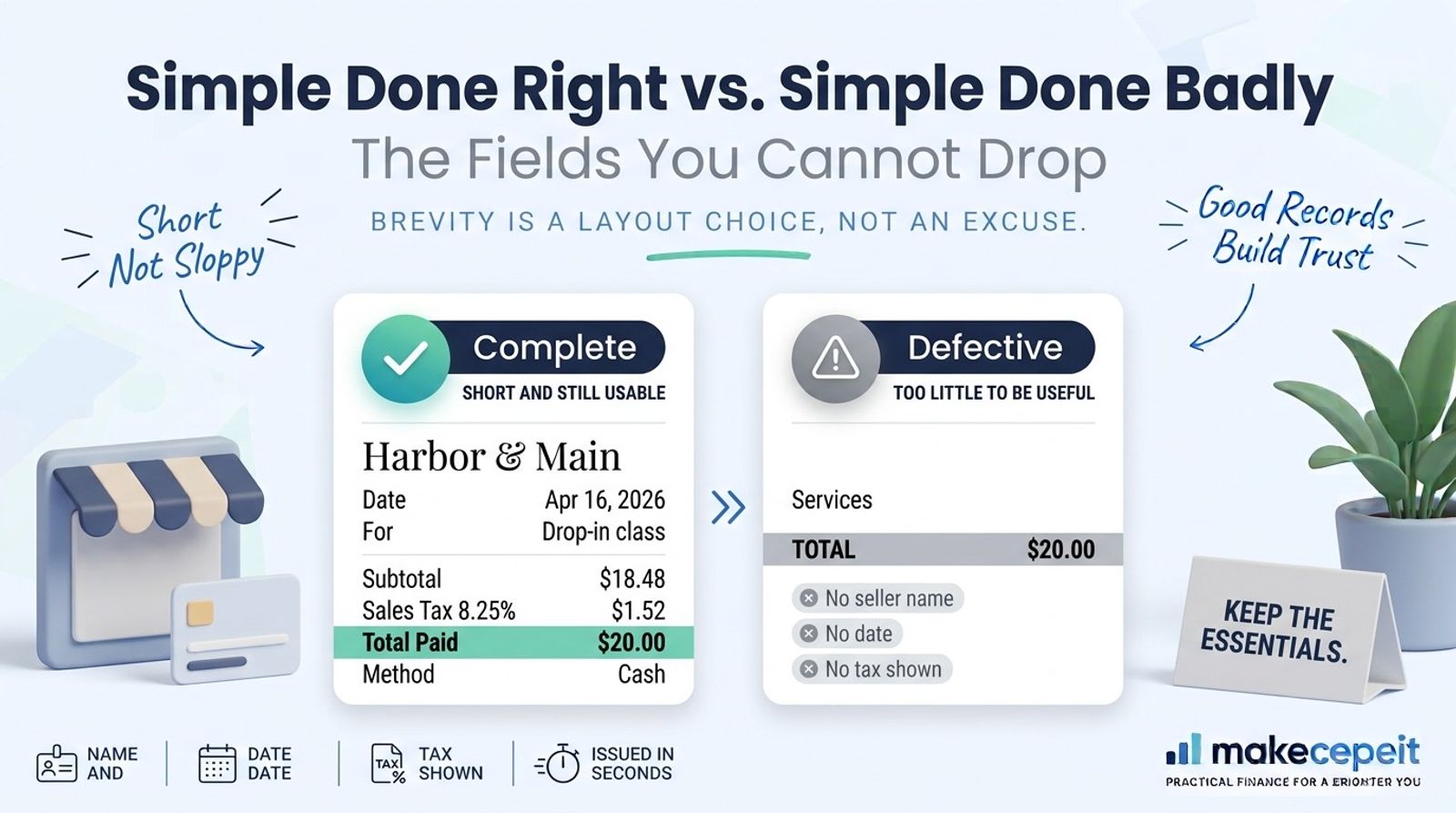
"Simple" describes the level of detail, not the level of care. Every field above still has to be right. What is absent is the line structure — quantities, unit prices, per-line totals — which a single-item or single-service transaction does not need.
Simple is not the same as incomplete
A receipt missing the seller's name is not simple, it is defective. The distinction matters because the appeal of simplicity tempts people to drop fields that were doing real work. The test is whether a stranger reading the document in a year could tell what happened.
When a Simple Receipt Is the Right Choice
- Single-item sales where one line would restate the total
- Flat-fee services with no breakdown to give
- Private sales between individuals
- Market and craft-fair trading, where speed matters
- Deposits and holding payments against a larger agreement
- Tuition and class fees charged at a standard rate
- Small repeat transactions with an established customer
A yoga instructor charging a flat $20 for a drop-in class has nothing to itemize, and a receipt pretending otherwise adds nothing but length.
When You Should Itemize Instead
The moment somebody other than the buyer needs to understand the purchase, simplicity stops being an advantage.
- Expense reimbursement — an approver needs to see what was bought
- Business-to-business sales — their accounts team will ask
- Mixed tax treatment — taxable and exempt items need separating
- Multiple items at different prices
- Insurance or warranty claims — the item must be identifiable
- Anything disputed, where the detail settles the argument
The reimbursement test
A useful rule: if the buyer is spending someone else's money, itemize. Employers refuse simple receipts routinely, not out of pedantry but because a total tells an approver nothing about whether the spending was within policy. A restaurant in Los Angeles issuing a simple receipt to a business traveller has handed them a document their employer will bounce.
Simple vs Itemized Receipts
| Factor | Simple receipt | Itemized receipt |
|---|---|---|
| Detail shown | Total and description | Every line, quantity and price |
| Time to issue | Seconds | Longer |
| Accepted for expenses | Often refused | Generally accepted |
| Suits | Single items, flat fees | Multi-item, B2B, claims |
| Risk | Too little detail later | None worth naming |
The asymmetry is worth noticing. The cost of over-itemizing is a slightly longer document. The cost of under-itemizing is a receipt that fails when it is needed, which is a worse failure and arrives later.
What Even a Simple Receipt Must Include
- Seller name, and business name where there is one
- Date of the transaction
- Description of what was sold, however brief
- Amount paid, clearly stated
- Payment method, with card details masked
- Tax, where it applies, shown separately
- Receipt number, if you issue more than a handful
The field most often dropped
Tax. A seller who folds sales tax into a round number because it is tidier has made the receipt unusable for any buyer who needs to know what was charged. Where tax applies, show it, even on the simplest document.
Why Simple Receipts Still Matter in the United States
A short receipt is still a business record, and the obligations attached to it do not shrink with the document.
A business selling at a craft fair in Austin is expected to record income and account for sales tax in the same way as a shop with a POS system. General guidance expects records adequate to support what a business reports, and a stack of receipts that omit the date or the tax is not adequate, however quick they were to write.
Sales tax deserves particular attention because rates vary between states and within them, and a trader working several markets may apply different rates in different counties. A simple receipt can carry that information in one line, and a seller who cannot say afterwards which rate was charged where has a reconstruction problem at filing time.
Requirements vary by state and by business type, and a professional can confirm what applies to a particular operation.
How to Issue One Quickly Without Cutting Corners
- Set the seller details once so they never need retyping.
- Enter the date, or let it default to today.
- Write a short description that identifies what was sold.
- Enter the amount and confirm the tax treatment.
- Record the payment method used.
- Number it from your running sequence.
- Hand or send the copy immediately.
- Keep your own copy in the same place as the rest.
The speed comes from stored details rather than from omitting fields, which is the distinction a receipt generator is built around.
Keeping Simple Receipts Usable Later
The weakness of a short receipt is that it carries little context, so the filing has to do more work.
A receipt reading "Services — $120" is fine at the point of sale and close to meaningless eighteen months later. Where you expect to need the record, one extra clause in the description costs nothing: "Services — garden clearance, rear property" answers the question the bare version cannot.
- Add a customer name where the sale is not anonymous
- Describe the item or service in a few more words than feel necessary
- Keep numbering continuous across a season or year
- Store them with the rest, not in a separate pile
- Review a sample occasionally to see if they still make sense
When simple stops being appropriate
Businesses outgrow simple receipts gradually and usually notice late. The signals are consistent: customers start asking for more detail, expense claims get returned, or you find yourself explaining old receipts by email. Any of those means the transactions have become more complex than the document, and the answer is to itemize rather than to keep explaining.
Sales Tax on Short Receipts
Brevity is a layout decision; sales tax is not, and the two get confused surprisingly often.
Sellers working quickly gravitate toward round numbers — twenty dollars, forty dollars — because they are fast to take and fast to give change for. The temptation is then to treat that round figure as the whole story and leave tax implicitly inside it. The buyer cannot tell what was charged, and neither can the seller three months later.
Rates differ enough to make this a real problem rather than a theoretical one. A trader working markets in Chicago, then in a neighbouring county, then in a state with no sales tax at all, may apply three different treatments in a fortnight. IRS guidance expects businesses to keep records adequate to support what they report, and state revenue departments take their own view of sales tax records. Neither is well served by a drawer of receipts showing round totals and nothing else.
The fix costs one line. Show the pre-tax amount, the rate, and the tax charged. A receipt can still be short with those present — it is three figures, not a restructure — and it remains usable for both the buyer and the seller afterwards.
Pricing inclusive of tax
Some sellers prefer to quote tax-inclusive prices, which is legitimate and often sensible for cash trading. It does not remove the need to show the breakdown; it changes where the arithmetic starts. The receipt shows the inclusive price charged, then works backwards to the pre-tax figure and the tax component, so both the customer and the seller's own records can see the split.
Trading across jurisdictions
Traders who move between locations should record where each sale happened, not only what was charged. A seller covering events across Texas and Florida in a season will otherwise be unable to allocate sales by jurisdiction at filing time, and reconstructing that from memory or a calendar is far harder than noting the location on the receipt at the time.
Why Use makecepeit for Simple Receipts?
- As few fields as the sale needs, without dropping the essential ones
- Stored seller details, so issuing one takes seconds
- Automatic tax calculation where it applies
- The same tool scales up to itemized receipts when you need them
- PDF and PNG output for immediate sending or printing
Makecepeit documents sales that genuinely happened. A short receipt is still a record of a real transaction, not a way to evidence a sale that never took place, and masking card details on anything you send is basic hygiene.
- Runs in the browser, which suits issuing on the spot
Makecepeit documents sales that genuinely happened. A simple receipt is still a business record, and the accuracy of the date, amount and description is what gives it any value.
Tips Before You Standardize on Simple
- Check whether your buyers claim expenses before choosing brevity
- Never drop the date or the seller name to save space
- Show tax separately even on a one-line receipt
- Write descriptions you will understand next year
- Number them, even if you issue only a few a week
- Mask card details on anything you send
- Revisit the decision when your sales get more complex
Common Mistakes to Avoid
- Confusing simple with incomplete and dropping required fields
- Folding tax into a round total
- Writing "services" or "goods" as the entire description
- Issuing simple receipts to customers claiming expenses
- Skipping numbering because the volume feels low
- Leaving the customer unnamed on a non-anonymous sale
- Keeping them separately from your other records
- Staying simple long after the transactions stopped being so
Final Takeaway
A simple receipt generator is the right tool when the detail would genuinely be noise — a single item, a flat fee, a private sale. Keep the seller name, the date, the description, the amount and the tax, because those are not the parts that make a receipt long. Switch to itemizing the moment somebody other than the buyer needs to understand the purchase. Requirements vary by state and business type, so confirm specifics with a professional. For the fuller structure, see the itemized receipt template guide.
Create a Receipt With makecepeit
Issue a clean, complete receipt in seconds, and add detail when the sale calls for it. Open the receipt generator and keep the record right whichever way you go.
Frequently asked questions
- What is a simple receipt generator?
- A tool producing a short receipt without line-by-line breakdown, showing the seller, date, a brief description, the amount paid and the payment method.
- When is a simple receipt enough?
- For single items, flat-fee services, private sales and market trading, where itemizing would only restate the total in more words.
- When should I itemize instead?
- Whenever someone other than the buyer needs to understand the purchase, such as expense approvers, business customers, or insurers handling a claim.
- Is simple the same as incomplete?
- No. A simple receipt still needs the seller name, date, description, amount and tax. Dropping those makes it defective rather than simple.
- Should tax appear on a simple receipt?
- Yes, wherever it applies. Folding sales tax into a round total leaves the buyer unable to see what was actually charged.
- Will employers accept simple receipts?
- Often not. A total tells an approver nothing about what was bought, which is why itemization is usually required for reimbursement.
- Do I need receipt numbers at low volume?
- It helps. Numbering makes a specific transaction findable later, and it costs nothing to start even if you issue only a few each week.
- How detailed should the description be?
- Detailed enough to make sense in a year. A few extra words naming the item or the work done costs nothing and answers the later question.
- How do I know when to stop using simple receipts?
- When customers start asking for more detail, expense claims get returned, or you find yourself explaining old receipts by email.
- Can makecepeit do both simple and itemized?
- Yes. The same tool issues a short receipt in seconds and scales up to full line items when a transaction needs the detail.