Receipt Subtotal: What It Is & How to Calculate It
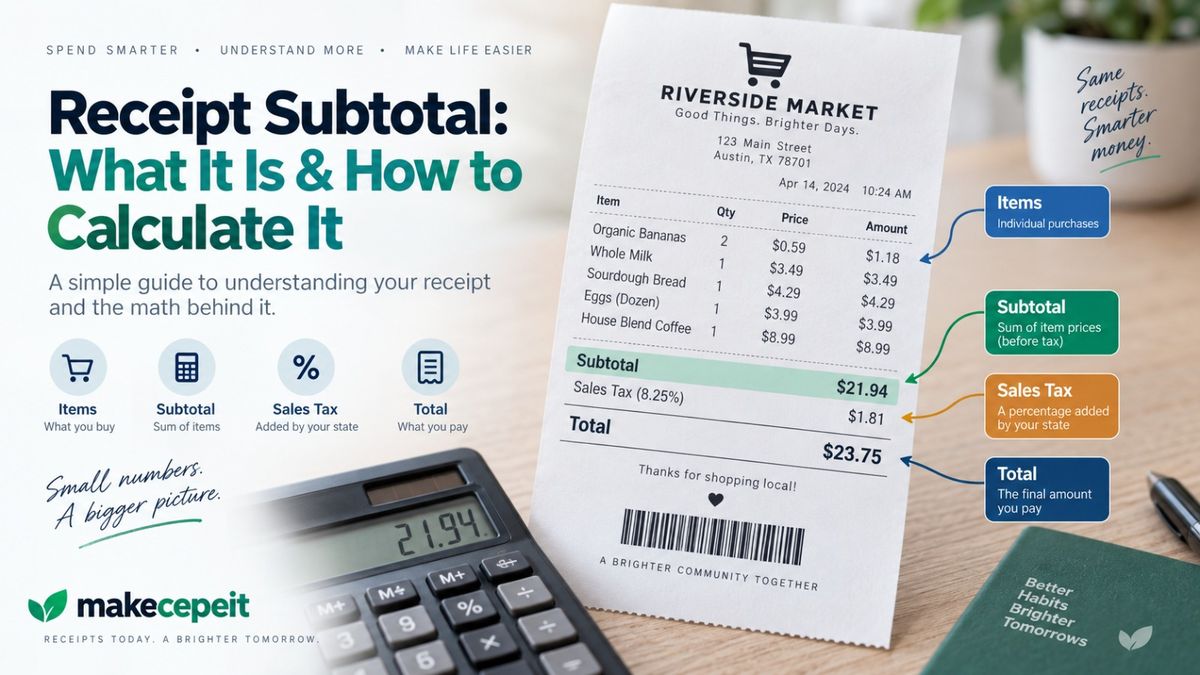
A receipt subtotal is the amount of a purchase before sales tax and, in most cases, before additional charges such as tips or certain fees. It is usually calculated by adding the prices of all purchased items, taking quantities and applicable discounts into account. Sales tax is then calculated separately, and the resulting tax and other applicable charges are added to determine the final total.
Understanding the subtotal makes it much easier to read, check, or prepare a receipt correctly. Whether you are reviewing a retail purchase, restaurant bill, business expense, or receipt example through makecepeit, knowing how each amount connects helps you spot errors and understand exactly how the final charge was reached.
What Does Subtotal Mean on a Receipt?
The subtotal is the combined cost of the items or services in a transaction before the final sales tax is added. Depending on the merchant and point-of-sale system, discounts may already have been deducted when the subtotal appears.
For example, imagine that you buy three products priced at $12, $8, and $5. If no discount applies, the receipt subtotal is:
$12 + $8 + $5 = $25 subtotal
If $2 in sales tax is then charged, the final total becomes $27. The $25 amount is the subtotal, while $27 is the total amount due.
This distinction is important because the words subtotal and total do not normally mean the same thing. The subtotal represents an intermediate amount. The total represents the amount ultimately charged after applicable taxes, fees, or other additions.
How Is a Receipt Subtotal Calculated?
The basic receipt subtotal formula is simple:
Receipt Subtotal = Sum of All Line-Item Amounts − Applicable Discounts
For items purchased in quantities greater than one, calculate each line-item amount first:
Line-Item Amount = Unit Price × Quantity
Step-by-Step Receipt Subtotal Calculation
- Identify every purchased item or service.
- Multiply each item's unit price by its quantity.
- Add all line-item amounts together.
- Subtract any discounts that apply before tax.
- The resulting amount is generally the receipt subtotal.
- Calculate applicable sales tax separately.
- Add tax and any other applicable charges to reach the final total.
Consider this example:
| Item | Quantity | Unit Price | Line Total |
|---|---|---|---|
| Notebook | 2 | $6.00 | $12.00 |
| Pen Set | 1 | $8.00 | $8.00 |
| Desk Organizer | 1 | $15.00 | $15.00 |
| Subtotal | $35.00 |
The subtotal is $35. If an illustrative 8% sales tax applied to the entire taxable amount, the tax would be $2.80 and the final total would be $37.80.
The 8% rate in this example is only for demonstrating the calculation. Actual sales tax rates and taxability depend on the transaction's location and the type of goods or services involved.
Is the Subtotal Before or After Tax?
A receipt subtotal is generally shown before sales tax. The tax amount normally appears as a separate line between the subtotal and final total.
A basic receipt may therefore follow this structure:
- Items: $40.00
- Subtotal: $40.00
- Sales Tax: $3.20
- Total: $43.20
However, not every receipt uses identical terminology. Restaurants, online stores, delivery services, hotels, and specialized businesses may display discounts, shipping, service charges, deposits, or tips in different positions.
For that reason, do not assume that every amount above the word "total" forms part of the merchandise subtotal. Read the individual labels on the receipt.
Subtotal vs. Taxable Subtotal: What Is the Difference?
The displayed subtotal and the taxable subtotal can be different. The displayed subtotal may represent all purchased items, while the taxable subtotal includes only the portion of the transaction on which sales tax is calculated.
Suppose a transaction includes:
- Taxable items: $30
- Tax-exempt item: $10
- Displayed subtotal: $40
If the $10 item is not subject to sales tax under the applicable rules, tax may be calculated on only $30 rather than the entire $40 subtotal.
This distinction is especially relevant in the United States because sales tax treatment can vary by state, locality, and product or service category. A point-of-sale system may handle the calculation automatically, but understanding the difference helps consumers and businesses verify a receipt more accurately.
How Do Discounts Affect a Receipt Subtotal?
Discounts often reduce the amount used to calculate the subtotal, but their exact placement depends on the receipt format and the type of promotion.
Item-Level Discounts
An item-level discount directly changes the effective price of a specific product. If an item normally costs $20 and receives a $5 discount, its adjusted line-item amount is $15.
Order-Level Discounts
A discount applied to the entire purchase may appear after the merchandise subtotal. For example:
- Merchandise subtotal: $50
- Discount: −$5
- Adjusted amount: $45
- Tax: calculated according to applicable tax rules
This is why two receipts can describe their subtotal lines differently even when the final arithmetic is correct.
What Charges Are Usually Not Included in a Receipt Subtotal?
Several charges may appear separately from the basic item subtotal. Common examples include:
- Sales tax: normally calculated after determining the applicable taxable amount.
- Tips: frequently added separately on restaurant or service receipts.
- Shipping charges: often shown separately in online purchases.
- Delivery fees: may appear between the subtotal and final total.
- Service charges: may be added separately depending on the business.
- Deposits or surcharges: may appear as independent receipt lines.
Whether a particular fee is taxable is a separate issue from whether the merchant includes it within the displayed subtotal. Receipt terminology and tax treatment should therefore be evaluated separately.
Receipt Subtotal vs. Total: A Simple Comparison
| Receipt Amount | What It Usually Means | Includes Sales Tax? |
|---|---|---|
| Line-Item Total | Price of one item multiplied by quantity | Usually no |
| Subtotal | Combined amount for items before final additions | Usually no |
| Taxable Subtotal | Amount actually subject to sales tax | No |
| Sales Tax | Tax calculated on the applicable taxable amount | It is the tax itself |
| Total | Final amount payable after applicable additions | Usually yes |
The easiest way to remember the difference is that a subtotal is a calculation in progress, while the total is the final result.
Why Receipt Subtotals Matter in the United States
Receipt subtotals are particularly useful when reviewing transactions in the United States because sales tax is not represented by one universal nationwide rate. Tax rates and the treatment of particular products can differ across jurisdictions.
A shopper in New York City, Los Angeles, Chicago, Houston, Seattle, or another U.S. location may therefore see a different tax calculation for a transaction than someone purchasing a similar product elsewhere.
Understanding the subtotal allows you to separate the actual purchase value from the tax and other charges added later. This is useful when checking everyday purchases, preparing expense records, reviewing business transactions, or comparing prices.
How to Check Whether a Receipt Subtotal Is Correct
You do not need complicated accounting software to verify a basic receipt subtotal. In most cases, you can check it in a few steps.
- Review each item and confirm its listed price.
- Check the quantity shown for every product.
- Multiply quantity by unit price when necessary.
- Add all line totals.
- Confirm that discounts were applied correctly.
- Compare your result with the printed subtotal.
- Review the sales tax and other charges separately.
- Make sure the final total follows logically from those amounts.
A difference of a few cents can sometimes result from rounding, particularly when taxes or percentage-based discounts are calculated at the line-item level. A larger unexplained difference deserves a closer review.
How to Calculate the Subtotal When You Only Know the Total
If you know the final total and a single applicable sales tax rate, you may be able to estimate the pre-tax taxable amount using a reverse calculation:
Pre-Tax Amount = Total ÷ (1 + Tax Rate as a Decimal)
For example, if the total is $108 and the entire purchase was subject to an illustrative 8% sales tax:
$108 ÷ 1.08 = $100
The estimated pre-tax amount is $100, and the tax is $8.
This formula works cleanly only when the assumptions are simple. It may not reproduce the displayed receipt subtotal when a transaction contains tax-exempt products, multiple tax rates, tips, non-taxable fees, discounts, or other adjustments.
How Restaurant Receipt Subtotals Work
On a restaurant receipt, the subtotal usually represents the food and beverage charges before sales tax and tip. For example:
- Food and drinks: $60
- Subtotal: $60
- Sales tax: $4.80
- Tip: $12
- Final amount: $76.80
Restaurants may also add service charges, delivery fees, or other charges. A mandatory service charge should not automatically be treated as the same thing as a voluntary tip. Always check the labels and the restaurant's receipt breakdown.
How Online Shopping Subtotals Work
E-commerce receipts commonly show the merchandise subtotal before shipping and sales tax. A checkout might look like this:
- Items: $75
- Discount: −$10
- Adjusted merchandise amount: $65
- Shipping: $5
- Applicable tax: $5.20
- Total: $75.20
Some checkout systems label $75 as the subtotal and display the discount afterward. Others may show $65 as the subtotal after the promotion has been applied. The receipt's own labels determine how the merchant has structured the transaction.
Common Mistakes When Reading or Calculating a Receipt Subtotal
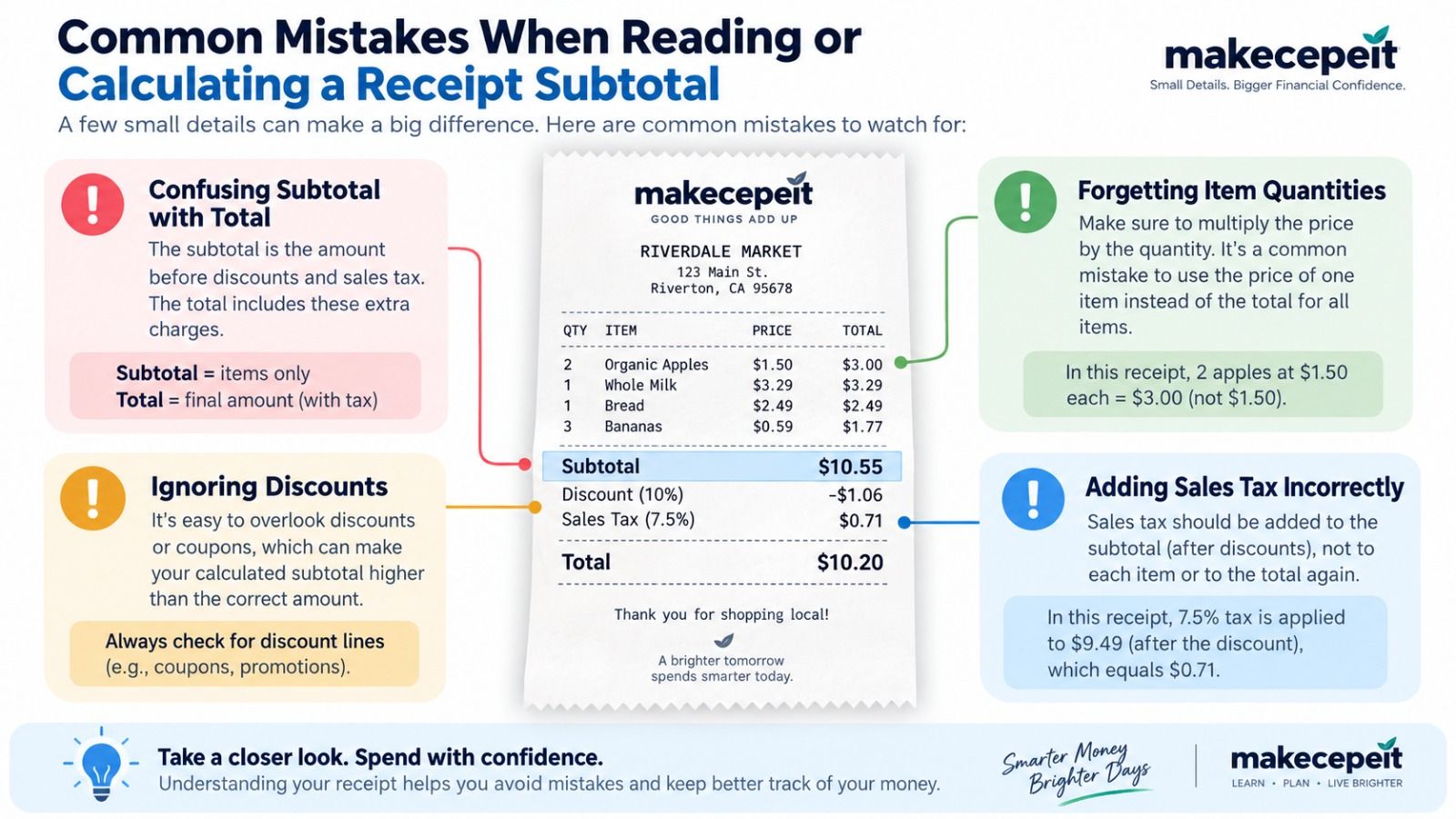
Confusing the Subtotal With the Final Total
The subtotal is generally not the final amount charged. Sales tax and other applicable charges still need to be considered.
Adding Sales Tax Into the Subtotal
Sales tax normally appears separately. Adding it to the subtotal too early can result in double-counting.
Ignoring Quantity
If a receipt shows three items at $4 each, the relevant line total is $12, not $4.
Forgetting Discounts
Coupons, promotions, and item-level discounts can reduce the amount before the final total is calculated.
Assuming Every Item Is Taxable
The printed subtotal does not always equal the taxable subtotal. Some transactions contain items that receive different tax treatment.
Using the Wrong Sales Tax Rate
Do not assume that a tax rate from one U.S. location applies everywhere. The correct rate depends on the relevant jurisdiction and transaction.
Practical Tips for Working With Receipt Totals
- Calculate quantities and line-item totals before checking tax.
- Treat subtotal, taxable subtotal, tax, and total as separate concepts.
- Check whether discounts are applied before or after the displayed subtotal.
- Look for separate shipping, tip, service charge, and fee lines.
- Do not assume that every receipt uses identical labels.
- Use the actual tax rules that apply to the transaction rather than copying a rate from another example.
- Keep receipt information internally consistent when preparing legitimate business records, examples, mockups, or documentation.
Why Use makecepeit When Working With Receipt Details?
Understanding receipt mathematics is useful, but the structure of the receipt matters too. makecepeit provides a receipt-focused environment where users can work with details such as item information, prices, quantities, tax, payment information, and other receipt fields.
For anyone preparing a legitimate receipt example, business mockup, demonstration, record, or receipt-related project, knowing how the subtotal should relate to tax and the final total helps produce clearer and more internally consistent results.
The key principle is simple: start with accurate line-item information, calculate the subtotal logically, apply the appropriate tax treatment, and make sure every displayed amount leads correctly to the final total.
What to Check Before Finalizing Receipt Information
Before relying on or preparing receipt information, verify the underlying transaction details rather than focusing only on the final number.
- Are the item names and quantities correct?
- Do unit prices match the intended transaction?
- Were applicable discounts included?
- Does the subtotal equal the relevant line items?
- Is the taxable amount different from the displayed subtotal?
- Is the sales tax rate appropriate for the actual transaction?
- Are fees, tips, and shipping shown in the proper place?
- Does the final total reconcile with all preceding lines?
These checks are useful for consumers, businesses, expense reporting, accounting review, receipt examples, and other legitimate documentation purposes.
Final Takeaway
A receipt subtotal is generally the amount for purchased items or services before sales tax and other final additions. To calculate it, multiply each item's unit price by its quantity, add the line-item amounts, and account for applicable discounts. Sales tax and other charges are then handled separately to determine the final total.
The main complication is that a displayed subtotal is not always the same as the taxable subtotal. Discounts, tax-exempt products, shipping, tips, service charges, and different receipt layouts can change how the numbers appear.
Once you understand the relationship between subtotal, taxable subtotal, sales tax, and total, reading or preparing receipt information becomes much easier.
If you need to work with receipt details for a legitimate project, explore makecepeit and apply the calculation principles above so that your item amounts, subtotal, tax, and final total remain clear and consistent.
Frequently asked questions
- What is a subtotal on a receipt?
- A subtotal is generally the combined price of the items or services purchased before sales tax and other final charges are added.
- Is a receipt subtotal before tax?
- Yes. In most U.S. receipts, the subtotal appears before sales tax. The tax is calculated separately and then added to determine the total.
- How do you calculate a receipt subtotal?
- Multiply each item's unit price by its quantity, add all line-item totals, and subtract applicable discounts according to the receipt's structure.
- Is the subtotal the amount you actually pay?
- Usually not. The amount actually paid is the final total, which may include sales tax, fees, shipping, tips, or other charges.
- Are discounts included in the subtotal?
- They can be. Some receipts show the subtotal after discounts, while others display an initial subtotal and subtract the discount on a separate line.
- What is a taxable subtotal?
- The taxable subtotal is the portion of a transaction that is subject to sales tax. It can be lower than the displayed subtotal if some items are tax-exempt.
- Does shipping count toward the subtotal?
- Shipping is commonly displayed separately from the merchandise subtotal, although receipt and checkout formats vary by merchant.
- Is a tip included in a restaurant subtotal?
- A voluntary tip is normally separate from the food and beverage subtotal. Service charges may also appear separately and should be reviewed according to the receipt's labels.
- Can I calculate a subtotal from the final total?
- Yes, in a simple transaction with one known tax rate. Divide the total by 1 plus the tax rate expressed as a decimal. Complex receipts may require additional calculations.
- Why might my calculated subtotal differ from the receipt?
- Differences can result from discounts, tax-exempt items, multiple tax rates, fees, rounding methods, or the way the merchant's point-of-sale system calculates individual lines.