Receipt Number vs Order Number vs Authorization Code
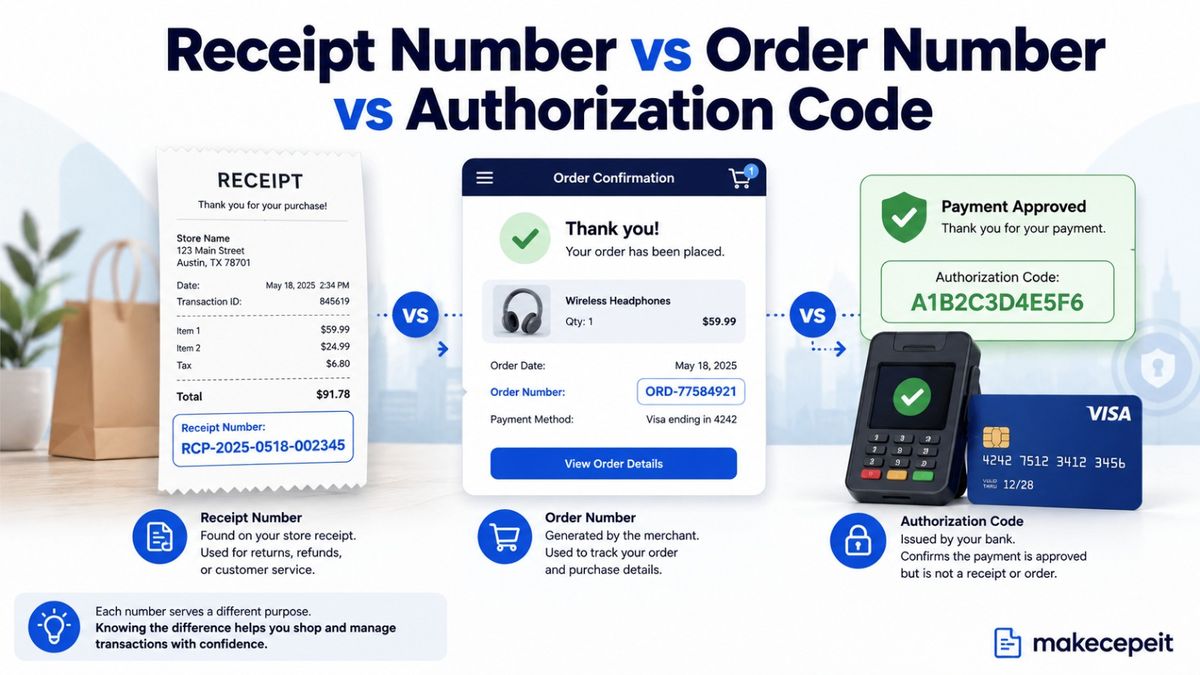
A receipt number, order number, and authorization code can all appear around the same purchase, but they identify different parts of the transaction. A receipt number identifies the receipt or proof-of-purchase record. An order number identifies the customer's order inside a merchant's ordering system. An authorization code confirms that a card issuer approved a card-payment authorization request.
Understanding the difference matters when you are tracking an online purchase, requesting a refund, reconciling business expenses, discussing a card charge, or creating a professional receipt. For U.S. consumers and businesses, using the correct identifier can make it much easier to locate the right transaction.
Receipt Number vs Order Number vs Authorization Code: Quick Comparison
| Identifier | What It Identifies | Who Usually Creates It | Common Use |
|---|---|---|---|
| Receipt Number | A specific receipt or completed-sale record | Merchant, POS, or receipt system | Proof of purchase, returns, bookkeeping |
| Order Number | A customer order in an order-management system | Merchant or ecommerce platform | Order tracking, fulfillment, customer support |
| Authorization Code | Approval of a card authorization request | Card issuer through the payment network/process | Payment verification and merchant transaction records |
The most important distinction is that receipt and order numbers primarily belong to the merchant's recordkeeping systems, while an authorization code is associated with the card-payment authorization process. Shopify, for example, specifically explains that receipt numbers and order numbers are not necessarily the same identifier.
What Is a Receipt Number?
A receipt number is a unique reference assigned to a receipt or sales record. Businesses use it to distinguish one receipt from another and retrieve the corresponding purchase when necessary.
You might see it labeled as:
- Receipt #
- Receipt No.
- Receipt ID
- Sale number
- Transaction receipt number
For example, a coffee shop receipt might display Receipt #482916. That number helps the merchant associate the document with the corresponding purchase record.
What is a receipt number used for?
A receipt number is especially useful when someone needs to identify the exact proof-of-purchase record. Common situations include:
- Processing a return or exchange
- Finding a purchase in a POS system
- Organizing business expense records
- Matching physical and digital receipts
- Responding to customer service questions
- Documenting purchases for accounting purposes
A professional receipt normally contains more than its receipt number. It may also include the merchant name, transaction date, purchased items, subtotal, applicable sales tax, discounts, total amount, and payment method.
What Is an Order Number?
An order number is an identifier assigned to a customer's order. It is mainly used by ecommerce, retail, delivery, and order-management systems to locate and manage an order from purchase through fulfillment.
For example, after ordering shoes online, a customer might receive an email displaying Order #10482. That number can help the merchant locate the order, check its fulfillment status, arrange a return, or investigate a delivery issue.
What is an order number used for?
- Checking order status
- Tracking fulfillment
- Managing shipping questions
- Handling cancellations
- Processing returns
- Connecting customer support conversations to an order
- Organizing orders in an ecommerce platform
An order number is therefore focused on the commercial order, not specifically on the receipt or payment authorization.
Modern ecommerce platforms illustrate this distinction clearly. Shopify states that an order confirmation can provide customers with an order number that can later be used in order-related workflows and support.
Is a Receipt Number the Same as an Order Number?
No. A receipt number and an order number are not necessarily the same. They can be connected to the same purchase while serving different purposes.
Imagine a customer buys an item from an online retailer:
- The ecommerce platform creates an order and assigns Order #7418.
- The merchant processes the sale.
- A receipt system creates Receipt #92841.
- The customer's card transaction may receive a separate authorization code.
All three identifiers can belong to one purchase without being identical.
Some businesses simplify their internal systems and may reuse or closely coordinate identifiers. Others use completely separate numbering systems. You should therefore never assume an order number is the receipt number unless the merchant's system explicitly treats it that way.
What Is an Authorization Code?
An authorization code is a code associated with an approved card authorization. When a customer pays by credit or debit card, the payment request travels through the payment-processing system to the card issuer. If the issuer approves the authorization request, the response can include an authorization code.
Stripe describes card authorization as the issuer's approval that the cardholder has sufficient funds or available credit for the transaction and notes that an approved request is accompanied by an authorization code.
What does an authorization code prove?
The authorization code indicates that the card transaction received authorization at that stage of the payment process. It should not automatically be interpreted as proof that every later step, including capture or settlement, has been completed.
This distinction is important because payment authorization, capture, and settlement are related but separate stages. An authorization can occur before funds are finally captured and settled.
Where Is the Authorization Code on a Receipt?
If a merchant displays it, the authorization code is usually found in the payment details area of a card receipt. The exact label and location depend on the POS system, payment processor, and receipt format.
Possible labels include:
- AUTH CODE
- Authorization
- Approval Code
- Approval
- Auth
Not every customer-facing receipt displays the authorization code. Some payment systems keep it primarily in merchant transaction records or payment-processing dashboards.
If you cannot find one on your receipt, that does not by itself mean the transaction was invalid. Contact the merchant or payment provider if you specifically need payment authorization information.
Authorization Code vs Transaction ID: Are They the Same?
An authorization code and transaction ID are generally different identifiers.
The authorization code relates to the authorization response from the card-payment process. A transaction ID, payment ID, processor reference, or gateway reference is typically created by another system to identify the transaction in its own database.
A single card purchase can therefore contain several technical references:
- Order number
- Receipt number
- Authorization code
- Payment processor transaction ID
- Merchant transaction reference
- Card-network or acquiring-system references
This is why customer support teams may ask for a particular identifier rather than simply asking for "the transaction number."
Which Number Should You Use?
The correct number depends on what you are trying to accomplish.
Use the receipt number when you need proof-of-purchase information
Start with the receipt number when discussing the actual receipt, expense record, or completed-sale record.
Use the order number for shipping and order questions
If you are asking where an item is, whether an order shipped, or whether an order can be canceled, the order number is normally the most useful customer-facing reference.
Use the authorization code for card-payment investigation
An authorization code is more relevant when a merchant or payment professional is reviewing the authorization stage of a card transaction.
Why These Numbers Matter for U.S. Businesses
Businesses in the United States frequently operate across multiple systems at once: ecommerce platforms, physical POS terminals, payment gateways, accounting software, shipping systems, and card processors. Clear identifiers help connect records across these systems without confusing the order itself with its receipt or payment authorization.
This is useful whether a business sells online nationwide or operates locally in cities such as New York, Austin, Los Angeles, or Chicago.
Accurate receipt records can also support bookkeeping, expense reporting, returns, and tax documentation. However, receipt and recordkeeping requirements can depend on the state, locality, industry, transaction type, and tax situation. Businesses should follow the rules that apply to their specific operations rather than assuming one receipt requirement applies everywhere in the United States.
Sales tax is another reason clear transaction records matter. U.S. sales tax rules can vary by jurisdiction, so a receipt should clearly distinguish relevant totals and tax information when applicable.
How to Find the Right Number on a Receipt or Order Confirmation
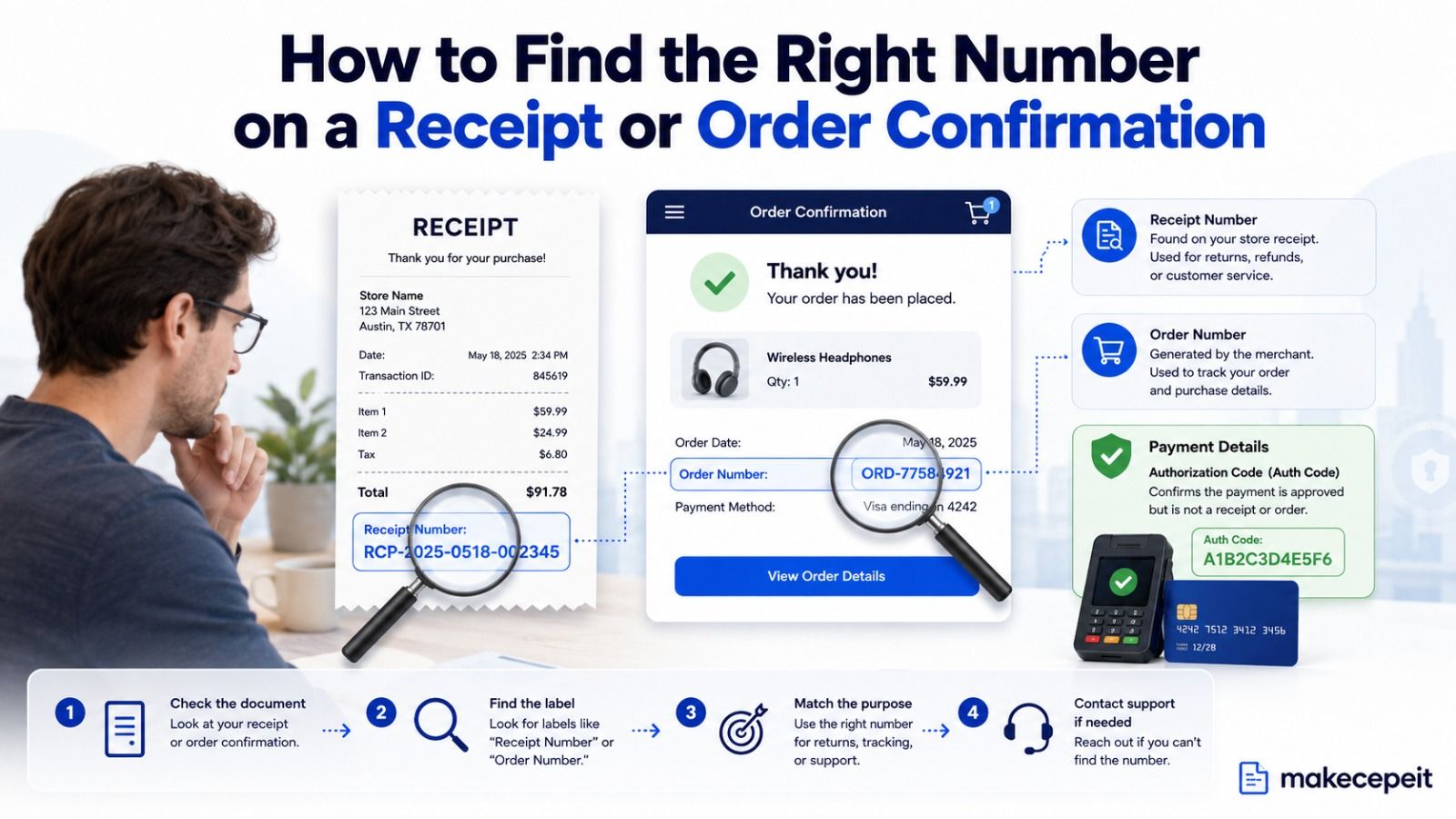
If a document contains several codes, use the following process to determine which one you need:
- Identify the document. Decide whether you are viewing a sales receipt, ecommerce order confirmation, card slip, invoice, or bank record.
- Check the labels. Look for "Receipt #," "Order #," "Auth Code," or similar wording.
- Match the purpose. Use the order number for fulfillment, the receipt number for proof-of-purchase records, and the authorization code for card-authorization questions.
- Check the merchant account. Online stores often display the order number in the customer's account or confirmation email.
- Contact the merchant if needed. Provide the purchase date, amount, and other non-sensitive information so the business can locate the transaction.
Do not publicly share complete card numbers, security codes, passwords, or other sensitive payment information while trying to identify a transaction.
What Information Should a Clear Receipt Include?
A useful receipt should make the purchase easy to identify without forcing the customer or business to guess what each number means.
Depending on the transaction, a well-structured receipt can include:
- Business name and relevant contact details
- Purchase date and time
- Unique receipt number
- Products or services purchased
- Quantity and unit prices
- Subtotal
- Applicable discounts
- Applicable sales tax
- Tip, when relevant
- Total amount paid
- Payment method
- Appropriate non-sensitive payment references
Keeping these fields organized improves readability for both customers and internal accounting teams.
How Makecepeit Helps Create Clear Receipt Records
When a business needs to create a professional receipt, Makecepeit provides an online receipt-building workflow with customizable receipt information and downloadable formats. Its current receipt builder allows users to edit details such as business information, items, prices, taxes, tips, payment information, and receipt identifiers while previewing the receipt.
The practical benefit is control over the document structure. Instead of placing unrelated identifiers in ambiguous fields, businesses can label the receipt number clearly and include other transaction references only when they are appropriate.
For U.S. freelancers, retailers, service providers, restaurants, independent contractors, and small businesses, a clearly structured receipt can make records easier to understand for customers, bookkeepers, and support teams.
A receipt generator should be used to document legitimate transactions accurately. Receipt details should reflect the real purchase rather than creating misleading or false proof of payment.
Common Mistakes to Avoid
Calling every identifier a transaction number
This creates confusion because an order number, receipt number, authorization code, and processor transaction ID can each point to different records.
Using an authorization code as an order number
An authorization code belongs to the payment authorization process. It is not normally the reference a fulfillment team uses to locate an ecommerce order.
Assuming an order confirmation always equals a receipt
An order confirmation primarily confirms that an order was received. Depending on the merchant and payment workflow, the final receipt or completed-payment record may be generated separately.
Publishing sensitive card information
Receipts and support messages should avoid exposing unnecessary sensitive payment credentials. Use appropriate masked or non-sensitive references.
Creating unclear receipt numbering
A consistent receipt-number system makes records easier to locate and reconcile. Avoid changing formats randomly unless there is a business reason to do so.
Tips Before Creating or Reviewing a Receipt
- Use a unique and consistent receipt number.
- Label order and payment references separately.
- Confirm the purchase date and amount.
- Itemize goods or services clearly.
- Show sales tax separately when applicable.
- Do not treat authorization as identical to settlement.
- Avoid placing sensitive card information on customer-facing documents.
- Keep receipt copies according to your applicable accounting and recordkeeping requirements.
The goal is straightforward: anyone reviewing the receipt later should be able to understand what was purchased, when it happened, how much was paid, and which reference identifies the receipt.
Receipt Number vs Order Number vs Authorization Code: Final Takeaway
The simplest way to remember the difference is to connect each number to the system that needs it.
A receipt number identifies the receipt. An order number identifies the order. An authorization code identifies an approval within the card authorization process.
They can all relate to one transaction, but they answer different questions. Keeping those identifiers clearly labeled reduces confusion during customer support, returns, expense reporting, bookkeeping, fulfillment, and payment investigations.
When creating legitimate receipts for your own business transactions, Makecepeit can help you organize essential receipt details into a clear, professional document. Create the receipt with accurate transaction information, label each reference correctly, and keep the resulting record easy for both your business and your customer to understand.
Sources and Verification
- Shopify documentation confirms that receipt numbers and order numbers can be separate identifiers in POS and order-management workflows.
- Stripe's payment documentation explains card authorization, authorization codes, capture, and settlement.
- Makecepeit's official website documents its receipt builder, customizable receipt fields, preview workflow, and export capabilities.
Frequently asked questions
- Is a receipt number the same as an order number?
- No. A receipt number identifies a receipt or sales record, while an order number identifies an order in the merchant's ordering system. Some businesses may connect them, but they are not inherently the same.
- What is an authorization code on a receipt?
- An authorization code is associated with the approval of a credit or debit card authorization request. It may appear in the payment section of some merchant or customer receipts.
- Where can I find my receipt number?
- Look near the top or bottom of the receipt for labels such as "Receipt #," "Receipt No.," or "Receipt ID." The location varies by merchant and POS system.
- Where can I find my order number?
- Order numbers are commonly shown on order-confirmation pages, confirmation emails, customer accounts, packing documents, or order-status pages.
- Can I track a package with a receipt number?
- Usually, merchants use an order number or shipping tracking number for fulfillment. A receipt number may help customer service locate the purchase, but it is not normally a carrier tracking number.
- Is an authorization code the same as a transaction ID?
- Generally, no. An authorization code relates to payment approval, while a transaction ID is typically a reference generated by a merchant, gateway, processor, or payment platform.
- Does an authorization code mean the payment is fully settled?
- No. Authorization confirms approval at the authorization stage. Payment capture and settlement are separate parts of card processing.
- Can one purchase have several identification numbers?
- Yes. One purchase may have an order number, receipt number, authorization code, processor transaction ID, shipping tracking number, and other references.
- Which number should I give customer service?
- For an order problem, start with the order number. For a receipt or proof-of-purchase issue, use the receipt number. Payment investigations may require additional payment references.
- Can I create a receipt with Makecepeit?
- Yes. Makecepeit provides an online receipt-building tool for creating and customizing receipt documents. Always use accurate information that reflects a legitimate transaction.