Oil Change Receipt: What It Shows and How to Make One

An oil change receipt shows the service date, the odometer reading, the oil grade and quantity, the filter, the price paid and when the next change is due. Keep every one: together they are the maintenance history a warranty claim or a used-car buyer will ask to see. To issue one, start from the oil change receipt template, which has those fields laid out.
An oil change receipt template is a service document for routine maintenance, used by quick-lube operators, repair shops, mobile technicians and owners keeping their own records. It captures the mileage at service, the oil and filter fitted, and the point at which the next service falls due.
A repair receipt proves a fault was fixed. A maintenance receipt proves a schedule was followed, which is a different job and a longer-lived one. Makecepeit lets you create a service receipt from a fixed layout, so a routine change in Dallas reads the same as one in Seattle two years later.
What Is an Oil Change Receipt Template?
It is a maintenance layout built around mileage, oil specification and the next service due.
The fields are deliberately narrow. A routine service does not need a parts-and-labor breakdown running to twenty lines; it needs the few facts that matter later — when it happened, at what odometer reading, with what oil, and when the next one is expected. Everything else is supporting detail.
Those few facts are what a manufacturer, a buyer or a warranty administrator will ask for, and they are the ones most often missing from a hurried receipt.
Why a maintenance record outlives a repair record
A repair receipt matters until the warranty on that part expires. A maintenance record matters for as long as somebody owns the vehicle, because it is the evidence that the schedule was kept. That is why the same shop may reasonably keep a tighter grip on oil change records than on one-off repairs.
What Should an Oil Change Receipt Include?
- Business name and address, plus a phone number
- Customer name
- Vehicle year, make and model
- Mileage at service, taken from the odometer that day
- Date of service
- Oil type and viscosity, such as full synthetic 0W-20
- Quantity of oil, in quarts
- Filter part number, where you record it
- Any additional service performed, such as a tire rotation
- Labor or service charge
- Sales tax on whatever portion your state taxes
- Total and payment method
- Next service due, by mileage and approximate date
The three fields that carry the record
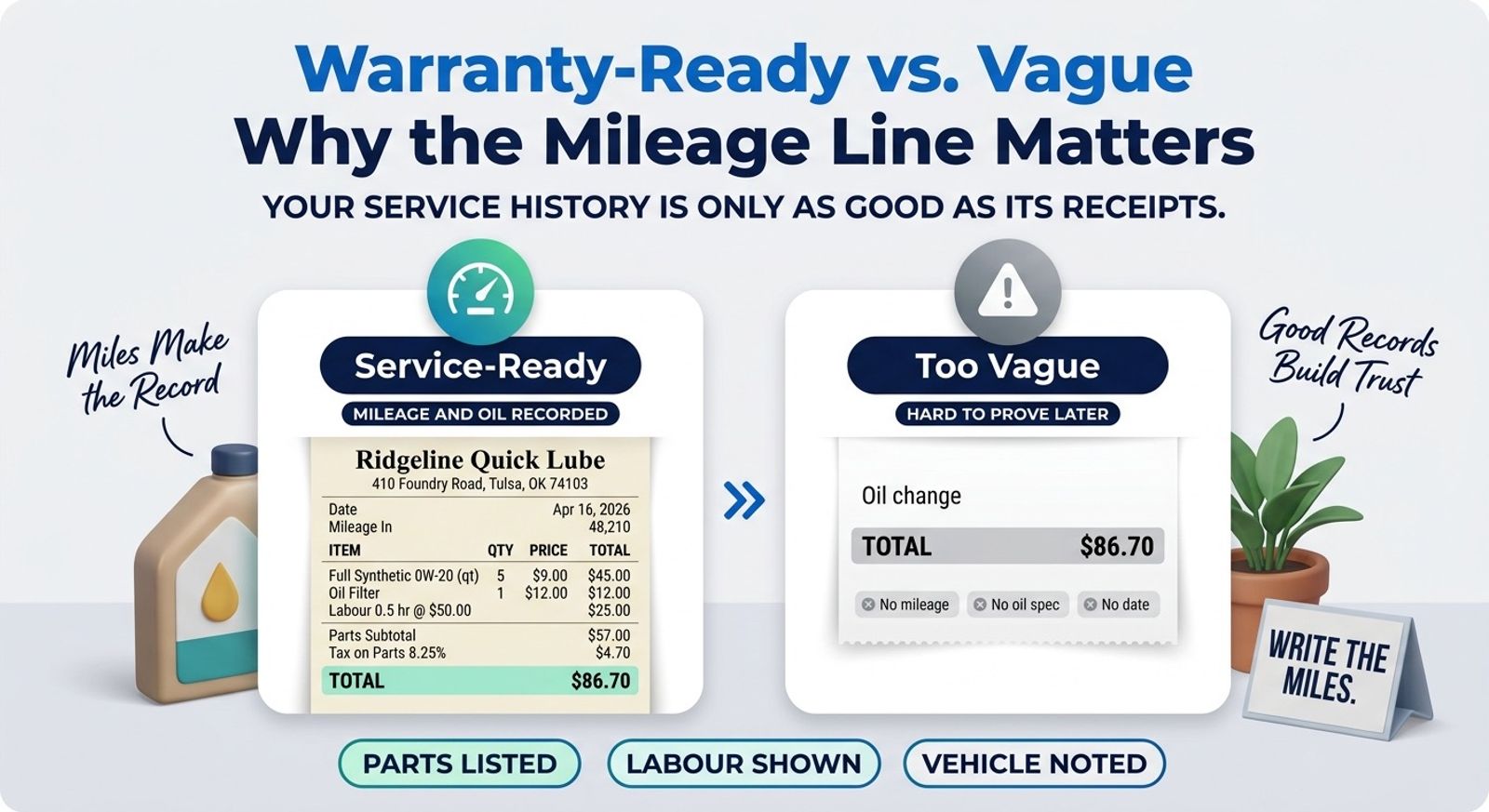
Mileage, oil specification and next service due are what make the document a maintenance record rather than a payment receipt. Without them it proves money changed hands and nothing about the vehicle's history.
Oil Specification: Why the Detail Matters
Modern engines specify an oil grade, and the receipt is where that choice is documented.
Manufacturers publish a required viscosity and often a specification standard for each engine. A receipt that says only "oil change" leaves a later reader unable to tell whether the correct grade went in, which may matter if a warranty claim is assessed. One that records full synthetic 0W-20, five quarts, answers it permanently.
| Field | Example | Why it is recorded |
|---|---|---|
| Oil type | Full synthetic | Affects interval and price |
| Viscosity | 0W-20 | Manufacturer specifies it per engine |
| Quantity | 5 quarts | Shows a full service was performed |
| Filter | Part number | Supports a claim if the filter fails |
| Mileage | 48,210 | Fixes the service against the schedule |
| Next due | 53,210 or six months | Sets the customer's expectation |
Where a customer requests a different grade from the manufacturer's recommendation, note the request on the document. It is their vehicle and their choice, and a line recording it protects everyone if the question comes up later.
Why Maintenance Records Matter in the United States
Because the service history is the part of a vehicle's paperwork that carries value.
At resale, a documented history may support the asking price, particularly on a high-mileage vehicle in a competitive market. Under warranty, a manufacturer assessing a powertrain claim will generally want evidence that scheduled maintenance was performed, and receipts are the usual evidence. Owners in Chicago, Miami and Houston all face the same question when a dealer asks for service records.
For the business issuing them, these are also tax records. The IRS expects records supporting what a return claims, and your state department of revenue governs how a service like this is taxed. Both depend on your circumstances, so a tax professional is the right person to ask about your own.
Important: a service receipt records work that was actually carried out at the mileage shown. Backdating a service, or recording maintenance that never happened, is fraud and may void the warranty it was meant to support.
How to Issue an Oil Change Receipt
- Read the odometer and record the figure before the vehicle is lifted.
- Note the oil by type, viscosity and quantity.
- Record the filter part number if you track them.
- Add any extra service performed on the same visit.
- Enter the charge and apply tax as your state requires.
- Calculate the next service by mileage and by date.
- Print or send the copy and keep your own.
- File it by vehicle, so the history builds in one place.
Next service due, by miles and months
Write both. Mileage alone fails the driver who covers 3,000 miles a year, and a date alone fails the courier who covers 3,000 a month. Giving the earlier of the two is the convention most shops follow, and it saves a phone call later.
Intervals, Severe Service and Honest Advice
Recommend the interval the manufacturer publishes, adjusted for how the vehicle is actually used.
Manufacturers often define a severe service schedule for short trips, towing, dusty conditions or extended idling, and many real drivers fall into it without knowing. A receipt that records which schedule was applied, and why, gives the customer something to act on rather than a sticker in the corner of a windscreen.
Avoid intervals shorter than the manufacturer's without a stated reason. An unexplained short interval reads as a shop selling services rather than maintaining a vehicle, and customers compare notes.
Additional Services on the Same Visit
A routine visit often includes small extras, and each deserves its own line.
Tire rotations, cabin filters, wiper blades and fluid top-ups are commonly done while a vehicle is already on the lift. Listing them separately serves the customer, who can see what they paid for, and the shop, which can show later that a rotation happened at a particular mileage.
It also keeps the maintenance record honest. A single line reading service, covering four different jobs, tells a future reader nothing about which of them was actually performed at that mileage.
Recommendations the customer declined
Where an inspection turns up something the customer chose not to address today, record it as a factual note: the item, the mileage and the date it was raised. That protects both sides if the component fails later, and it gives the next technician a starting point.
Stickers, Reminders and the Next Visit
The windscreen sticker is a convenience; the receipt is the record.
Most quick-lube operations fit a reminder sticker, and most customers rely on it until it falls off or fades. Because the sticker carries no proof of anything, the receipt has to carry the same figures in a form that survives, which is another reason to write the next service due in both miles and months.
Where you send reminders by text or email, referencing the receipt number keeps the conversation tied to a real record rather than an approximate memory of a visit.
Fleet and Company Vehicle Services
Fleets need the vehicle identified their way, not yours.
A fleet operator tracks cost per unit and service compliance across dozens of vehicles. Recording the unit number alongside the plate, and keeping the mileage accurate to the odometer rather than rounded, makes your receipts usable inside their system. Rounded mileage is the single most common complaint fleet managers raise about service paperwork.
Batching several vehicles
When a fleet brings in four vans on one day, issue one receipt per vehicle rather than one combined invoice. Each vehicle's history should stand alone, and a combined document makes every future lookup harder than it needs to be.
Why Use makecepeit for Service Receipts?
Because the maintenance fields are already in the layout, and nothing has to be retyped.
- Mileage, oil specification and next-service fields in fixed positions
- Space for additional services performed on the same visit
- Totals and tax that calculate as lines change
- Consistent output that builds into a readable service history
- Clean files you can email to a customer or a fleet office
- Free to start, with nothing to install
Owner-Kept Records Between Shops
A history only works if it survives a change of garage.
Vehicles move between shops, and each one keeps its own files. The owner is the only person who holds the whole history, which is why the copy handed over matters as much as the copy filed. A one-page record per service, kept in a folder or a phone album, is usually enough.
Drivers in Texas and California selling privately often find this is what separates a quick sale from a long negotiation, because a buyer can see the schedule rather than take a seller's word for it.
Digital copies and photographs
A photographed receipt is better than a lost one, though a file emailed at the time is better still. Where a shop offers to send the record, take it, and keep the message rather than relying on the paper copy in the glovebox surviving two summers.
Tips Before You Hand It Over
- Read the odometer, never estimate it
- Record viscosity as well as oil type
- Write the next service by both miles and months
- Note any customer-requested deviation from the specification
- Keep one receipt per vehicle
- Mask card details to four digits
- File by vehicle so the history accumulates
Common Mistakes to Avoid
- Omitting mileage. The document stops being a maintenance record.
- Recording only "oil change". The grade is what a warranty assessor asks about.
- Rounding the odometer. Fleet systems and service schedules both need the real figure.
- Next service by date only. A high-mileage driver will be well past due.
- Silent short intervals. State the reason, or the recommendation looks like a sale.
- One invoice for four fleet vehicles. Each vehicle needs its own history.
- Backdating a service. It falsifies the record the customer relies on.
Final Takeaway
An oil change receipt template works because it captures the few facts that matter for years: the mileage, the oil, the filter and the next service due. Record those accurately and a routine visit becomes part of a history that supports a warranty claim or a resale price.
For a full repair job with parts and labor, our guide on how to make a mechanic receipt covers the structure, and the auto repair template gives you a layout to start from.
Create Your Service Receipt With makecepeit
Enter the mileage, the oil and the next service due, and hand over a record that still means something in three years. Build your service receipt and file it by vehicle.
Frequently asked questions
- What is an oil change receipt template?
- It is a maintenance document built around mileage, oil specification and the next service due, rather than the parts-and-labor structure a repair receipt uses.
- Why record the oil viscosity?
- Manufacturers specify a grade for each engine, and a receipt naming only an oil change cannot show the correct specification was used if a claim is assessed.
- Should mileage be exact?
- Yes. Service schedules and fleet systems both work from the real odometer reading, and rounding is the most common complaint fleet managers raise.
- How should the next service be shown?
- By mileage and by date, with whichever comes first. Mileage alone fails a low-mileage driver, and a date alone fails a high-mileage one.
- What is severe service?
- A shorter manufacturer schedule for short trips, towing, dust or heavy idling. Where it applies, record which schedule was used and why.
- What if a customer wants a different oil?
- Fit what they ask for if it is safe to do so, and note the request on the receipt so the deviation from the specification is documented.
- Can one receipt cover several fleet vehicles?
- Better not. One receipt per vehicle keeps each service history complete and makes future lookups far easier for the fleet office.
- Does a service receipt help at resale?
- It may. A documented history is often what supports an asking price on a higher-mileage vehicle, because the buyer can see the schedule was kept.
- Do manufacturers require receipts for warranty?
- Claims are generally assessed with evidence that scheduled maintenance was performed, and receipts are the usual evidence. Requirements vary by manufacturer.
- Is backdating a service record illegal?
- Recording maintenance that did not happen, or dating it falsely, is fraud, and it may void the very warranty the record was meant to support.