How to Make a Mechanic Receipt: Parts, Labor, Payment
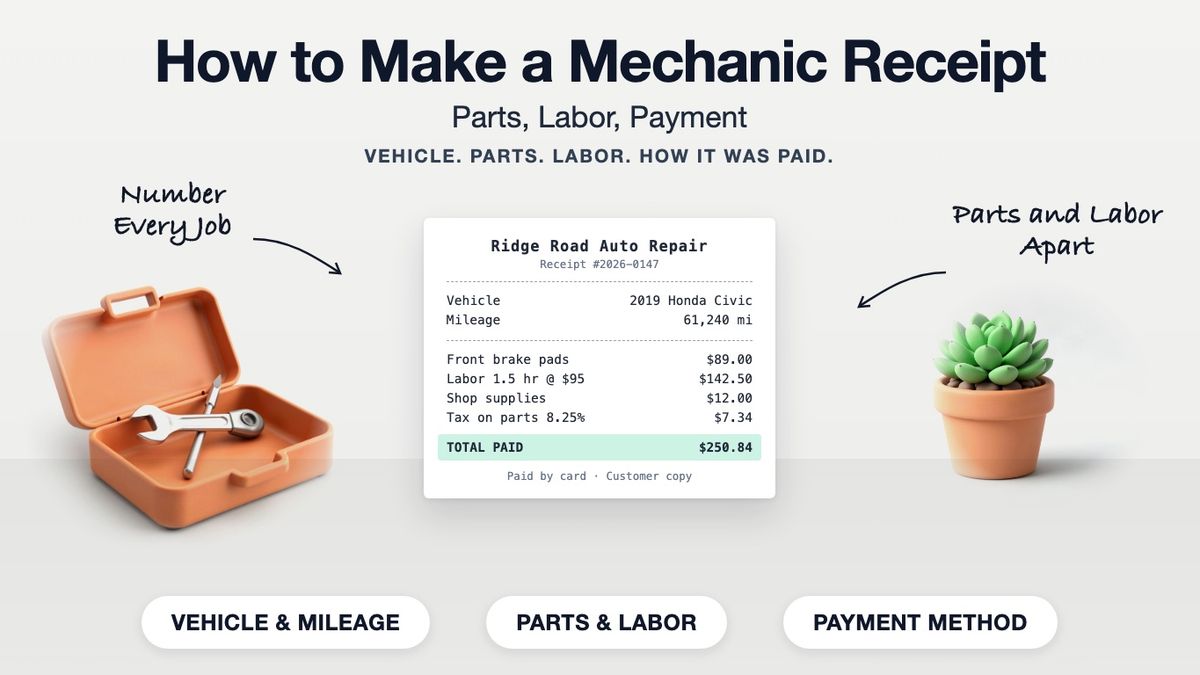
To make a mechanic receipt, write your business name and contact details, the customer and the vehicle (year, make, model and mileage), each part with its price, the labor as hours and rate or a flat charge, sales tax where your state applies it, the total and the payment method. Number it, date it and give the customer a copy. The auto repair receipt template opens with those fields already laid out.
A mechanic receipt template is a reusable layout for a one-person repair business, used by independent mechanics, mobile technicians and weekend operators who work from a van rather than a shop floor. It produces the document handed to a customer when the job is done, showing the vehicle, the parts, the labor and how payment was made.
An independent has no service adviser, no counter and often no printer. Makecepeit lets you create a receipt from a fixed layout on a phone, so a roadside battery swap in Phoenix and a driveway brake job in Atlanta both end with a record the customer can keep.
What Is a Mechanic Receipt Template?
It is a fixed layout an independent mechanic fills in per job, so every customer leaves with the same clear document.
The template holds the business identity, the vehicle fields, the parts and labor sections and the payment line. Only the job changes. For a sole operator that consistency does two things at once: it makes the business look organised to a customer deciding whether to call again, and it gives the owner records that reconcile at tax time without a reconstruction exercise.
It documents work genuinely performed on a vehicle, which is the only thing that makes it worth issuing.
Why independents need this more than shops do
A shop has a system that numbers jobs whether anybody thinks about it or not. An independent has a phone, a toolbox and whatever habit they build. Without a template, the record of a busy Saturday is three text messages and a memory, and the first customer to query a charge in November will find nothing to argue with.
What Should a Mechanic Receipt Include?
- Business name as you trade, plus a phone number
- Your license or registration number, where your state requires one
- Customer name and the service location
- Vehicle year, make, model and mileage
- Receipt number, in a sequence you control
- Date of the work
- Parts supplied, each with quantity and price
- Labor, as hours and rate or as a flat-rate line
- Any call-out or travel charge, named plainly
- Sales tax where it applies to the portion your state taxes
- Total, and the amount actually received
- Payment method, with cash stated as cash
Fields worth adding for mobile work
The service location matters more than it does in a shop, because you were not at a fixed address. Note the street and city, or the yard or lot, so the job can be identified later. A short line naming what the customer reported, in their words, is also useful when a comeback happens.
Cash Jobs, Signatures and Proof of Payment
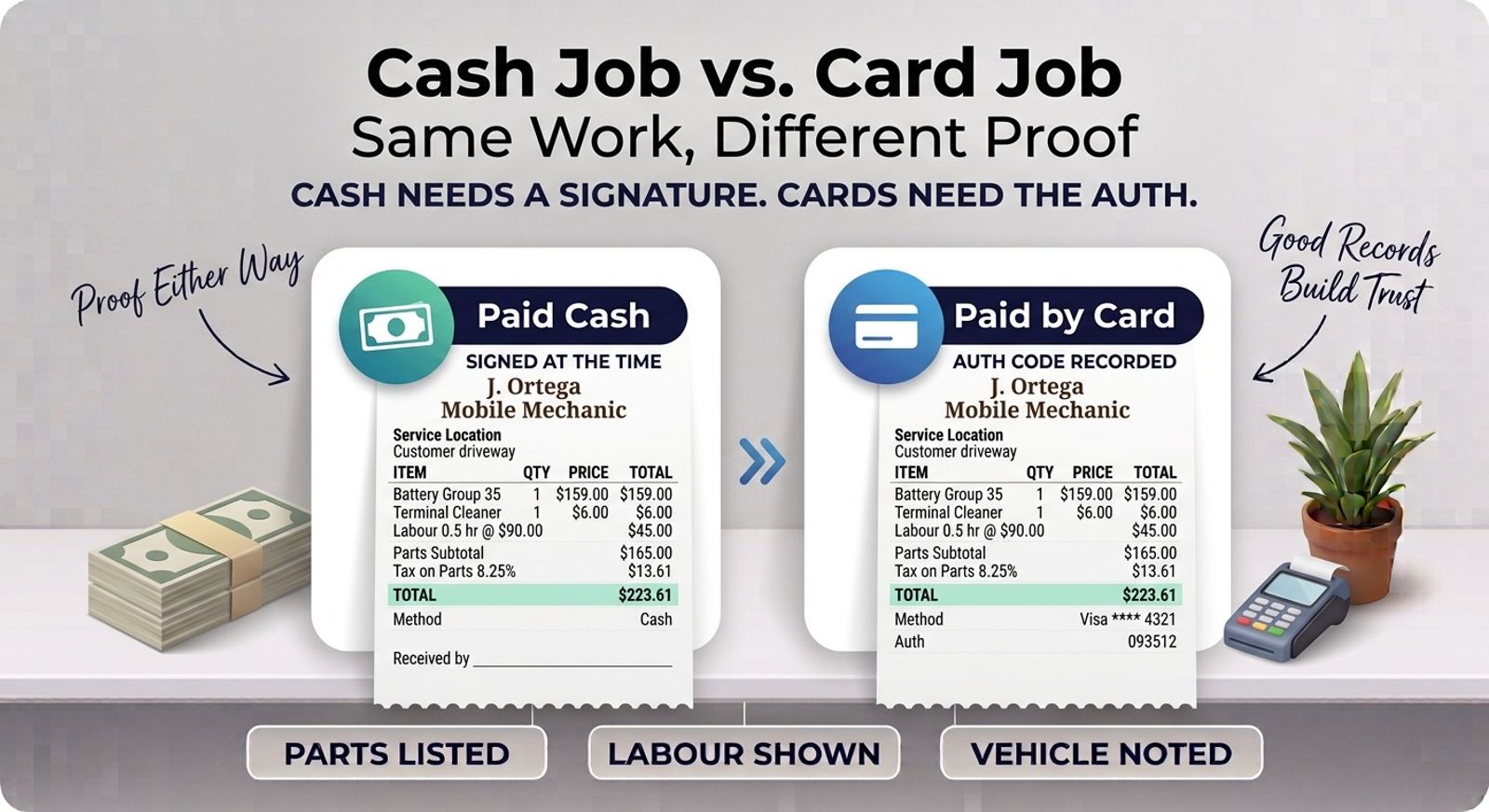
Cash is legitimate and leaves no trail, which is exactly why the receipt has to carry the weight.
A card payment produces a record on both sides. Cash produces nothing unless somebody writes it down, so the receipt becomes the only evidence that money changed hands. Two details make it hold up: the amount received written in words as well as figures, and a signature line the customer signs when they take the copy.
| Payment | What already exists | What the receipt must add |
|---|---|---|
| Card | Processor and bank records | The job detail behind the charge |
| Bank transfer | A dated transfer record | What the payment was for |
| Cash | Nothing | The whole record, ideally signed |
| Partial payment | A record of one amount | The balance still outstanding |
| Customer-supplied part | No purchase record for you | What you fitted and what you warrant |
Where a customer pays part now and part later, say so on the document. A balance line naming the outstanding amount and the agreed date prevents the disagreement that otherwise arrives a fortnight afterwards.
Why Independent Mechanics Need Records in the United States
Because the paperwork is what separates a business from a favour.
Self-employed mechanics report income like any other sole proprietor, and the IRS expects records that support what a return claims. Parts bought for a job are business costs; cash taken for that job is business income. Neither reaches a return reliably unless a receipt exists, and a shoebox of handwritten notes is the version that falls apart under any scrutiny.
State rules add a second layer. Mechanics in California, Texas and Florida may face registration, disclosure or written-estimate requirements that differ considerably, and your state department of revenue governs the sales tax side. Because both depend on where you work, treat them as questions for your own state and a tax professional.
Important: a mechanic receipt records work that was actually performed and money that was actually received. Issuing a receipt for work never done, or understating cash taken, is fraud.
How to Issue a Receipt on the Job
- Start the record before you pack up, while the detail is in front of you.
- Enter the vehicle and mileage from the odometer, not from memory.
- List the parts you fitted, with quantities and prices.
- Add the labor, as hours or as the flat rate you quoted.
- Name any call-out or travel charge on its own line.
- Apply tax where your state taxes the work.
- Take payment and record the method, including cash.
- Have the customer sign the copy where the payment was cash.
- Send or hand over their copy and keep yours.
Numbering Receipts When You Are the Whole Business
Pick a sequence and never restart it.
A simple year-and-number scheme works everywhere: 2026-001 onwards, one number per job, no gaps and no reuse. That single habit gives a sole operator something a shop gets from software — a way to refer to a job, find it again and prove the record is a series rather than a collection of loose documents.
Where you void a receipt, keep the number and mark it void rather than reusing it. A missing number invites the question a full sequence never raises.
Keeping a running list
A one-line index per job, listing number, date, customer, vehicle and total, takes seconds to maintain and turns a folder into something searchable. At year end, it is also the fastest route to a total that matches the bank.
Estimates Before You Start
A short written quote generally prevents the only argument an independent is likely to have.
Customers rarely dispute good work; they dispute a figure they were not expecting. A two-line message naming the expected parts cost, the labor and the call-out charge usually does the whole job, and it may be a requirement in your state once the amount passes a threshold.
Send it before you begin, keep it with the job, and if the work grows once the wheel is off, say so and get a yes before continuing. Most states that regulate repair disclosure care about exactly that moment, and the rules vary enough that your own state's requirements are worth reading once.
When a job turns out bigger
A seized bolt, a snapped stud or a second failed component may turn a one-hour job into three. Tell the customer what you found, what it now costs and what happens if it is left, then record the answer with the time. Written at the moment, it takes seconds; reconstructed later, it usually cannot be done honestly.
Warranting Your Own Work
Say what you warrant, for how long, and what voids it.
An independent lives on repeat customers, and the warranty line is what makes a first-time caller comfortable. State it plainly: the part warranty passed through from the supplier, the labor warranty you offer yourself, and any exclusions such as customer-supplied parts.
Where a customer brings their own component, record it on the line and say what you cover. Fitting a part you did not source is ordinary, and being explicit about the arrangement protects the relationship if the part fails.
Getting Paid Without a Card Terminal
Name the payment method on the document, whatever it was.
Independents take payment in more ways than shops do: cash at the kerb, a bank transfer that afternoon, a payment app, or a card reader plugged into a phone. Each leaves a different trail, and the receipt is what ties the method to the job.
A transfer that arrives the next day should show as a balance outstanding until it lands, then be updated. Marking a job paid before the money moves is how a busy week ends with two invoices nobody can account for, and reconciling weekly usually catches it while the detail is still fresh.
Deposits on parts
Where a job needs an expensive component ordered up front, taking a deposit is ordinary and worth documenting properly: the amount received, what it is for, and whether it is refundable if the customer changes their mind. That one line may save a genuinely awkward conversation.
Why Use makecepeit for Mechanic Receipts?
Because a template on a phone beats a notebook in a toolbox, and the math is done for you.
- Parts and labor sections that stay separate
- Line totals and tax that calculate as you type
- Room for the vehicle, mileage and the service location
- A signature line for cash jobs
- Clean file output you can text or email from the driveway
- Free to start, with nothing to install
The same layout scales from a roadside jump start to a two-day engine job.
Tips for Working Without a Shop
- Build the record before leaving the job
- Photograph the odometer if you are rushed
- Keep a spare charged phone or a paper pad as a fallback
- Number every job, including free comebacks
- Say cash on the document when the payment was cash
- Keep supplier invoices for the parts you fitted
- Reconcile your week against the bank every Friday
Common Mistakes to Avoid
- No receipt at all on cash jobs. The one payment with no trail is the one needing a document.
- Restarting the numbering. Gaps and repeats make a series look improvised.
- Leaving out the service location. On mobile work it is how a job is identified later.
- Bundling travel into the labor rate. Name the call-out charge instead.
- Silence on customer-supplied parts. Record what you fitted and what you warrant.
- Verbal warranties. If it is not on the document, it will be remembered differently.
- Losing supplier invoices. Your costs matter as much as your income at tax time.
Final Takeaway
A mechanic receipt template gives a one-person business the paperwork discipline a shop gets from its systems. Number the jobs, record the vehicle and mileage, keep parts and labor apart, state the warranty and say plainly when a payment was cash.
The auto repair receipt template has every field above already in place, so a job can be written up in the driveway before you leave.
Create Your Mechanic Receipt With makecepeit
Enter the vehicle, the parts and the labor, take payment and hand over a copy before you leave the driveway. Build your receipt and keep the sequence running.
Frequently asked questions
- What is a mechanic receipt template?
- It is a reusable layout for a one-person repair business, holding the vehicle, parts, labor and payment details so every job ends with the same document.
- Do I need a receipt for a cash job?
- Especially then. A card payment leaves records on both sides, while cash leaves nothing unless the receipt records it, ideally with a signature.
- Should a mobile mechanic record the location?
- Yes. Without a fixed shop address, the street, city or yard where the work happened is how the job gets identified months later.
- How should I number my receipts?
- A simple year-and-number sequence works well: 2026-001 onwards, one per job, no gaps, no reuse, and voided numbers marked rather than recycled.
- What about parts the customer supplies?
- Record them on the line as customer supplied, and state what you warrant. Fitting a part you did not source is normal, but the terms should be explicit.
- Should travel charges be separate?
- Yes. A named call-out or travel line is easy to explain, while the same amount folded into an hourly rate usually prompts a question.
- What records do I keep for taxes?
- Both sides: the receipts you issue and the supplier invoices for parts you bought. What applies to your situation is a question for a tax professional.
- How do I handle a partial payment?
- Show the amount received and the balance outstanding with the agreed date, so both parties read the same figures a fortnight later.
- Does a signature matter on a receipt?
- On cash work it may be the only confirmation the customer received the document and the money changed hands, so it is worth the ten seconds.
- Is issuing my own receipts legal?
- Yes, and it is expected of any business. Issuing receipts for work that never happened, or understating cash income, is fraud.