Home Depot Receipt Generator for Job Materials
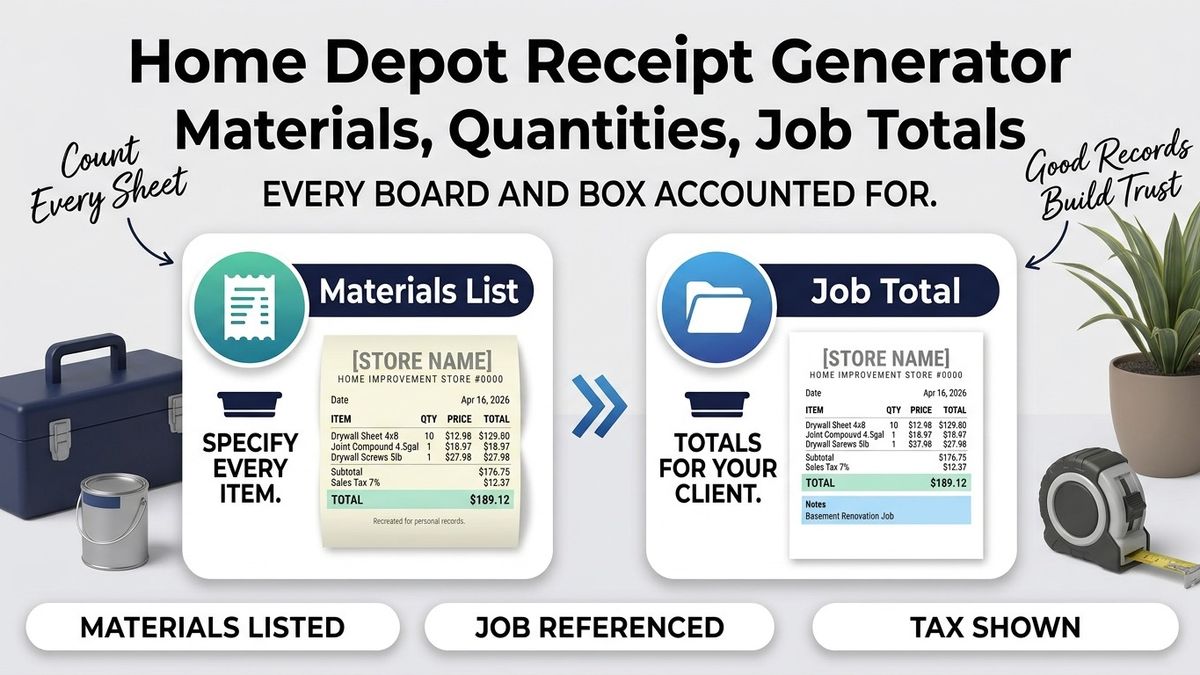
A Home Depot receipt generator is a receipt builder used to record a materials purchase in the detail a trade buyer needs, for contractors, remodellers, handypeople and homeowners running a project. It produces one document showing what was bought, in what unit, at what price, and which job the spend belongs to.
Materials purchases are harder to record than groceries, because a single trip may mix lumber sold by the foot, fasteners sold by the pound and fixtures sold each. Makecepeit lets you create a receipt with a column structure that holds all three, so a deck build in Raleigh and a bathroom remodel in Phoenix file the same way.
What Is a Home Depot Receipt Generator?
It is a builder that arranges a real materials purchase into a receipt layout with units, quantities and line totals.
The phrase describes a use, not a product the retailer sells. You enter what you bought, the tool structures it, and the output is your own record. Nothing connects to the store's systems, and the document is yours rather than a reissue of theirs.
For trade buyers the structure is the point. A record that says "materials, $412.68" answers nothing three months later; a record listing eight line items answers the job-costing question, the client question and the tax question at once.
What it is not
It is not a reprint of the store's receipt, and it does not retrieve anything from their transaction history. When the original is what you need — for a return, an exchange or a warranty claim on a tool — our guide to a Home Depot and Lowe's receipt reprint covers how to ask the retailer.
What Should a Materials Receipt Include?
- Store location, at least the city and state you bought in
- Purchase date, matching your card statement
- Item description in plain language, not a register abbreviation
- Unit of measure, such as each, foot, pound, box or sheet
- Quantity bought in that unit
- Unit price and the resulting line total
- Subtotal before tax
- Sales tax charged on the taxable portion
- Total paid, matching the statement to the cent
- Payment method, masked to the last four digits
- Job reference, if you cost work by project
The unit column earns its place
Lumber, wire, pipe and aggregate are priced by measure, and a quantity without a unit is ambiguous. "Six" of a twelve-foot board is different from six feet of it, and the difference may be the largest single error on the document. Naming the unit removes the ambiguity permanently.
Why Job Materials Records Matter in the United States
Because materials are usually the largest line in a small contractor's costs, and the one most often lost.
A remodelling business in Austin may make three supply runs in a week, two of them on a personal card. Those trips reach the books only if a record survives, and thermal paper in a work truck generally does not. What gets lost is not just the deduction but the job cost, which is what tells the owner whether a quote was profitable.
Contractors in California, Texas and Illinois also work under state rules that vary in how materials are taxed, especially where labour and materials are billed together. Treatment depends on the contract and the state, so a tax professional is the right person to ask about your own work.
Important: a generated receipt records materials you actually bought. Producing a document for a purchase that never happened, or passing your copy off as the retailer's receipt, is fraud.
How to Generate a Materials Receipt
- Start from the statement line, which fixes the date and the total.
- List each material separately, rather than grouping a trip into one line.
- Name the unit for every line — each, foot, pound, sheet or box.
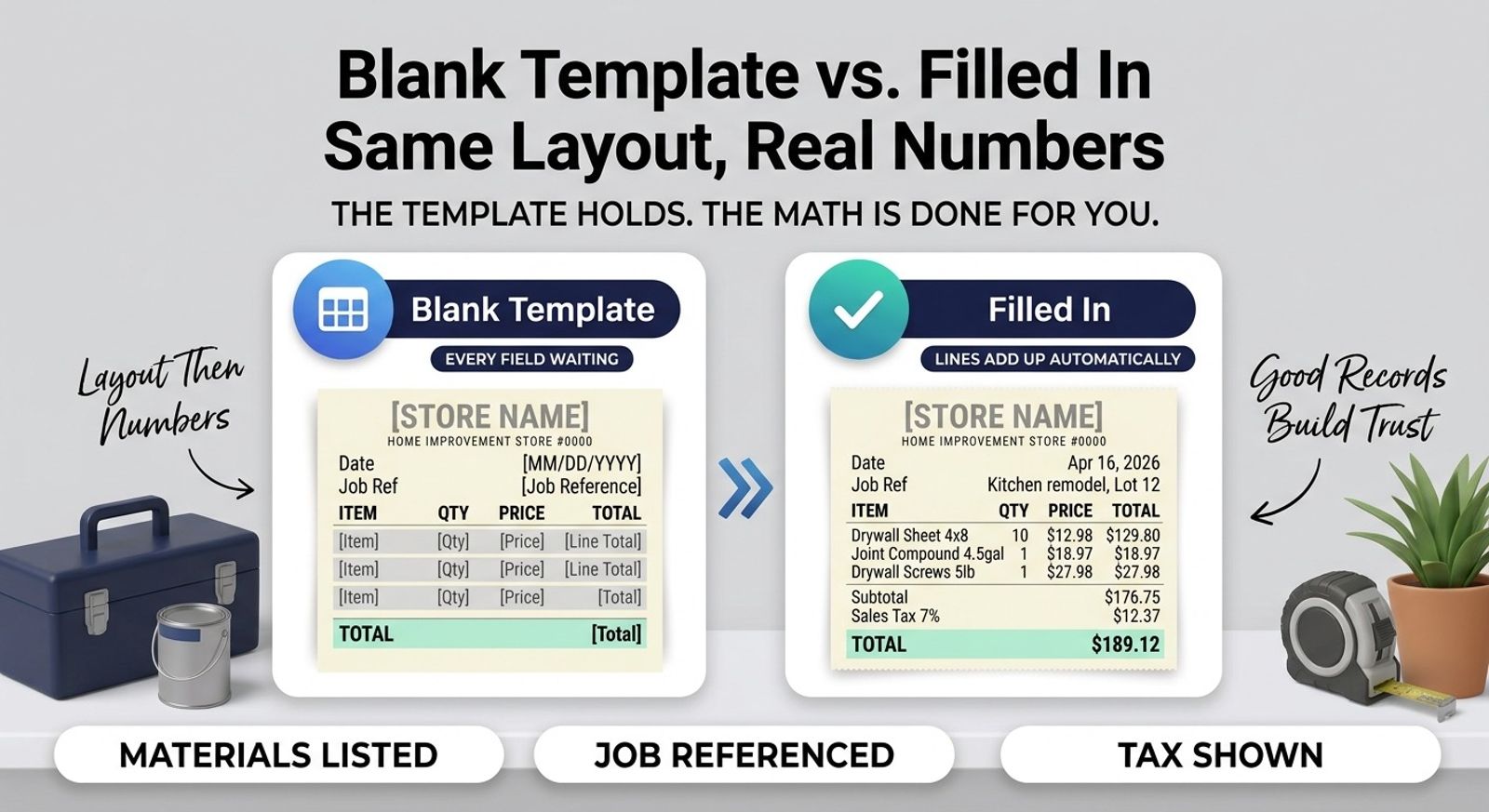
- Enter quantity and unit price, and let the line total calculate.
- Add the tax you were actually charged.
- Check the total against the statement, to the cent.
- Tag the job, so the record can be rolled into a project total later.
- File it with the statement page and the job folder.
Units, Quantities and Waste Factors
Record what you bought, not what the job consumed.
A siding job may use 38 boards from 42 bought, and the receipt documents 42. Waste, offcuts and the spare box in the van belong to the job cost, not to a separate calculation, and a record that quietly drops them understates what the project actually cost. Our guide to an itemized receipt template covers the column discipline in more detail.
Returns are the other half of this. Materials taken back change the total, and the cleanest way to handle that is a second record rather than an edit to the first, which the companion post on editable templates covers.
Reading a materials line back
A line that says twelve, at four dollars and twenty-five cents, coming to fifty-one dollars, can be checked by anybody in two seconds. A line that says lumber, fifty-one dollars, cannot be checked at all. That difference is why the unit, quantity and price columns exist, and why a record built properly may still be useful to somebody a year after the job closed.
Sales Tax on Building Materials
Enter the tax the register charged rather than a rate you look up afterwards.
Materials tax varies by state, and in several states it varies again by whether the buyer is a contractor billing a client or a homeowner buying retail. Some purchases may be exempt with the right documentation, and some jurisdictions apply local rates on top of the state figure.
| Field | What to enter | Why it matters |
|---|---|---|
| Unit | Each, foot, pound, sheet, box | Removes the ambiguity in a bare quantity |
| Quantity | The amount bought in that unit | Lets a reader verify the line total |
| Unit price | Price per single unit | Makes the arithmetic checkable |
| Tax | The amount charged at the register | Local rates vary and change |
| Job reference | Project or client name | Turns receipts into job costs |
Pro Accounts, Bulk Buys and Volume Pricing
Record the price you actually paid, including any discount, rather than the shelf price.
Trade buyers often pay less than the posted figure, through account pricing, volume breaks or a quoted rate on a large order. A record showing the shelf price will not reconcile with the statement, and the gap grows with the size of the order.
Where a discount applies to the whole basket rather than a line, give it its own row beneath the subtotal so the arithmetic stays visible. A reader can then follow the path from line totals to the amount that left the account without guessing where the difference came from.
Per-unit versus bulk pricing
A box of a hundred fasteners bought as one unit is one line at the box price. The same fasteners recorded as a hundred lines at a per-piece price will drift on rounding and take ten times as long to enter. Record the purchase the way it was priced at the till, and the arithmetic looks after itself.
Sharing Materials Records With a Client
A client reading a materials record wants to see what was bought, not how it was priced internally.
On cost-plus work in Seattle or Denver, the materials record is part of the bill, and it will be read closely. Plain descriptions, honest quantities and a visible tax line answer most questions before they are asked. Register abbreviations and grouped lines invite the opposite.
Send the record as a file rather than a photograph of a screen, keep card details masked, and make sure the version the client receives is the version you filed. Two slightly different copies of one materials record is a conversation nobody enjoys.
What clients actually read
In practice they read the total first, then scan for anything that looks unusual: a large single item, a quantity that seems high, a line they do not recognise. Anticipating those three questions when you write the descriptions is usually enough to keep a billing conversation short.
Why Use makecepeit for Materials Receipts?
Because the column structure is built for units and quantities, and the totals recalculate as you type.
- Item, unit, quantity, unit price and line total in one row
- Totals that update when a quantity changes, so the math cannot drift
- A job or reference field for project-based filing
- Consistent output across every trip, which makes a folder scannable
- Free to start, with nothing to install
The same layout covers a single sheet of plywood and a forty-line framing order.
Filing Materials Receipts by Job
A materials record that is not attached to a job is a cost nobody can allocate.
Most small contractors file one folder per project and drop every supply record into it the day it is built. At the end of the job, the folder totals to the materials figure that belongs in the final accounting, and no reconstruction is needed. Firms working several jobs at once in Nashville or Kansas City gain the most from this, because the alternative is untangling a month of mixed receipts from memory.
Where one trip serves two jobs, split it across two records rather than guessing a percentage later. The split takes a minute at the time and may be impossible to do honestly three weeks afterwards.
The end-of-job check
Before closing a project, read the folder once. A missing trip usually shows up as a gap between the materials total and what the bank says left the account, and finding it then is far easier than finding it at tax time.
Tips Before You Build the Record
- Photograph the pile at the truck if you cannot photograph the slip
- Write descriptions a client would understand
- Keep the unit column filled on every line
- Record returns as their own document
- Tag the job before you file, not later
- Mask card details to four digits
- Reconcile against the statement the same week
Common Mistakes to Avoid
- Grouping a whole trip into one line. It saves a minute now and costs the job cost later.
- Dropping the unit. A quantity without a unit may be read two ways, and usually is.
- Inventing SKUs or store codes. Fabricated identifiers look authoritative and are not.
- Using a generic tax rate. Enter what the register charged.
- Copying store branding. Your record needs no logo, and copying one creates a trademark problem.
- Editing a filed record after a return. Add a second document instead.
- Treating the copy as proof for a return. The retailer verifies against their own record.
Mixed baskets: materials and tools
One trip often carries both consumables for a job and a tool that stays in the van. They may belong in different places in your books, because a tool is generally an asset and the materials are a job cost. Recording them on one receipt is fine; noting which is which, or splitting them across two records, is what saves the sorting later.
Final Takeaway
A Home Depot receipt generator is worth using when the detail matters: units, quantities, prices and the job the materials belong to. Build from the statement, keep each material on its own line, name the unit, and tag the project before filing.
For a return or a warranty claim, ask the retailer for the original. For job costing, bookkeeping and client transparency, an accurate record you built yourself does the work.
Create Your Materials Receipt With makecepeit
Enter the materials, the units and the quantities, and let the line totals and tax calculate as you go. Build your receipt and file it against the job it belongs to.
Frequently asked questions
- What is a Home Depot receipt generator?
- It is a receipt builder used to record a materials purchase you made, with units, quantities, unit prices and line totals arranged the way a trade buyer reads them.
- Why does the unit column matter?
- Because lumber, wire and aggregate are priced by measure. Six boards and six feet of board are different purchases, and a bare quantity may be read either way.
- Should I record materials I did not use?
- Yes. The receipt documents what you bought, including waste and spares. What the job consumed is a separate calculation.
- How do I handle returned materials?
- Record the return as its own document rather than editing the original. Two clean records are easier to follow than one that changed after filing.
- What tax rate should I enter?
- The amount the register actually charged. Materials tax varies by state, by locality and sometimes by whether you are buying as a contractor or a homeowner.
- Can I include a job reference?
- Yes, and contractors generally should. A project or client tag is what turns a folder of receipts into a job cost you can total.
- Should I add store SKUs to each line?
- Only if you genuinely have them. Inventing identifiers that look like store codes puts fabricated data on a record you may rely on later.
- Is a generated receipt valid for a return?
- Generally not. Retailers verify returns against their own transaction records, so request the original receipt from the store instead.
- How do I describe materials clearly?
- In plain language a client could follow, such as pressure-treated 2x6, 12 foot. Register abbreviations save space and lose meaning.
- Is building a materials receipt legal?
- Recording materials you genuinely bought is ordinary bookkeeping. Creating a receipt for a purchase that never happened, or presenting it as the store's own, is fraud.