Goodwill Donation Receipt Template: How It Works
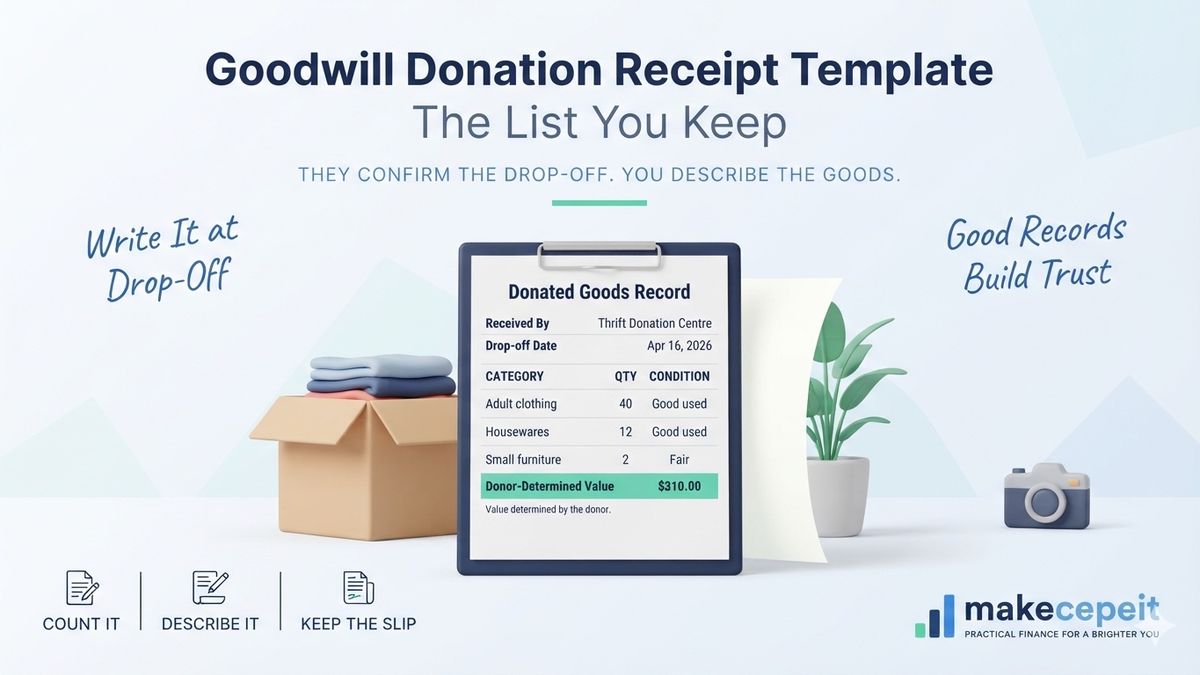
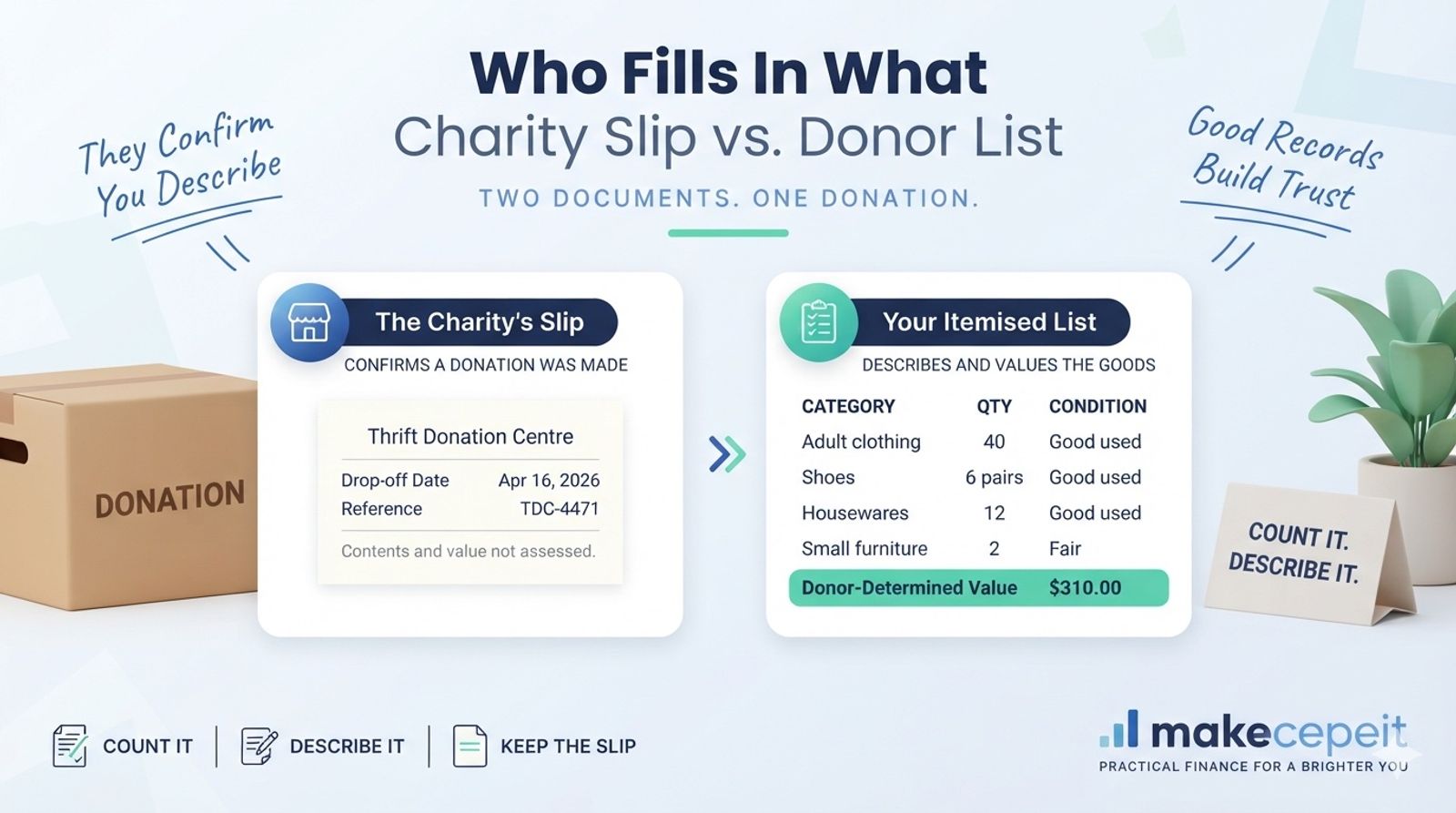
A goodwill donation receipt template is the itemized list a donor prepares to record what they dropped off at a thrift or charity shop, and understanding who fills in what is the whole point. The receiving organization generally confirms that a donation was made. The donor is the one who describes the items and determines what they were worth.
Across the United States, that split catches people out every filing season. A blank slip handed over a counter in Chicago or Phoenix is not a complete record of anything until somebody writes down what was in the bags. Makecepeit lets you build an itemized record of what you donated so the list exists in a readable form rather than on a fading paper stub.
What Is a Goodwill Donation Receipt Template?
It is a donor-side form for listing donated goods by category, quantity and condition, kept alongside whatever acknowledgment the organization provided.
Thrift and charity shops receive far too many drop-offs to inventory each one. Most hand over a dated slip confirming a donation occurred and leave the itemization to the donor, which is standard practice rather than an oversight. The template is simply a structured place to do that itemizing while you still remember what was in the boxes.
What the organization provides
Typically a dated receipt with the organization's name and location, sometimes a reference number, and space for the donor to complete. It confirms the transaction. It does not usually confirm contents or value, because staff did not count the items.
What the donor provides
A description of what was given, the quantity, the condition, and a value the donor has determined. That last part is the donor's responsibility and nobody else's.
An Important Limit Worth Stating Plainly
Document what you actually donated. Never create a document that appears to come from an organization you do not represent.
There is a real difference between keeping your own itemized record of a genuine drop-off, which is ordinary and sensible, and producing something designed to look like a charity's official acknowledgment. The first is record-keeping. The second misrepresents an organization that has not agreed to it, and no template should be used that way.
If an acknowledgment from the receiving organization is missing, the fix is to contact the organization and ask, not to reconstruct one on their behalf.
What Should the Itemized List Include?
- Organization name and location where the donation was made
- Date of the drop-off, which fixes the tax year
- Category of goods — clothing, housewares, furniture, electronics
- Quantity in each category, counted rather than estimated
- Condition, described honestly
- Your own valuation, with the method you used
- A reference to the slip the organization gave you
- Photographs, where the donation was substantial
Why condition matters more than people expect
Guidance on donated household goods generally turns on whether items are in good used condition or better. "Eight men's dress shirts, good used condition" is a record. "Bag of clothes" is not, and it tells you nothing a year later when you are trying to reconstruct what you gave.
Who Assigns the Value?
| Element | Donor's role | Organization's role |
|---|---|---|
| Confirming the drop-off | Keeps the slip | Issues the dated slip |
| Listing the items | Writes the itemized list | Generally does not itemize |
| Describing condition | Records it honestly | Rarely inspects individually |
| Assigning a value | Determines it | Does not value donated goods |
| Supporting the figure | Keeps the method on file | Not involved |
The pattern is consistent: the charity documents that it received something; the donor documents what that something was and what it was worth. A charity that started assigning values to strangers' used furniture would be making judgments it has no basis for.
Why Donated-Goods Records Matter in the United States
Non-cash donations are recorded differently from cash, and the paperwork expectations rise with the amount.
IRS guidance treats contributions of property differently from cash gifts, and the documentation generally expected increases at higher values — a written acknowledgment becomes relevant at $250, and additional substantiation may apply for larger non-cash contributions. Where a single item or group of similar items is valued highly, a qualified appraisal may come into play.
Those thresholds and the methods for valuing used goods are exactly the kind of detail that varies by situation. Donors in California, Texas and New York face the same federal framework but very different state pictures, and a tax professional is better placed than any template to say what applies to a particular donation.
The template's job is narrower and more useful: make sure that when the question is asked, you can answer it from a record you wrote at the time rather than from memory.
How to Use the Template at Drop-Off
- Sort into categories before you leave the house.
- Count each category and write the numbers down.
- Note the condition honestly, category by category.
- Photograph anything substantial before it goes in the car.
- Get the organization's slip and keep it with your list.
- Record the date and location exactly as on the slip.
- Determine values using a consistent, documented method.
- File both documents together where you can find them.
A donation receipt generator gives that list a consistent layout, which matters if you donate several times a year and want the records to look alike.
Valuing Used Goods Without Guessing
Pick a method, apply it consistently, and write down which one you used.
Most donors work from what comparable used items sell for in the local second-hand market. Some organizations publish general valuation ranges for common categories as a convenience. Either approach may be reasonable; the failure is using one method for shirts, another for furniture, and remembering neither.
- Use the same basis across the whole donation
- Record the basis alongside the list
- Do not use original purchase price as the value of used goods
- Be conservative where condition is uncertain
- Keep comparables if you looked any up
Clothing and Household Goods in Detail
Most drop-offs are clothing and housewares, and most vague records are too.
Categories are worth agreeing with yourself in advance, because consistency across the year is what makes the records usable. The categories below cover the large majority of what people actually donate.
| Category | Record this | Common error |
|---|---|---|
| Clothing | Item type, count, adult or child | "Two bags" with no count |
| Shoes | Pairs, type, condition | Counting items instead of pairs |
| Housewares | Item type and count | Lumping crockery as miscellaneous |
| Small appliances | Item, working or not | Omitting whether it functions |
| Furniture | Piece, material, condition | No note of damage |
| Books and media | Count, hardback or paperback | Estimating by box size |
| Electronics | Item, age, working state | Treating obsolete as current |
Bundling similar items sensibly
Listing forty individual t-shirts helps nobody. Grouping them as "40 adult t-shirts, good used condition" is both accurate and readable. The rule of thumb is to bundle items that share a category, a condition and a rough value, and to separate anything that differs materially on any of those three.
Items a charity may not accept
Not everything left at a donation point is accepted, and goods that are rejected were never donated. Damaged upholstered furniture, recalled equipment and certain electronics are frequently turned away. If part of a load is refused, the record should reflect what the organization actually took rather than what left the house, which is another reason to write the list at the point of drop-off rather than beforehand.
Multiple Donations Across the Year
Donors who drop off regularly need the records to aggregate cleanly. Keep one list per drop-off rather than one running list for the year, because the dates matter and a single combined document obscures them. A simple folder, physical or digital, holding paired slips and lists in date order is enough.
When a year-end summary helps
Building a summary in January from individual records is straightforward. Building individual records in January from a year-old memory is not. The summary is a convenience layered on top of contemporaneous records, never a substitute for them.
What Happens If You Are Asked About a Donation
The question is rarely dramatic. It is usually a request to show how a figure was arrived at.
Donors sometimes imagine that supporting a non-cash contribution means producing a document stamped by the charity. In practice what is generally wanted is the reasoning: what was given, when, in what condition, and on what basis a value was reached. A contemporaneous itemized list answers all four, which is precisely why writing it at drop-off matters more than any particular format.
A record written months later has a structural weakness even when it is entirely honest, because it was reconstructed rather than observed. Somebody trying to remember in March what they gave in September will generalize, round and forget, and the resulting list may understate as easily as overstate. The list written in the car park is better evidence than the one written from memory, and it takes less effort.
Where a donation is substantial, the supporting material generally expands. Photographs help. So does a note of where valuations came from, whether that was a published guide, observed second-hand prices, or comparable listings. None of this needs to be elaborate. It needs to exist and to be consistent with what the organization's slip says about the date and location.
The one thing that does not help is a document that overstates its own authority. A donor-prepared list presented as a donor-prepared list is straightforward and credible. The same information dressed up to look like it came from the charity raises a question about everything else in the file, and there is no version of that trade which favours the donor.
Why Use makecepeit for Donation Records?
- Itemized line structure built for listing goods by category
- Consistent layout across every drop-off you record
- Editable in the browser, with nothing to install
- PDF and PNG output to file alongside the organization's slip
- Reusable details so repeat donations take a minute
- Clear, readable records that survive better than a paper stub
Makecepeit is for documenting donations you genuinely made. It is not a way to manufacture a charity's acknowledgment, and the value of the record comes entirely from it being accurate about what left your house and when.
Tips Before Your Next Drop-Off
- List items before you go, not from memory afterwards
- Photograph larger donations while they are still together
- Keep the organization's slip attached to your list
- Record the location, not just the organization name
- Apply one valuation method across the whole donation
- Describe condition honestly, including where it is poor
- File immediately rather than in a pile for later
Common Mistakes to Avoid
- Recreating an organization's acknowledgment rather than requesting one
- Writing "bag of clothes" instead of counting items
- Using original purchase prices for used goods
- Valuing items the organization should not value and attributing it to them
- Losing the slip and reconstructing the date approximately
- Combining several drop-offs into one undated list
- Overstating condition on items that were worn out
- Leaving it until filing season to write anything down
Final Takeaway
A goodwill donation receipt template works because it puts the donor's half of the record somewhere durable. The organization confirms a donation happened; you describe what it was and what it was worth, at the time, honestly. Keep the two documents together, apply one valuation method, and never produce something that purports to come from a charity you do not represent. Rules on non-cash contributions vary with amount and circumstance, so confirm the specifics with a tax professional. For the organization's side of the same transaction, see the donation receipt template guide.
Record Your Donation With makecepeit
List what you gave while you still remember it, in a layout that reads the same every time. Open the itemized record builder and keep a clean copy alongside the organization's slip.
Frequently asked questions
- What is a goodwill donation receipt template?
- It is the donor's itemized list of goods dropped off at a thrift or charity shop, kept alongside the dated slip the organization provides.
- Does the charity itemize my donation?
- Usually not. Most organizations confirm that a donation was made and leave the itemization and valuation to the donor.
- Who decides what donated goods are worth?
- The donor does, generally based on what comparable used items sell for locally, and ideally with the method recorded alongside the list.
- Can I create a receipt from the charity myself?
- No. Document your own donation, but never produce a document that appears to come from an organization you do not represent. Request a copy instead.
- What if I lost the organization's slip?
- Contact the organization and ask whether a copy is available. Reconstructing their acknowledgment yourself is not an appropriate substitute.
- How detailed should the item list be?
- Detailed enough to be meaningful later. Count items by category and note condition, rather than writing a general description like bag of clothes.
- Does condition affect a donated-goods record?
- Yes. Guidance on household goods generally turns on items being in good used condition or better, so describe condition honestly, category by category.
- Should I photograph donated items?
- For substantial donations it is worth doing. Photographs taken before drop-off support the list far better than a recollection months afterwards.
- Can I combine several drop-offs into one list?
- Better not to. Keep one list per drop-off, since the individual dates matter and a combined document obscures them.
- Can makecepeit record donated goods?
- Yes. The itemized layout suits listing goods by category, quantity and condition, for documenting donations you genuinely made.