Donation Receipt Template: Fields and Format
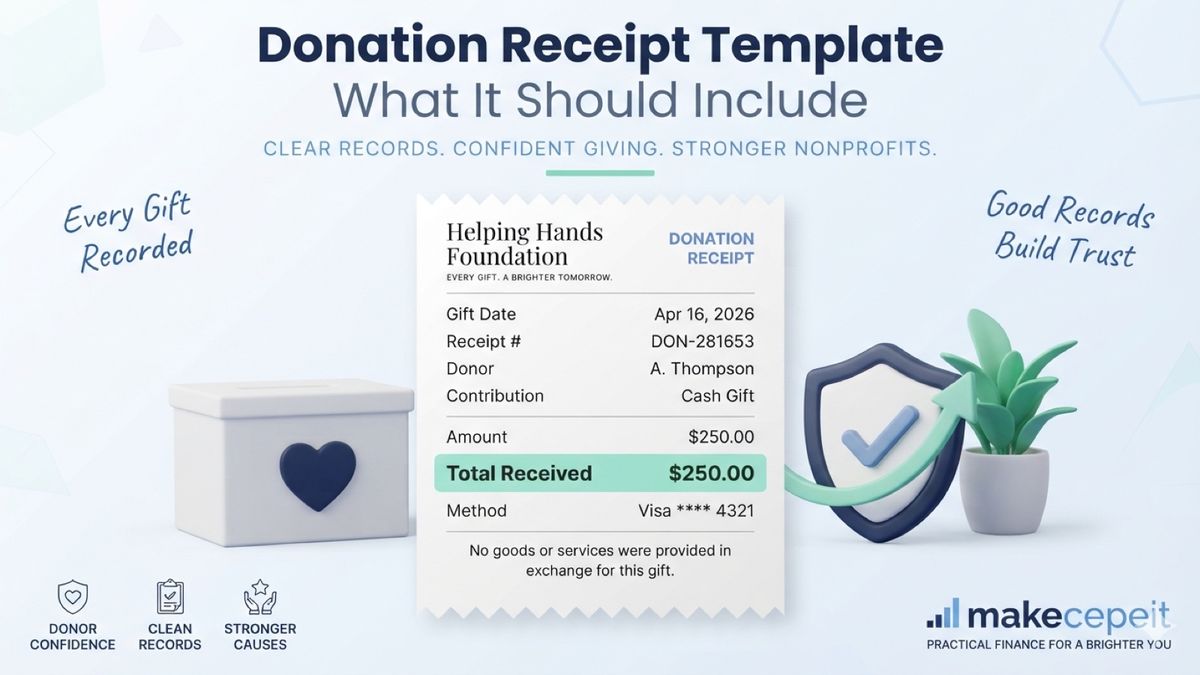
A donation receipt template gives nonprofits, charities, churches, booster clubs and community fundraisers a reusable format for acknowledging every gift they take in, so each receipt names the organization, the donor, the date and the amount without anybody rebuilding the document from scratch. The template holds the structure. The individual gift supplies only the details that change.
Across the United States, a donation receipt does two jobs at once: it tells the donor what the organization received, and it leaves the nonprofit an accurate record for its own books. Makecepeit lets you generate a donation receipt from a fixed layout in the browser, so the fields stay consistent from a January gift through the year-end letter run.
What Is a Donation Receipt Template?
A donation receipt template is a pre-built document layout that a nonprofit reuses for every contribution, leaving blanks only for the donor, the gift and the date.
The point of a template is consistency. An organization in Chicago that types each acknowledgment by hand will produce receipts that disagree with one another — one names the fund, the next forgets the date, a third omits the sentence about goods and services that a donor may actually need. A template removes that variation by deciding the format once.
Templates generally come in two shapes. A static file, such as a Word or PDF document, is filled in manually each time. A generated receipt is produced by a tool from the values you enter, which keeps the arithmetic and the layout out of your hands.
What Should a Donation Receipt Template Include?
A workable template generally carries these fields:
- Organization name exactly as registered, not an informal nickname
- Organization address and, where applicable, the tax identification number
- Donor name, and address if the organization keeps mailing records
- Date of the contribution, which is the date the gift was received
- Amount for a cash gift, written in figures
- Description of the property for a non-cash gift, without a stated value
- A statement about goods or services provided in return, if any
- Receipt number or reference for the organization's own records
- Signature line or authorized name, which many donors expect to see
Nonprofits generally describe a donated item on the receipt but leave the valuation to the donor — stating a dollar figure for someone else's used furniture is a judgment the organization is usually not positioned to make.
Fields people forget
The date is the most commonly missing field, and it is the one that decides which tax year the gift belongs to. The goods-or-services sentence is second. A receipt that records $500 but says nothing about whether the donor got a gala dinner in return is incomplete for a donor who intends to claim the gift.
Cash vs In-Kind Donation Receipts: What Is the Difference?
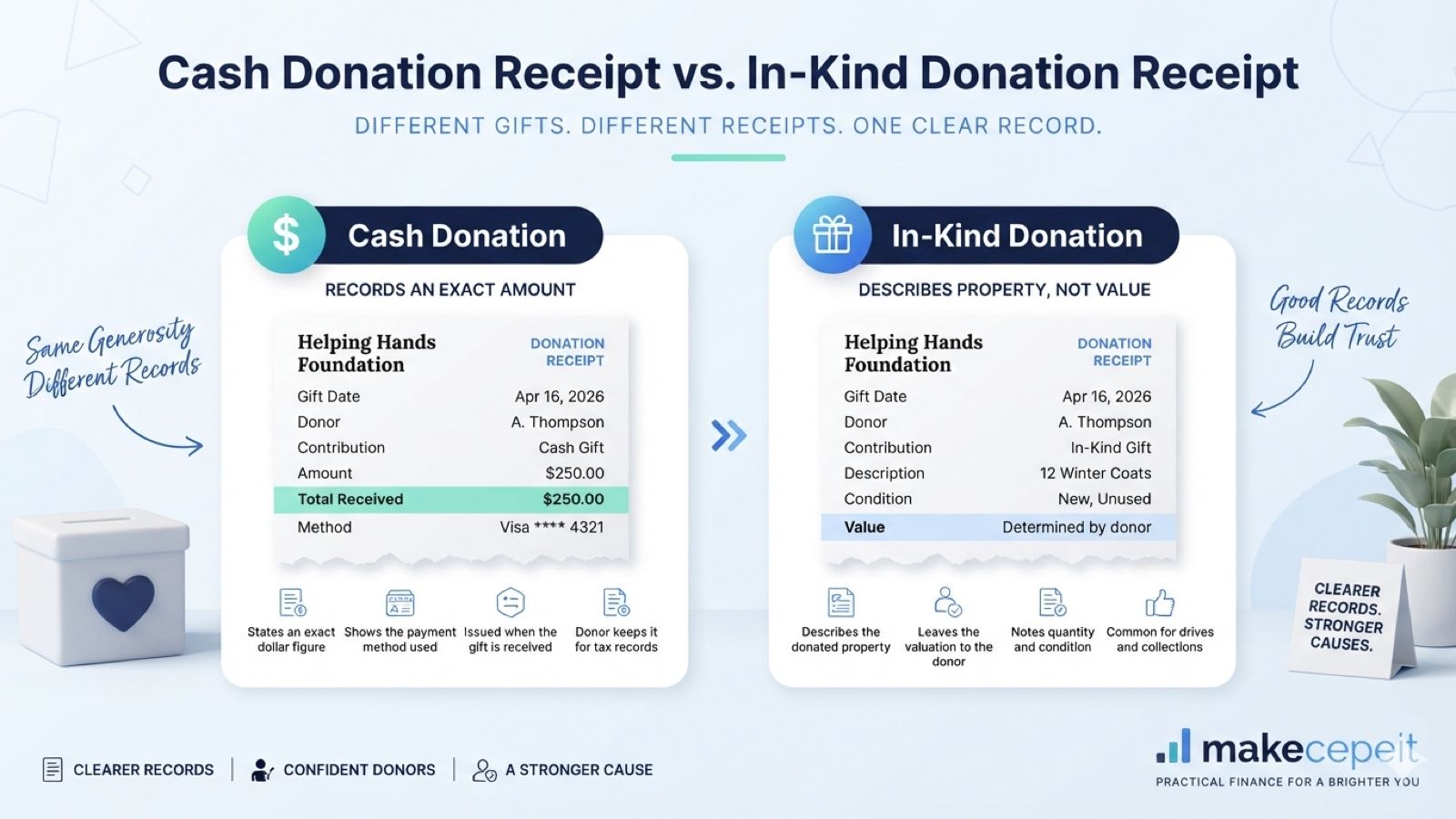
A cash receipt states an amount; an in-kind receipt describes property and deliberately avoids stating its worth.
| Element | Cash donation receipt | In-kind donation receipt |
|---|---|---|
| What the gift is | Money, by check, card or transfer | Goods, property or inventory |
| Amount shown | Exact dollar figure | Description only, no value |
| Who values the gift | Not applicable | The donor, generally with their own adviser |
| Typical detail | Payment method and date received | Condition, quantity and date received |
| Common use | Appeals, recurring giving, events | Food drives, clothing, equipment |
Services donated to a nonprofit are a third case. Volunteer time is generally not treated the same way as donated property, so an organization in Seattle thanking a volunteer attorney may want to send a letter of appreciation rather than a receipt that implies a deductible contribution.
Why Donation Receipts Matter in the United States
In the U.S., the receipt is the document that connects a donor's claim to the organization's record of the gift.
IRS Publication 1771 sets out that for a single contribution of $250 or more, a donor generally needs a written acknowledgment from the charity, and that the acknowledgment carries a statement about whether the organization provided any goods or services in return. That is why the familiar line about no goods or services being provided appears at the bottom of so many receipts. It is not filler. It is the statement the rule asks for.
Below $250, a written acknowledgment is generally not required, but a charity that issues one anyway spares the donor from reconstructing a gift months later from a bank line that reads only "transfer." Organizations in New York, Texas and Florida also answer to their own state charity regulators, and state registration or reporting duties vary, so confirm what your state expects.
State and local treatment differs, and a receipt does not by itself establish that anyone's gift is deductible. That question turns on the organization's tax status and the donor's own circumstances. Nonprofits generally document what they received and leave deductibility to the donor and a tax professional.
What a receipt does not do
A receipt records a transaction; it does not certify a tax outcome. A nonprofit in Phoenix that writes "this donation is tax deductible" on every acknowledgment has made a claim it is not positioned to make, because deductibility depends on the donor's own return. The safer construction states the facts of the gift and leaves the conclusion alone.
How to Create a Donation Receipt From a Template
- Choose the format your organization will use for every gift this year.
- Enter the organization details once — name, address, identification number.
- Add the donor's name and mailing address as they gave it to you.
- Record the date received, not the date you processed the paperwork.
- State the amount for cash, or describe the item for an in-kind gift.
- Add the goods-or-services statement that matches what actually happened.
- Number the receipt so it can be found again in your records.
- Review the figures against your deposit or intake log before sending.
- Send it promptly and keep a copy in the donor's file.
Doing this from a donation receipt generator removes steps two and seven from the manual pile, because the organization details persist and the numbering runs on its own.
The $250 Threshold and the Sentence That Has to Appear
For a single gift of $250 or more, the acknowledgment generally needs to say whether the donor received anything in return.
The threshold applies per contribution, not per year. A donor in Los Angeles who gives $100 monthly has made twelve separate gifts, none of which crosses the line on its own — though a year-end summary is still a courtesy most organizations extend.
The wording matters more than the format. If nothing was given back, the receipt says so. If something was, the receipt describes it. Silence on the point is the failure mode, and it is the one a template fixes permanently by printing the line every time.
Receipts for recurring gifts
Monthly giving programs raise a small design question the template should answer up front: does each charge generate its own receipt, or does the donor get one summary? Many organizations send an automated acknowledgment per charge and a consolidated statement in January, which covers both the donor who files quarterly and the one who waits for the year-end letter.
Quid Pro Quo Donations: When the Donor Got Something Back
A quid pro quo contribution is a payment made partly as a gift and partly in exchange for goods or services — the classic case being a charity dinner ticket. Where such a payment exceeds $75, the organization generally provides a written disclosure giving a good-faith estimate of the value of what the donor received.
- A $200 gala ticket with a $60 dinner leaves roughly $140 treated as the gift
- A raffle ticket is generally not treated as a charitable contribution at all
- Token items of small value are handled differently from substantial benefits
A template that includes a benefits line makes these cases routine rather than a scramble the week after the event.
Estimating the value of a benefit
The good-faith estimate is the organization's responsibility, not the donor's, and it is generally based on what the benefit would cost on the open market rather than what it cost the charity. A dinner catered at a discount is still valued at roughly what that dinner would sell for. Where a benefit is genuinely token — a branded pin, a printed program — different treatment may apply, and a tax professional can confirm which side of the line an event falls on.
Donation Receipt Template Formats Compared
| Format | Best for | Watch out for |
|---|---|---|
| Word document | Small volumes, hand-edited | Layout drifts as text is retyped |
| PDF form | Consistent printed output | Fields can be awkward to edit |
| Spreadsheet | Bulk year-end statements | Formatting rarely matches a receipt |
| Online generator | Frequent or repeat giving | Confirm the fields you need are present |
None of these is automatically better. A volunteer-run food pantry issuing six receipts a year may be fine with a document file. A nonprofit in Miami processing gifts weekly usually finds that hand-editing becomes the error source.
Choosing a format by gift volume
Volume is usually the deciding factor rather than preference. Under roughly a dozen gifts a year, a document file edited by one person stays consistent. Past that, the retyping itself becomes the error source — a wrong year carried over from the last receipt, a donor name left in from the previous gift. That failure mode is predictable enough that it is worth switching formats before it happens rather than after.
Year-End Statements vs Individual Receipts
An individual receipt acknowledges one gift; a year-end statement summarizes everything one donor gave across the year.
Many organizations send both — a prompt receipt at the time of each gift, and a consolidated statement in January. The statement generally itemizes the dates and amounts rather than presenting a single total, because a donor may need to identify which gifts crossed the $250 line individually.
What a year-end statement should itemize
A statement that reports only a single annual total is less useful than it looks. Listing each gift by date and amount lets the donor identify which individual contributions crossed the $250 line, since the threshold applies per gift rather than to the yearly sum. It also gives them something to reconcile against their own bank records, which a lump figure does not.
Why Use makecepeit for Donation Receipt Templates?
Makecepeit is built to produce a clean, consistent receipt quickly, which is exactly the problem a template solves:
- Fixed layout so every receipt from your organization looks alike
- Donation-specific fields rather than a retail sales form bent to fit
- A footer line for the goods-or-services statement, present by default
- In-browser editing, with no document software to install
- PDF and PNG output for emailing or printing
- Reusable organization details so the header is typed once
The tool documents contributions the organization genuinely received. It is a record-keeping aid, not a way to manufacture a gift that did not happen, and accuracy in the amount and date is what makes the receipt worth issuing at all.
Tips Before Sending Donation Receipts
- Send promptly — donors generally expect acknowledgment within a few weeks
- Check the spelling of the donor's name before it goes out
- Match the date to your bank or intake record, not the processing date
- Describe, don't value, any donated property
- Keep a copy in a form you can retrieve a year later
- Review the template annually against current guidance
- Mask payment data — a receipt has no reason to carry a full card number
Common Mistakes to Avoid
- Omitting the goods-or-services sentence on gifts of $250 or more
- Assigning a dollar value to donated goods on the organization's behalf
- Using the processing date instead of the date the gift was received
- Issuing a receipt for volunteered time as though it were property
- Treating a raffle or auction purchase as a straightforward donation
- Stating that a gift is deductible, which the organization cannot certify
- Letting each staff member keep a personal version of the template
- Forgetting the disclosure on quid pro quo payments above $75
Final Takeaway
A donation receipt template is a small piece of administrative infrastructure that pays for itself the first time a donor calls in March asking what they gave in October. Decide the fields once, include the goods-or-services statement by default, record the date the gift actually arrived, and describe property rather than pricing it. The specific tax treatment depends on the organization and the donor, and it generally varies by state, so confirm the details with a tax professional before relying on any receipt for a filing.
If you are weighing the no-cost options first, the companion piece on choosing a free donation receipt template covers what "free" usually does and does not include.
Create Donation Receipts With makecepeit
Set your organization details once, enter the gift, and produce a receipt that carries the fields a donor expects. Start with the donation receipt generator and keep every acknowledgment consistent from the first gift of the year to the last.
Frequently asked questions
- What is a donation receipt template?
- A donation receipt template is a reusable document layout a nonprofit fills in for each gift, holding the organization details and required statements constant while the donor, date and amount change.
- What must a donation receipt include?
- Generally the organization's name, the donor's name, the date received, the amount for cash or a description for property, and a statement about whether goods or services were provided in return.
- Does a donation receipt need a dollar value for goods?
- Usually not. The organization describes the donated property, and the donor determines its value, generally with their own tax adviser.
- What is the $250 rule for donation receipts?
- For a single contribution of $250 or more, a donor generally needs a written acknowledgment from the charity that states whether any goods or services were provided in return.
- Do small donations need a receipt?
- A written acknowledgment is generally not required below $250, but many organizations issue one anyway so donors have a clear record of the gift.
- Can a nonprofit receipt volunteer hours?
- Donated time is generally treated differently from donated property. Many organizations send a thank-you letter instead of a receipt to avoid implying a deduction.
- What is a quid pro quo donation?
- It is a payment made partly as a gift and partly for goods or services, such as a gala ticket. Above $75, a written disclosure of the benefit's estimated value generally applies.
- Should receipts be sent per gift or yearly?
- Many nonprofits do both: a prompt receipt for each contribution, plus an itemized year-end statement in January summarizing everything that donor gave.
- Does a receipt make a donation tax deductible?
- No. Deductibility depends on the organization's tax status and the donor's circumstances. The receipt documents what was received and nothing more.
- Can makecepeit create donation receipts?
- Yes. Makecepeit produces donation receipts from a fixed layout with donation-specific fields and a footer statement, for documenting contributions your organization genuinely received.