Editable Home Depot Receipt Template Guide
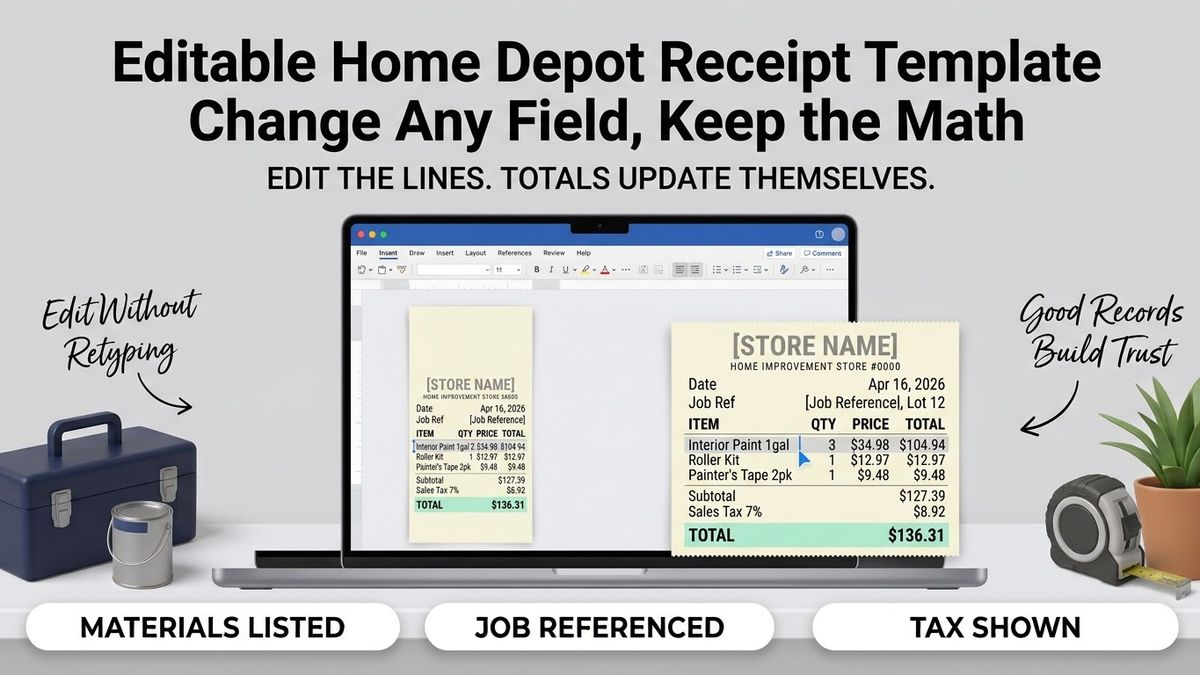
An editable Home Depot receipt template is a materials receipt layout whose fields can be changed after the first draft, with the totals recalculating instead of being retyped. It suits contractors adjusting an order, bookkeepers correcting a mistyped price and anyone whose supply run changed between the aisle and the register.
Editing is where most receipt records go wrong: a quantity changes, the line total is updated by hand, and the subtotal quietly no longer agrees. Makecepeit lets you edit a receipt with the arithmetic handled for you, so a corrected record in Denver adds up as well as the original did.
What Is an Editable Receipt Template?
It is a layout where changing one field updates every figure that depends on it.
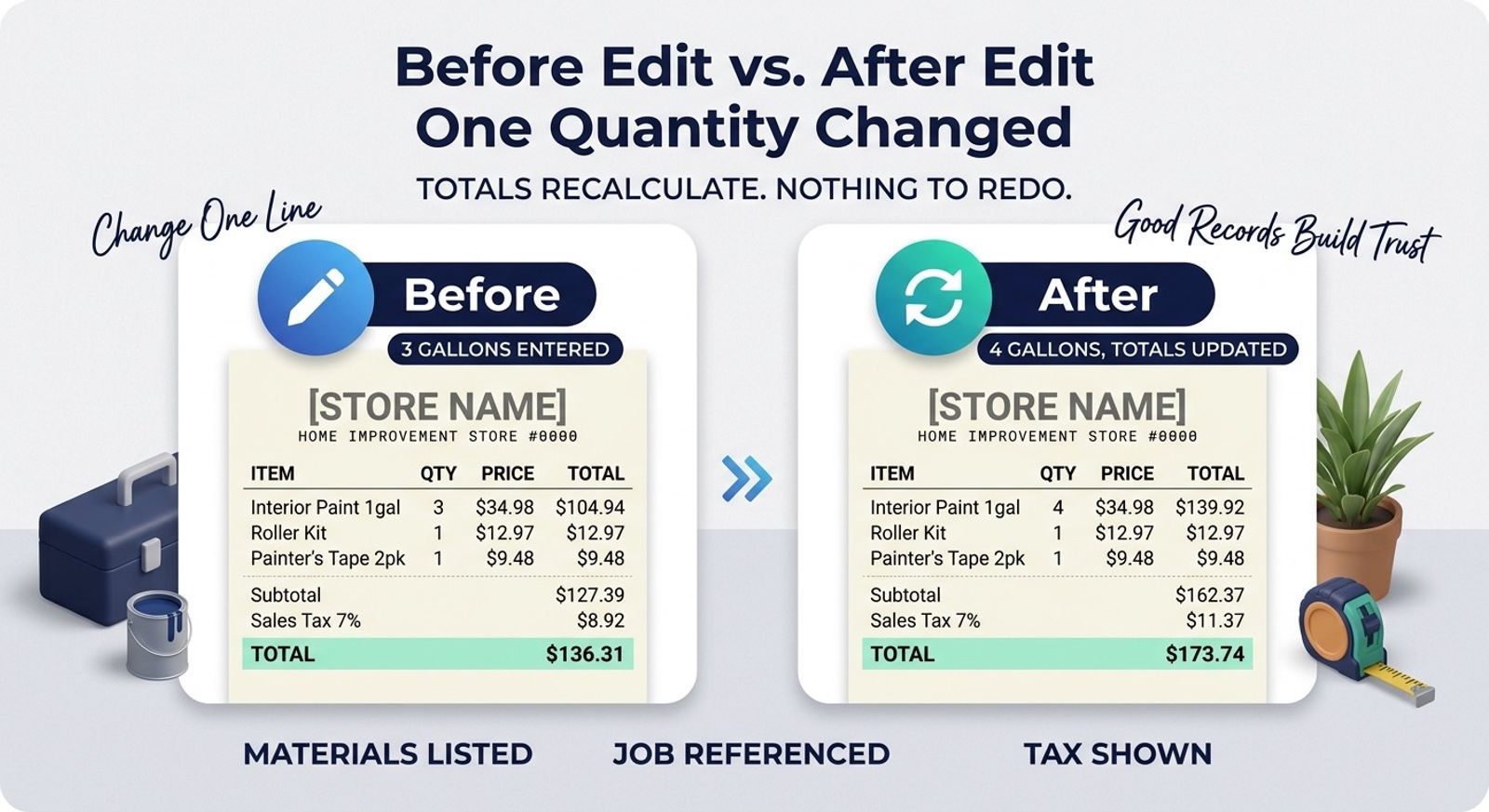
Change a quantity from three to four and the line total, the subtotal, the tax and the grand total all move together. That is the whole difference between an editable template and a static one, and it is the reason corrected records stay trustworthy.
The output remains a record of materials you actually bought. Editing a draft to make it accurate is ordinary bookkeeping; editing a filed record to say something different about what happened is not.
Where hand-editing fails
A record edited by hand usually has two or three numbers updated and one forgotten. The forgotten one is generally the tax, because it sits furthest from the change. A reader comparing the document with a bank statement finds the mismatch immediately, and the record loses its authority over a difference of a few dollars.
When Do You Need to Edit a Materials Receipt?
- A quantity changed between the estimate and the till
- A price was mistyped when the record was first built
- Materials were returned and the total needs restating
- An item was missed and the record does not reconcile
- The job reference changed, because the materials moved to another project
- A description was unclear and a client asked what it meant
- Two trips were merged by mistake and need separating
Corrections versus rewrites
A correction brings a record into line with what actually happened. A rewrite changes the story the record tells. The first is required of anybody keeping books honestly; the second is what turns a record into a problem, and no template should make it feel casual.
Why Accurate Corrections Matter in the United States
Because a record that no longer reconciles is worse than no record at all.
Bookkeepers in Chicago, accountants in Miami and expense reviewers everywhere work by matching documents to bank lines. A materials receipt whose total drifted during an edit raises a question that costs more time to answer than the edit saved. The IRS expects records that support what a return claims, and what applies to your circumstances depends on your business, so ask a tax professional about your own.
Contractors have a second reader: the client. A materials record handed over as part of a bill may be checked line by line, and an edit that left the subtotal stale is the kind of thing that costs trust on a job.
Important: edit a draft to make it accurate, never to change what happened. Restating a purchase that did not occur, or presenting your copy as the retailer's receipt, is fraud.
How to Edit a Receipt Record Safely
- Find the source figure — the statement line, the original slip or the order confirmation.
- Change one field at a time, so you can see what moves with it.
- Let the totals recalculate rather than typing over them.
- Re-check the grand total against the statement.
- Note what changed and why, in a line at the foot or in your folder.
- Save the corrected version over the draft, not over a filed record.
- Keep returns separate, as their own document rather than an edit.
Returned Materials: Edit or New Record?
Write a second record for the return and leave the original alone.
| Situation | Edit the original | New record |
|---|---|---|
| Typo in a price, found before filing | Yes | No |
| Quantity wrong on an unfiled draft | Yes | No |
| Materials returned a week later | No | Yes |
| Extra items bought on a second trip | No | Yes |
| Job reference corrected | Yes | No |
| Record already sent to a client | No | Yes, plus a note |
The rule behind the table is simple: correct mistakes about what happened, and document new events separately. A return is a new event, even though it undoes part of the first one.
What a return record should show
Name the original purchase date, list the materials going back with their units and quantities, show the refund amount and note the refund method. Filed beside the original, the pair tells the whole story without either document being altered.
Version Control for Receipt Records
Keep one current version, and make it obvious which one that is.
The simplest scheme works everywhere: the file name carries the purchase date and the store, and a corrected version replaces the earlier file rather than sitting beside it. Where a record has already left your hands, the corrected copy gets a short note at the foot saying what changed and when.
Trouble starts when three versions of one purchase live in the same folder with names that do not say which is current. A bookkeeper in Portland opening that folder has no way to choose, and will generally pick the wrong one.
When to keep the earlier version
Keep it when somebody else has already acted on it — a client who paid against it, an expense claim already submitted. In those cases the pair of documents is the audit trail, and the note explaining the correction is what connects them.
Editing Before the Client Sees It
Corrections are cheap while a record is still a draft and expensive afterwards.
Build the record, reconcile it against the statement, then send it. Reversing that order is what produces the awkward second email, and on cost-plus work it may cost more goodwill than the error was worth. Our guide to the Home Depot receipt generator covers building the record accurately the first time.
A short review habit catches most of it: read the descriptions once as a stranger would, check the quantities against what you remember loading, and confirm the total matches the statement.
A worked correction
A framing order in Atlanta was entered as sixteen studs at $4.25 when twenty were bought. Editing the quantity moves the line total from $68.00 to $85.00, the subtotal by the same amount, and the tax with it. The corrected grand total then matches the statement, and the record can be filed. Nothing else needed touching, which is exactly how an edit should feel.
Keeping the Arithmetic Honest
The tax line is where most edits break.
When a quantity or price changes, the taxable subtotal changes, and the tax must change with it. A template that recalculates does this silently; a hand-edited document usually does not. The check takes seconds: add the line totals, apply the tax, compare with the statement.
Rounding deserves the same care. Let the tool round once at the end rather than rounding each line, because rounding twice may leave a few cents that nobody can explain later.
Partial Returns and Exchanges
A partial return changes the total without changing what was originally bought.
Twelve sheets bought and three taken back is two events, and the honest record shows both: the original purchase at twelve, and a return document for three with the refund amount. Netting them into a single nine-sheet record hides an exchange that a client, a bookkeeper or an accountant may later need to see.
Exchanges work the same way. The material going back and the material coming out are separate movements, even when no money changes hands, and recording them as a pair keeps the job cost right.
Why netting causes trouble
A netted record disagrees with two bank lines rather than matching one. The original charge and the later refund both appear on the statement, and a single blended document reconciles against neither. Keeping the pair separate means every number on both records ties to something a reviewer can find.
Why Use makecepeit for Editable Receipts?
Because every total is derived, so a change in one field cannot leave a stale figure behind.
- Line totals, subtotal, tax and grand total all recalculate together
- Unit and quantity columns suited to building materials
- A job reference field that survives an edit
- Clean re-download after a correction, with no manual retyping
- Free to start, with nothing to install
Tips Before You Edit
- Find the source document before changing anything
- Edit drafts freely, filed records rarely, sent records never
- Change one field at a time
- Let the tool do the arithmetic
- Record returns separately
- Note what changed and why
- Reconcile against the statement after every edit
Common Mistakes to Avoid
- Typing over a calculated total. The figure stops matching the lines above it.
- Forgetting the tax line. It is the number furthest from the edit and the first a reviewer checks.
- Editing a record already sent to a client. Issue a corrected version with a note instead.
- Folding a return into the original. Two events, two documents.
- Rounding every line. Round once at the end, or the cents will not reconcile.
- Backdating an edit. The purchase date belongs to the purchase, not the correction.
- Losing the audit trail. A one-line note about what changed costs nothing and answers everything.
Corrections on Records Shared With a Team
When several people can edit, say who owns the current version.
A small firm in Sacramento with two people entering receipts will eventually have both of them correcting the same record, in different ways, on the same afternoon. The fix is not a rule about editing; it is a rule about ownership. One person owns the folder, corrections go through them, and everybody else sends the source document rather than a revised file.
That also keeps the audit trail intact. A correction made by the folder owner, with a note, reads as bookkeeping. The same change made silently by somebody else reads as a discrepancy, even when the figure is right.
Training the habit
Most of this is one instruction repeated: reconcile before you file, correct before you send. Teams that follow it produce folders somebody can close a job from, and teams that do not produce folders somebody has to investigate.
Final Takeaway
An editable Home Depot receipt template is useful because materials orders change, prices get mistyped and quantities shift between the aisle and the till. Edit drafts to make them accurate, let the totals recalculate themselves, and handle returns as separate records.
The test is always the same: does the document still agree with the money trail? If it does, the edit was a correction. If it does not, something needs another look before it is filed.
Create Your Editable Receipt With makecepeit
Change a quantity, a price or a line and watch every total move with it. Start your receipt and keep the corrected version filed beside the statement it matches.
Frequently asked questions
- What is an editable receipt template?
- It is a layout where changing a field updates every figure that depends on it, so the line total, subtotal, tax and grand total stay in agreement.
- Is editing a receipt record allowed?
- Correcting a draft so it matches what actually happened is ordinary bookkeeping. Changing a record to describe something that did not happen is fraud.
- Should a return be edited into the original?
- No. A return is a separate event, so write a second record naming the original purchase, the materials going back and the refund amount.
- Why does the tax line break during edits?
- Because it sits furthest from the field being changed and is the one most often forgotten when totals are updated by hand.
- Can I edit a receipt already sent to a client?
- Issue a corrected version with a short note explaining the change, rather than quietly replacing a document somebody has already read.
- How should rounding be handled?
- Round once at the end rather than on every line. Rounding twice may leave a few cents that no later reader can account for.
- What should I note about an edit?
- One line saying what changed and why. It costs nothing to write and answers the obvious question a reviewer would otherwise have to ask.
- Do quantities change often on materials orders?
- Frequently. Stock shortages, substitutions and last-minute additions mean the order that reaches the till may differ from the one planned.
- Should the job reference be editable?
- Yes. Materials are sometimes moved between projects, and the reference should follow the truth rather than the first guess.
- Does an edited copy work for a return?
- Generally not. Retailers check their own transaction records, so ask the store for the original receipt when a return is the goal.