Clothing Store Receipt Generator with Discount
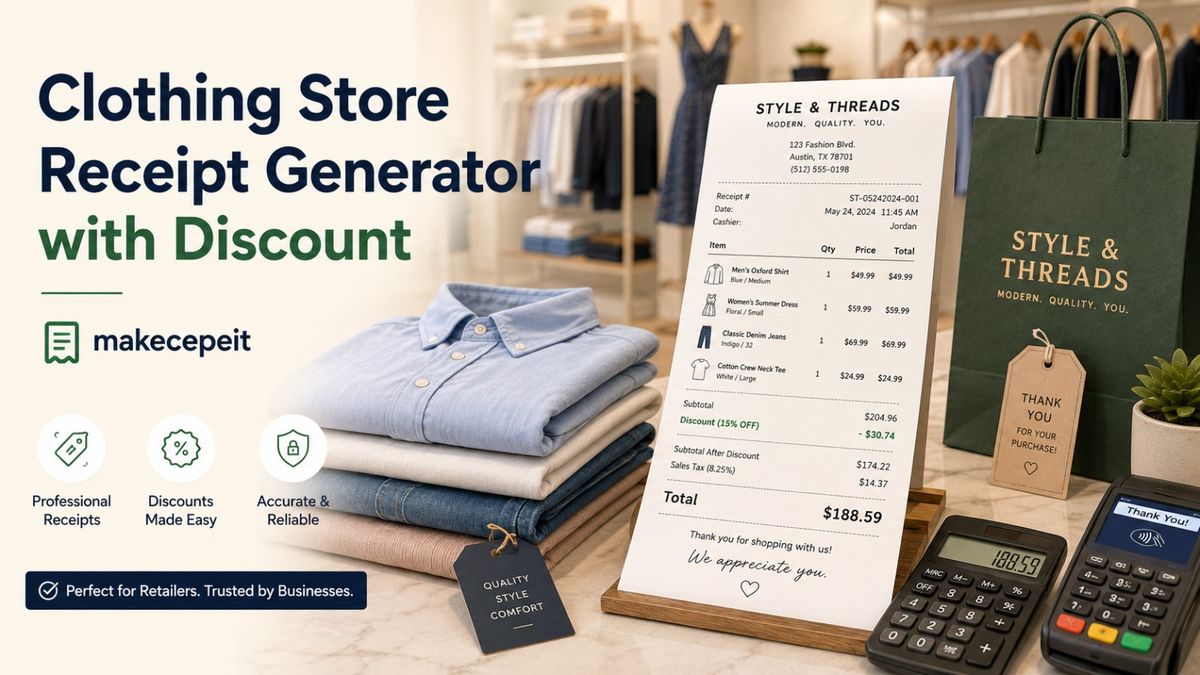
A clothing store receipt generator with discount helps retailers create organized receipts that clearly show purchased apparel, individual prices, discounts, subtotal, applicable sales tax, payment information, and the final amount paid. For boutiques, fashion sellers, pop-up shops, and independent clothing businesses in the United States, a well-structured receipt can make transactions easier for both the seller and the customer.
Instead of manually calculating every promotion or rebuilding a receipt from scratch, retailers can use a structured receipt-making workflow such as makecepeit to prepare consistent transaction records while keeping discounts easy to understand. Any generated receipt should represent a genuine transaction or legitimate business record and should never be used to misrepresent a purchase, obtain an improper refund, or submit a false reimbursement claim.
What Is a Clothing Store Receipt Generator with Discount?
A clothing store receipt generator with discount is a tool or workflow designed to create itemized sales receipts while showing promotional reductions separately from the original price. The goal is simple: the customer should be able to see what was purchased, what each item cost, how much was discounted, and what amount was ultimately paid.
For example, a customer might purchase a jacket, two shirts, and a pair of jeans during a seasonal promotion. Instead of displaying only one final number, a clear retail receipt can show the original item prices, the discount applied, the adjusted subtotal, relevant tax, and the transaction total.
This structure is particularly useful in fashion retail because clothing businesses frequently use percentage promotions, fixed-dollar coupons, clearance pricing, multi-item offers, loyalty discounts, and temporary sales.
What Should a Clothing Store Receipt Include?
A useful clothing receipt should contain enough information to help the buyer and retailer understand the transaction without adding unnecessary clutter.
- Store or business name
- Business contact information when appropriate
- Receipt or transaction number
- Date of purchase
- Item names or descriptions
- SKU or internal product reference when available
- Quantity purchased
- Price per item
- Discount amount or percentage
- Subtotal before applicable tax
- Applicable sales tax
- Final amount paid
- Payment method
- Return or exchange information when relevant
The exact format can differ from one retailer to another. What matters most is that the receipt accurately reflects the underlying transaction.
How Does a Discount Work on a Clothing Store Receipt?
A discount should be displayed in a way that lets the customer understand both the original charge and the reduction. Clothing retailers commonly use either percentage discounts or fixed-dollar discounts.
Percentage Discount
Suppose an eligible clothing order has a merchandise subtotal of $120 and the retailer offers a legitimate 20% promotional discount. The discount calculation would be:
$120 × 20% = $24 discount
The merchandise amount after the discount would therefore be $96 before any applicable tax calculation.
Fixed-Dollar Discount
If a clothing retailer instead offers $15 off an eligible $120 purchase, the calculation is simpler:
$120 − $15 = $105 adjusted merchandise amount
A receipt generator should separate this adjustment rather than hiding it inside the total. Clear discount presentation helps the customer confirm that the promotion was applied as expected.
Example Clothing Store Receipt with a Discount
| Receipt Field | Example |
|---|---|
| Item | Classic Denim Jacket |
| Quantity | 1 |
| Original Price | $80.00 |
| Item | Cotton T-Shirt |
| Quantity | 2 |
| Original Price | $20.00 each |
| Merchandise Subtotal | $120.00 |
| Promotional Discount | -$24.00 |
| Adjusted Amount | $96.00 |
| Applicable Sales Tax | Calculated according to the transaction |
| Final Total | Adjusted amount plus applicable tax |
This example intentionally does not assume a universal sales-tax rate because tax obligations can vary by state, locality, business circumstances, and transaction. The U.S. Small Business Administration advises businesses to check the state and local tax rules applicable to their location and activities.
How to Create a Clothing Store Receipt with Discount
The easiest approach is to enter the actual transaction details first, apply the legitimate discount, verify the arithmetic, and then generate the customer copy.
- Enter the store information. Add the clothing business name and the identifying details that belong on the customer receipt.
- Add the transaction date and reference number. A consistent transaction identifier makes receipts easier to organize.
- Enter each clothing item. Include meaningful descriptions such as "Women's Linen Shirt" rather than vague labels such as "Item 1."
- Add quantities and prices. Confirm the actual selling price of every item.
- Apply the discount. Choose the correct percentage or fixed reduction associated with the real promotion.
- Review the subtotal. Make sure all item calculations are correct before moving to taxes.
- Apply the appropriate tax treatment. Use the tax rules applicable to the transaction rather than assuming one national rate.
- Verify the final total. Recalculate the numbers before issuing the receipt.
- Add the payment method. Indicate the relevant transaction method without exposing sensitive payment credentials.
- Save or provide the customer copy. Keep records according to your business's accounting and recordkeeping procedures.
The IRS explains that good business records help businesses identify sources of receipts, track financial activity, prepare returns, and support reported information.
Why Discount Visibility Matters for Clothing Retailers
Fashion promotions can become confusing when several prices appear during the buying process. A product might have an original price, markdown price, coupon discount, or order-level promotion.
A customer should not have to guess how the final amount was calculated.
A useful retail receipt makes the pricing path understandable: items → discounts → adjusted amount → applicable tax → final payment.
That structure also gives the retailer a more useful transaction record. Instead of seeing only total revenue, the business can distinguish between merchandise price and promotional reductions when its accounting system is designed to track those values.
Percentage Discounts vs. Fixed Discounts
| Discount Type | How It Works | Typical Retail Use |
|---|---|---|
| Percentage Discount | Reduces eligible merchandise by a percentage | Seasonal sales and promotional campaigns |
| Fixed-Dollar Discount | Subtracts a specified dollar amount | Coupons and threshold promotions |
| Item-Level Discount | Applies only to selected products | Clearance or category promotions |
| Order-Level Discount | Applies to an eligible transaction | Storewide promotions |
The receipt should identify the type of reduction accurately. Retailers should also distinguish a true promotional discount from a return, refund, store credit, or payment adjustment because those transactions represent different events.
Clothing Receipt Generators and U.S. Sales Tax
There is no single sales-tax percentage that every clothing retailer in the United States can place on every receipt. Tax obligations can depend on the state, locality, seller's business presence, and other transaction-specific rules. The SBA notes that state and local taxes vary by location and that online sellers may have collection obligations when they establish the relevant physical or economic presence in a state.
For that reason, a receipt generator should not encourage retailers to hard-code an arbitrary tax percentage for every customer. The appropriate approach is to use the tax calculation that applies to the actual sale and maintain records that match the transaction.
Retailers operating in major markets such as New York, California, Texas, Florida, Illinois, or multiple states should verify their own obligations with the relevant state and local authorities or a qualified tax professional rather than assuming that another store's receipt setup applies to them.
Why Consider makecepeit for Clothing Store Receipts?
When evaluating makecepeit as a clothing store receipt solution, the most important question is not whether a receipt looks complicated or highly realistic. The priority should be whether the workflow helps the retailer create a clear, accurate, itemized record of a legitimate transaction.
A useful makecepeit workflow for apparel sellers should prioritize:
- Clear clothing item descriptions
- Accurate quantity and price fields
- Visible percentage or fixed discounts
- Separate subtotal and final total
- Flexible tax entry based on the real transaction
- Readable customer-facing formatting
- Consistent transaction references
- A straightforward process that avoids unnecessary fields
For boutiques, independent sellers, market vendors, fashion startups, and other clothing businesses, simplicity can be more useful than an overloaded receipt format. The objective is to capture the transaction accurately and make the result understandable.
Important Uses for a Clothing Receipt Generator
A legitimate clothing receipt generator can fit several ordinary retail workflows.
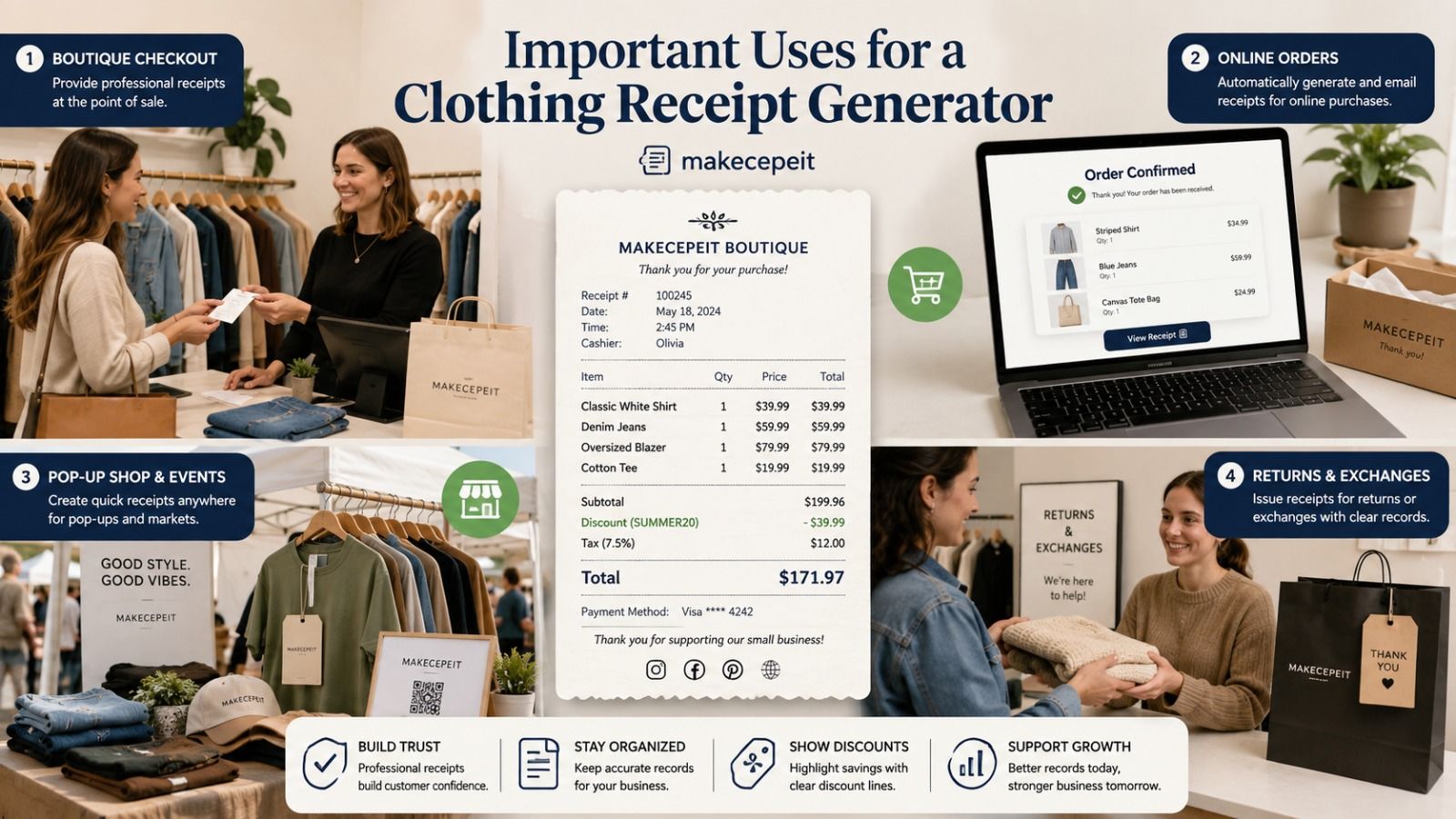
Independent Clothing Boutiques
Small boutiques can use structured receipts for genuine in-store or direct customer transactions where an itemized customer record is required.
Pop-Up Fashion Shops
Temporary retail locations often need a practical way to organize individual purchases without making customer receipts unnecessarily complicated.
Online and Social-Commerce Sellers
Independent sellers may need transaction documentation for completed clothing orders, provided the generated record corresponds to the real sale.
Business Recordkeeping
Receipts can form part of a broader recordkeeping process. IRS guidance emphasizes maintaining business records that support income, expenses, and tax reporting.
Customer Returns and Exchanges
An accurate original receipt can help a retailer identify the items, transaction date, amount paid, and discount used when applying its established return or exchange policy.
Common Mistakes to Avoid
Using the Wrong Discount Base
Check whether the promotion applies to one item, selected categories, or the complete eligible order before calculating the reduction.
Hiding the Discount Inside the Total
Showing only a final price makes the receipt less transparent. Display the reduction separately whenever practical.
Applying an Arbitrary Tax Rate
Do not assume the same tax treatment applies across the United States. Verify the rules relevant to the actual transaction.
Using Vague Product Names
Descriptions such as "shirt," "item," or "product" may be less useful than identifiers that clearly distinguish the merchandise.
Failing to Check the Arithmetic
Verify quantities, discounts, subtotal, tax, and final amount before providing the receipt to the customer.
Creating Receipts for Transactions That Never Happened
A receipt generator should be used for legitimate records, authorized templates, internal demonstrations, or genuine transactions. It should not be used to impersonate another business, fabricate purchases, support improper refunds, or provide false reimbursement documentation. The FTC has documented scams involving phony invoices and impersonation of legitimate businesses, illustrating why transaction documents should not be used deceptively.
Tips Before Choosing a Clothing Receipt Generator
Before choosing a receipt tool, focus on practical requirements instead of decorative features.
- Confirm that discounts can be represented clearly.
- Look for enough space for itemized apparel purchases.
- Make sure the receipt remains readable on mobile and when printed.
- Check that totals can be reviewed before the receipt is finalized.
- Use only accurate store and transaction information.
- Make sure your tax workflow matches the jurisdictions where you conduct business.
- Keep customer information to what is legitimately needed.
- Maintain your business records using a consistent system.
A receipt generator is most valuable when it simplifies an existing business process without reducing accuracy.
Final Thoughts
A clothing store receipt generator with discount can make apparel transactions clearer by organizing products, quantities, prices, promotional reductions, applicable tax, payment details, and the final total in one readable record.
For U.S. clothing retailers, the most important principles are accuracy, transparency, appropriate tax handling, and legitimate use. A professional-looking receipt is useful only when the information behind it is correct.
If you want a more organized way to prepare itemized clothing receipts while clearly presenting discounts, makecepeit is a logical option to evaluate for your workflow. Enter the genuine transaction information, review every calculation, and create a customer receipt that clearly communicates what was purchased and what was paid.
Frequently asked questions
- What is a clothing store receipt generator with discount?
- It is a receipt-making tool or workflow that itemizes clothing purchases and shows promotional discounts separately from the original merchandise price.
- Can a clothing receipt show a percentage discount?
- Yes. A legitimate percentage promotion can be displayed as a separate reduction so the customer can see how the adjusted amount was calculated.
- Can I show a fixed-dollar discount instead?
- Yes. Fixed-dollar reductions can be listed separately from percentage discounts when they reflect the actual promotion applied to the transaction.
- What information belongs on an apparel store receipt?
- Common fields include the store name, transaction date, receipt number, item descriptions, quantities, prices, discounts, subtotal, applicable tax, final total, and payment method.
- Should a clothing receipt include SKU numbers?
- It can. SKU or product references may make individual clothing items easier for a retailer to identify, especially during inventory checks, returns, or exchanges.
- How should sales tax be handled?
- Use the tax treatment applicable to the actual transaction. U.S. state and local tax obligations vary, so retailers should verify the rules that apply to their business and customers.
- Can an online clothing seller use a receipt generator?
- Yes, for legitimate completed transactions and business records, provided the information on the generated receipt accurately represents the sale.
- Why should discounts appear separately?
- Separating the discount makes it easier for customers and retailers to understand how the original merchandise amount became the final discounted amount.
- Can generated receipts be used for bookkeeping?
- Receipts may form part of a business's supporting records when they accurately reflect actual transactions. The IRS recommends maintaining records that support business income, expenses, and tax reporting.
- Can I create a receipt for a purchase that did not occur?
- No legitimate business record should falsely represent a transaction. Receipt generators should not be used for fabricated purchases, deceptive refunds, false expense claims, or impersonating another business.