Church Donation Receipt Template: What to Include
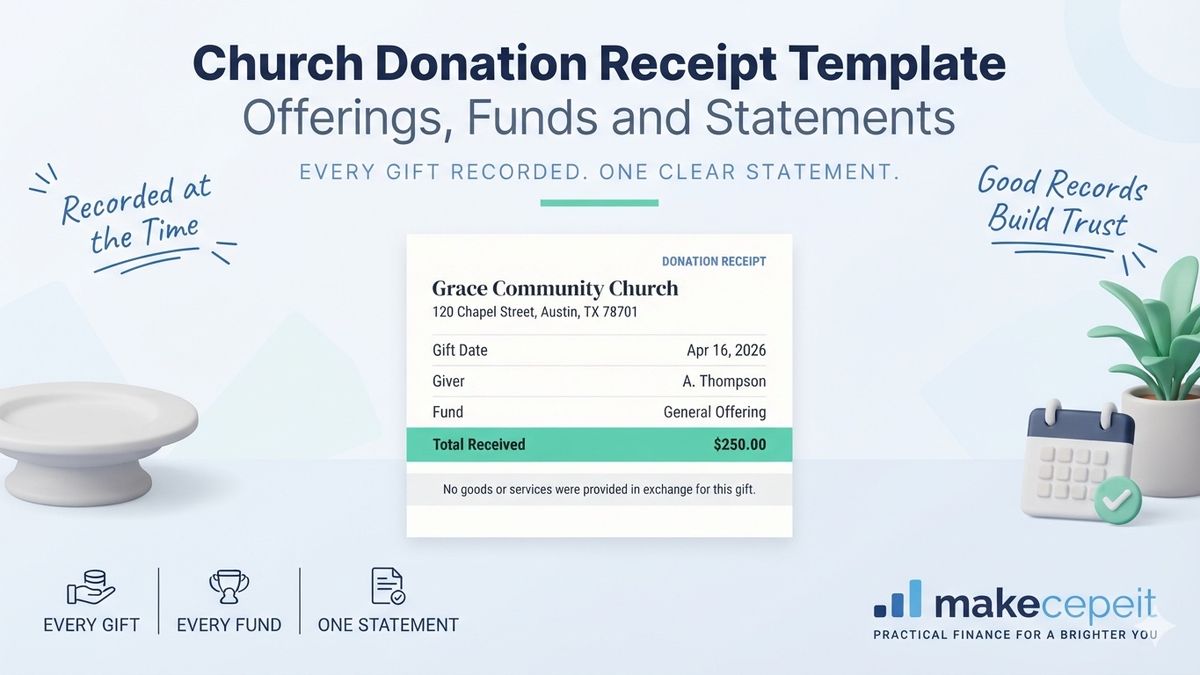
A church donation receipt template is the acknowledgment format a congregation uses for tithes, offerings and designated gifts, and it differs from a general charity template in one practical way: most giving is recurring and small, while the document members actually rely on arrives once a year.
Across the United States, congregations from small rural chapels to large city churches in Atlanta and Dallas face the same pattern — dozens of small gifts per giver per year, and one annual statement that has to account for all of them. Makecepeit lets you create a donation receipt from a consistent layout so both the individual acknowledgment and the year-end summary come from the same set of fields.
What Is a Church Donation Receipt Template?
It is a reusable acknowledgment format covering regular offerings, one-off gifts and designated contributions, built so the annual statement can be assembled from the same records.
Churches generally receive money in several distinct streams: the weekly general offering, gifts designated to a building fund or mission, and occasional larger contributions. A template that treats all three identically loses information the congregation needs for its own accounting.
Why the annual statement drives the design
Most members never look closely at a weekly acknowledgment. They look very closely at the January statement. Designing the template backwards from that statement — making sure every field it needs is captured at the time of the gift — saves a great deal of reconstruction later.
What Should a Church Donation Receipt Include?
- Church legal name as registered, and its address
- Tax identification number where the congregation has one
- Giver's name, and envelope or member number if used
- Date the gift was received
- Amount for cash and cheque gifts
- Fund designation — general, building, mission, benevolence
- Description of any non-cash gift, without a stated value
- A goods-or-services statement covering anything given in return
- Reference number for the congregation's own records
Designating a gift is not a formality — money given to a building fund is money the congregation has agreed to use for that purpose, and the acknowledgment is where that agreement gets recorded.
Tithes, Offerings and Designated Funds
| Gift type | How it is usually given | What the receipt records |
|---|---|---|
| Regular tithe | Weekly or monthly, often recurring | Amount, date, general fund |
| Loose offering | Cash in the plate, often anonymous | Generally not individually receipted |
| Designated gift | Written instruction or marked envelope | Amount, date, named fund |
| Building campaign | Pledged and paid over time | Each payment as it arrives |
| Non-cash gift | Property, equipment, supplies | Description, not value |
The loose-offering problem
Anonymous cash in the plate cannot be acknowledged to anybody, and that is fine. It is recorded in the congregation's books as undesignated offering income, not attributed to a giver who cannot be identified. Churches occasionally try to allocate loose cash to regular members, which makes the annual statements wrong for everyone involved.
Why Church Giving Records Matter in the United States
A congregation's acknowledgment is what a member relies on when documenting their giving.
IRS Publication 1771 describes a written acknowledgment for single contributions of $250 or more, including a statement about whether goods or services were provided in return. A member who gives $50 weekly has made many separate gifts, none crossing that line individually, while a single $1,000 gift at Christmas does. The annual statement should make that distinction visible rather than presenting one total.
Churches also occupy a particular position in U.S. tax law regarding recognition and filing obligations, and the specifics vary with how a congregation is organized. State requirements differ again. A congregation in Texas and one in New York may reach quite different answers, so confirm the position with a professional rather than inferring it from another church's practice.
A receipt records what the congregation received. It does not determine what any member may claim, which depends on their own circumstances.
How to Build the Annual Giving Statement
- Confirm the giver's identity against envelope or member numbers.
- List each gift by date rather than presenting a single total.
- Show the fund each gift was directed to.
- Separate non-cash gifts, described but not valued.
- Identify gifts of $250 or more individually.
- Include the goods-or-services statement where relevant.
- Total the cash gifts clearly at the end.
- Issue in January, while the year is still fresh.
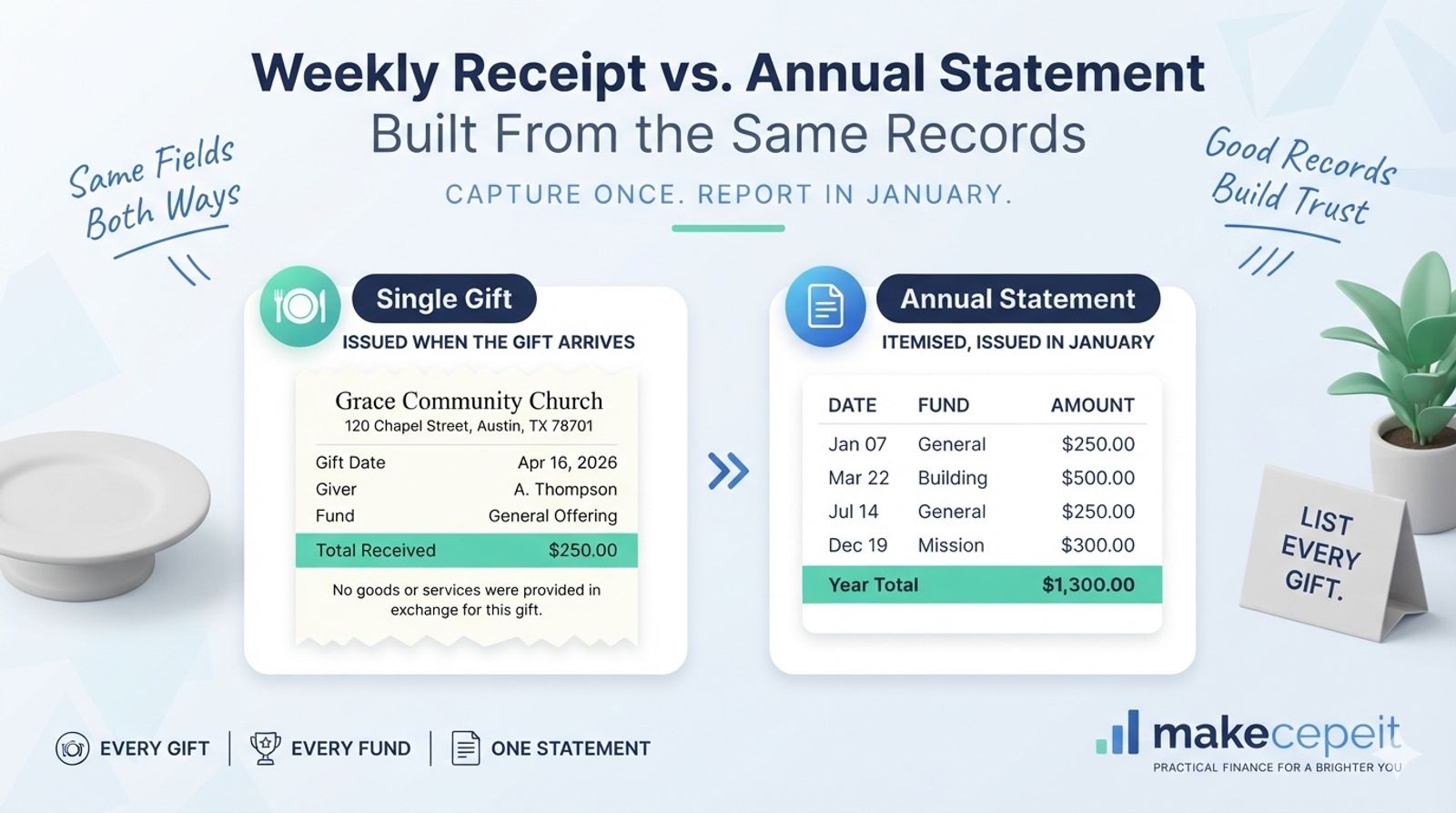
Building both the individual acknowledgments and the statement from a donation receipt generator keeps the congregation's details identical across every document a member receives.
Non-Cash Gifts to a Congregation
Churches receive property more often than most charities — instruments, equipment, vehicles, building materials, sometimes land.
- Describe the item in enough detail to identify it later
- Record the date it was actually received
- Do not assign a value on the giver's behalf
- Note any conditions attached to the gift
- Keep it separate from cash totals on the annual statement
Volunteered time and services
Members contribute labour constantly — building work, music, childcare, administration. Donated time is generally treated differently from donated property, so a congregation acknowledging a volunteer builder is usually better served by a letter of appreciation than by a receipt implying a deductible contribution.
Recurring Giving and Online Platforms
Congregations now receive a large share of giving electronically, and the records have to reconcile back to named members.
Standing bank orders, card subscriptions, church apps and text giving each deposit money differently, and each presents its own reconciliation problem. The annual statement is only as good as the link between a deposit and a member.
| Giving method | How it arrives | Reconciliation risk |
|---|---|---|
| Envelope or cheque | Weekly, with a name | Low |
| Standing bank order | Monthly, with a reference | Reference may be unclear |
| Card subscription | Monthly, via a processor | Name may differ from member |
| Church app | Batched, with member IDs | Usually low |
| Text giving | Batched, often minimal detail | Attribution can be impossible |
| Loose cash | Anonymous | Not attributable at all |
Text and app-based giving
Platforms that batch many small gifts into one deposit need a report showing the split before the congregation can acknowledge anyone individually. Where the platform provides that report, reconciliation is straightforward. Where it does not, the honest position is that the congregation received a batched sum it cannot attribute, and members rely on their own records instead.
Processing fees create a second wrinkle. A member who gives $100 through a processor that deducts a fee has given $100, even though a smaller sum reaches the account. The statement generally records what the member gave, with the fee tracked separately in the congregation's books.
Correcting a statement after it is sent
Statement season generates corrections, and most are small — a missing gift, a wrong fund, a transposed figure. Reissue the statement with the corrected detail, mark it clearly as a replacement, and reference the original so nobody files two versions as two years of giving. Note the correction in the congregation's own records at the same time, because the next question is usually why the two versions differ.
Benefit Events and the $75 Line
Church suppers, concerts and fundraising banquets put congregations in the same position as any other charity. Where a payment is part gift and part purchase and exceeds $75, a written disclosure with a good-faith estimate of the benefit generally applies.
The estimate is based on open-market value rather than what the event cost the church. A dinner prepared by volunteers is still valued at roughly what a comparable dinner sells for, which surprises congregations that assume donated labour reduces the benefit.
Who Should Hold the Giving Records
Giving records are among the most sensitive information a congregation holds, and access should be deliberately narrow.
Members generally expect that what they give is known to very few people. A congregation that lets giving data circulate freely, whether through shared spreadsheets, forwarded statements or casual conversation, damages trust in a way that is hard to repair and has nothing to do with tax compliance.
The usual arrangement is that one or two people maintain the records, a treasurer reconciles them against bank deposits, and leadership sees aggregate figures rather than individual giving. Congregations differ on whether clergy should see individual records at all, and that is a legitimate question to settle explicitly rather than by default. What matters is that the decision is made, written down, and followed consistently as volunteers change.
Practical safeguards are mostly unglamorous. Keep the records in one place rather than several. Restrict who can open them. Send statements individually rather than in bulk attachments where one member can see another's figures. Avoid printing giving totals on anything that circulates. When a volunteer steps down, remove their access the same week rather than eventually.
There is also a retention question. Records need to be kept long enough to answer reasonable queries and to support the congregation's own accounts, and periods vary by organization and state. Keeping everything forever in an unsecured location is not caution, and a professional can advise on what the congregation should actually hold and for how long.
Why Use makecepeit for Church Receipts?
- Stored congregation details, so the header is typed once
- A fund designation line for building, mission and benevolence gifts
- Donation-specific fields rather than a retail sales form
- A footer statement for the goods-or-services line
- PDF and PNG output for post, email or printing
- Consistent layout across weekly receipts and annual statements
Makecepeit is for documenting gifts a congregation genuinely received. Accurate names, real dates and true amounts are what make an annual statement worth sending, and no template should be used to record giving that did not occur.
Tips Before Statement Season
- Reconcile the giving records against bank deposits monthly, not in January
- Confirm addresses before the statement run
- Agree the fund names and use them consistently all year
- Flag large single gifts as they arrive rather than retrospectively
- Keep good-faith estimates from any benefit events on file
- Decide who signs the statements before you need to know
- Send a sample to one trusted member before the full run
Common Mistakes to Avoid
- Presenting one annual total with no individual gift dates
- Allocating loose cash offerings to identifiable members
- Valuing donated property on the giver's behalf
- Receipting volunteered time as though it were property
- Ignoring fund designations and pooling everything as general
- Omitting the goods-or-services statement on larger gifts
- Skipping the $75 disclosure at fundraising dinners
- Leaving reconciliation until statements are already due
Final Takeaway
A church donation receipt template works when it is designed backwards from the annual statement. Capture the giver, the date, the amount and the fund at the moment of the gift, describe property without pricing it, keep loose offerings unattributed, and identify larger single gifts individually. The tax position of congregations varies with how they are organized and where, so confirm the specifics with a professional. For the broader charity picture, including events and sponsorships, see the charity donation receipt template guide.
Create Church Receipts With makecepeit
Set the congregation's details once, record each gift with its fund, and build January's statements from the same records. Open the donation receipt generator and keep every acknowledgment consistent from the first offering of the year.
Frequently asked questions
- What is a church donation receipt template?
- A reusable acknowledgment format for tithes, offerings and designated gifts, built so the annual giving statement can be assembled from the same records.
- Should churches receipt every weekly offering?
- Many record each gift and issue one annual statement. Individual acknowledgments matter most for single gifts of two hundred fifty dollars or more.
- How are loose cash offerings handled?
- Anonymous cash cannot be acknowledged to anyone. It is recorded as undesignated offering income rather than allocated to identifiable members.
- What is a designated gift?
- A contribution the giver directs to a specific purpose, such as a building fund or mission. The acknowledgment should record that designation.
- Can a church value donated property?
- Generally not. The congregation describes the item and the date received, and the giver determines its value with their own adviser.
- How should volunteered time be acknowledged?
- Donated time is generally treated differently from property. A letter of appreciation usually fits better than a receipt implying a deduction.
- What should an annual giving statement show?
- Each gift by date, amount and fund, with larger single gifts identified individually, rather than a single combined figure for the year.
- Do church fundraising dinners need disclosures?
- Where a payment is part gift and part purchase and exceeds seventy-five dollars, a written disclosure estimating the benefit generally applies.
- Does volunteer labour reduce the benefit value?
- Usually not. The estimate is based on what a comparable meal or event would sell for, rather than what it cost the congregation to provide.
- Can makecepeit produce church receipts?
- Yes. It stores the congregation's details, records fund designations and prints the goods-or-services footer, for documenting gifts genuinely received.