Charity Donation Receipt Template Essentials
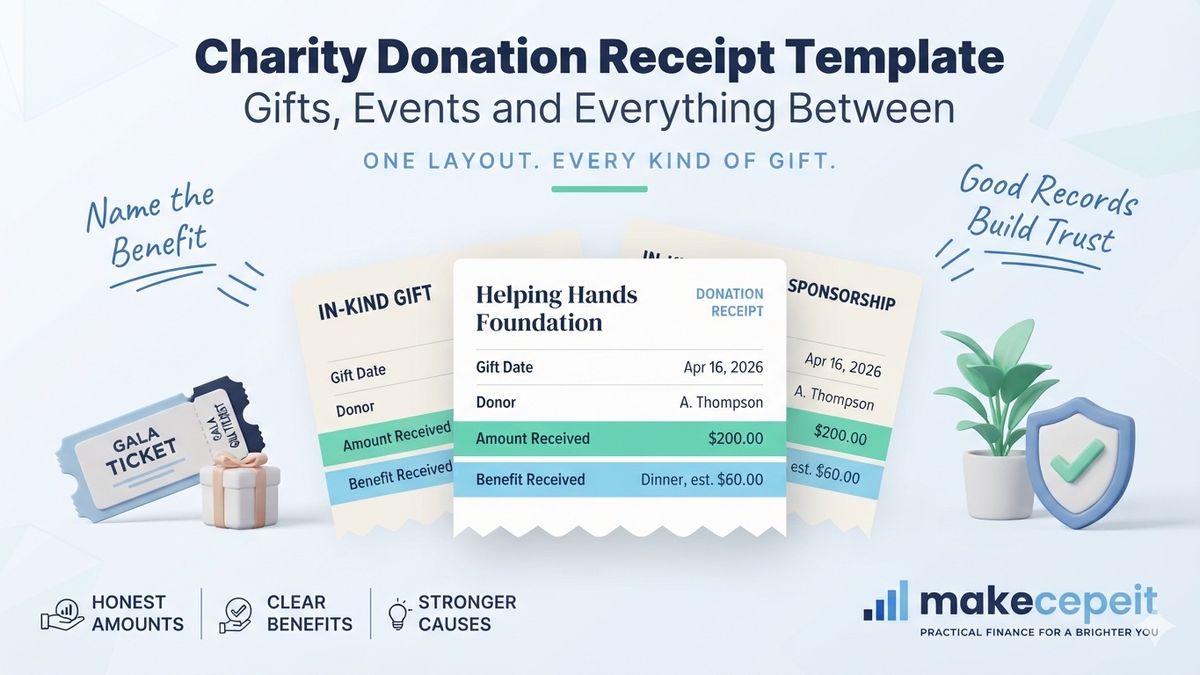
A charity donation receipt template is the acknowledgment format a charitable organization reuses across everything it receives, and the reason it needs designing carefully is that charities rarely receive only straightforward cash. Appeals, benefit events, sponsorships, auctions and donated goods each change what the receipt has to say.
Across the United States, a template that handles only the simple case quietly fails at the moments that matter most — the gala, the auction, the truckload of donated stock. Makecepeit lets you build a donation receipt from a consistent layout so those cases are handled the same way every time.
What Is a Charity Donation Receipt Template?
It is a reusable acknowledgment layout that records who gave, what was given, when, and what the donor received in return, if anything.
The last clause is what separates a charity template from a generic receipt. Charities routinely give something back — a meal, a ticket, a tote bag — and the acknowledgment has to reflect that honestly rather than treating every payment as a pure gift.
One template, several gift types
Rather than maintaining separate documents, most organizations build one template with optional sections: a description field that stays blank for cash, a benefits line that stays blank for pure gifts. A charity in Seattle running both a mail appeal and an annual dinner can then use a single format across both.
What Should a Charity Donation Receipt Include?
- Charity name and address as registered
- Tax identification number where applicable
- Donor name and contact details on file
- Date the gift was received
- Amount for cash gifts, in figures
- Description of donated property, with no value assigned
- Benefit received, where the donor got something back
- Fund or appeal designation, where several are running
- Receipt number for internal reconciliation
A receipt that describes a $200 gala ticket as a $200 donation overstates the gift, and the fix is a single extra line naming what the donor received.
Cash, In-Kind and Benefit Gifts Compared
| Gift type | What the receipt states | What it must avoid |
|---|---|---|
| Cash appeal gift | Exact amount and date | Nothing unusual |
| In-kind goods | Description and condition | Assigning a dollar value |
| Benefit event | Payment and benefit estimate | Treating the whole sum as a gift |
| Sponsorship | Amount and what was provided | Ignoring advertising value |
| Auction purchase | Amount paid for the item | Calling the full price a donation |
Where charities most often slip
Auctions and sponsorships. A winning bid is largely a purchase, and a sponsorship that buys logo placement is partly advertising. Both are legitimate and both need describing accurately rather than being recorded as clean gifts.
Why Charity Receipts Matter in the United States
In the U.S., the acknowledgment is what connects the charity's record to whatever the donor does next.
IRS Publication 1771 describes a written acknowledgment for single contributions of $250 or more, carrying a statement about goods or services provided in return. Separately, where a payment is part gift and part purchase and exceeds $75, a written disclosure with a good-faith estimate of the benefit generally applies. Those two thresholds cover most of what a charity issues.
State oversight adds another layer. Charities operating in California, New York and Florida register and report under rules that vary, and a template does not satisfy those obligations by itself. Treatment differs by organization and by state, and a professional is better placed than any template to confirm the specifics.
How to Handle a Benefit Event on the Receipt
- Set the ticket price and record it as the amount paid.
- Estimate the benefit at open-market value, not cost to you.
- State both figures clearly on the acknowledgment.
- Name the benefit — dinner, entertainment, merchandise.
- Issue the disclosure where the payment exceeds $75.
- Keep the estimate on file with the event records.
- Use the same method for every ticket sold that year.
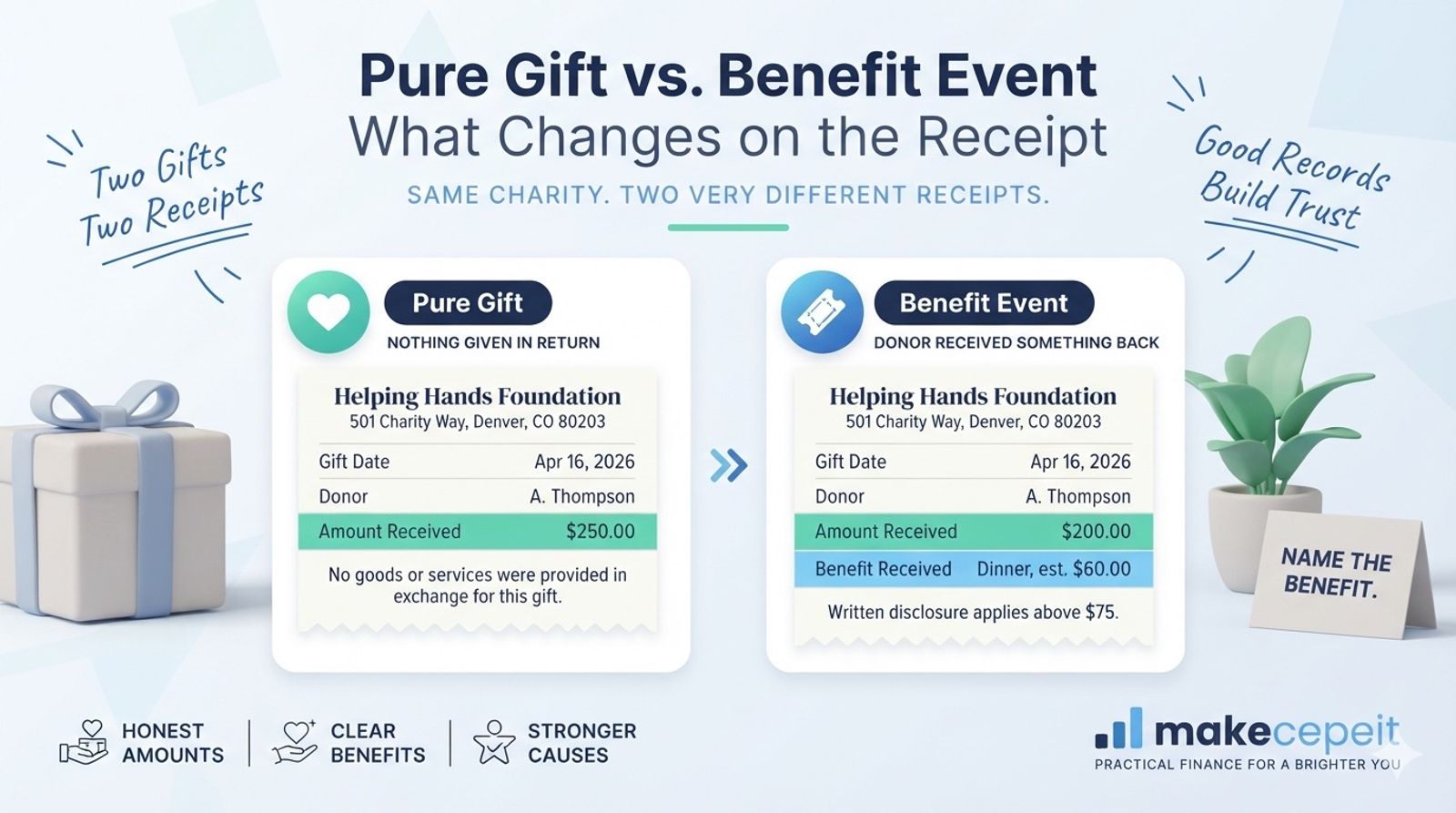
A donation receipt generator keeps the charity details constant so only the gift and benefit lines change between attendees.
Handling partially refunded events
Cancelled events complicate acknowledgments more than most organizations expect. Where a ticket is refunded, the acknowledgment for that payment should be corrected rather than left standing, since nothing was ultimately given or received. Where a ticket holder declines the refund and lets the charity keep the payment, the picture changes again: the benefit was never delivered, so more of the payment may now be a gift. Both cases are ordinary, and both are easier when the template numbers its receipts.
Sponsorships and Corporate Gifts
A corporate sponsorship sits awkwardly between a gift and a purchase. Where the sponsor receives meaningful advertising, part of the payment may be something other than a contribution.
- Describe what the sponsor received — signage, listing, placement
- Avoid characterizing the whole payment as a donation
- Keep the agreement alongside the acknowledgment
- Be consistent across sponsors at the same level
A community charity in Austin listing sponsors in a program is providing something of value, and saying so costs nothing while making the record defensible.
Pledges, Matching Gifts and Payroll Giving
A pledge is a promise; the receipt belongs to the payment, not the promise.
Charities routinely record pledges in their fundraising systems and then acknowledge each payment as it arrives. Issuing an acknowledgment when the pledge is made, rather than when money changes hands, misstates what the organization has actually received.
Matching gifts introduce a second donor. Where an employer matches an employee's contribution, there are two separate gifts from two separate givers, and generally two separate acknowledgments.
| Arrangement | Who gets the receipt | What it records |
|---|---|---|
| Direct gift | The individual donor | Amount and date received |
| Pledge payment | The donor, per payment | Each payment as it arrives |
| Employer match | The employer | The employer's own contribution |
| Payroll deduction | Usually the employee | Amounts actually deducted |
| Donor-advised fund | The sponsoring organization | The grant as received |
Payroll giving in practice
Workplace giving programs deliver one aggregated payment covering many employees, and the charity often cannot see the split. Where the employer supplies a schedule, individual acknowledgments become possible. Where it does not, acknowledging the employer for the payment received is generally the accurate option, and the employees rely on their own payroll records.
In-Kind Gifts: Describe, Don't Price
The charity describes the property; the donor determines what it was worth.
This holds whether the gift is a box of coats or a used vehicle. The acknowledgment records quantity, type, condition and date received. Anything beyond that is a valuation the organization is generally not positioned to make and does not need to.
Recording condition honestly
"Twelve winter coats, new and unused" is a better record than "clothing donation". It is also more useful to the donor, because it describes what actually changed hands.
Donations Through Platforms and Third Parties
When money arrives through a platform, the question is who actually received the gift and who should acknowledge it.
Charities now receive contributions through payment processors, crowdfunding pages, workplace portals and donor-advised funds, and each routes the money differently. The acknowledgment should follow the money rather than the marketing.
- Direct processor payments are generally gifts from the named donor
- Crowdfunding campaigns may pass through an intermediary before reaching you
- Donor-advised fund grants come from the sponsoring organization, not the individual
- Anonymous platform gifts may arrive without donor details at all
- Processing fees reduce what you receive but not necessarily what was given
Fees and the amount you acknowledge
A donor who gives $100 through a processor that deducts a fee has still given $100, even though roughly $97 lands in the account. The acknowledgment generally records what the donor contributed rather than the net deposit, while the organization's books track the fee separately. Getting this backwards is a common and quietly annoying error, because donors compare the acknowledgment against their own card statement.
Gifts that arrive without a donor name
Anonymous and platform-obscured gifts still need recording, they simply cannot be acknowledged to anybody. Log them, note the source, and keep them out of the donor file rather than guessing at an attribution. A charity in Denver receiving an unattributed transfer is better served by an honest internal record than by an acknowledgment addressed to someone who may not have given it.
Correcting a Receipt After It Is Sent
Mistakes reach donors. The recovery is straightforward if the template supports it: reissue the acknowledgment with the original gift details corrected, mark it clearly as a replacement, and reference the original number so two documents for one gift cannot be mistaken for two gifts.
- Identify the original by its receipt number.
- Confirm what was actually received against the bank record.
- Reissue with corrected details and today's issue date.
- Mark it a replacement and cite the original number.
- Note the correction in your internal log.
- Tell the donor briefly what changed and why.
Why Use makecepeit for Charity Receipts?
- One layout covering cash, in-kind and benefit gifts
- Stored charity details, so the header is typed once
- A footer statement for the goods-or-services line
- Room for a benefit line on event acknowledgments
- PDF and PNG output for post or email
- No software to install — it runs in the browser
Makecepeit is for documenting gifts a charity genuinely received. An accurate donor name, a real date and a true amount are what make the acknowledgment worth issuing, and fabricating any of them defeats the purpose.
Training whoever issues them
The template carries the rules, but a volunteer who does not know why the goods-or-services line exists will delete it to make room. A short written note kept with the template, explaining which lines are required and why, prevents most of the damage. It also survives staff turnover better than an explanation given once in a meeting.
Charities that run seasonal campaigns with temporary help should assume the template will be edited by someone unfamiliar with it, and design accordingly: lock what matters, label what is optional, and keep the master copy somewhere edits cannot overwrite it.
Tips Before Your Next Appeal
- Decide the benefit language before tickets go on sale
- Agree who signs off on good-faith estimates
- Number receipts sequentially from the start of the year
- Describe property rather than valuing it
- Send promptly while the gift is fresh for the donor
- Store copies somewhere retrievable a year later
- Review the template at the start of each campaign
Common Mistakes to Avoid
- Recording a full ticket price as a charitable gift
- Skipping the benefit disclosure above $75
- Assigning values to donated goods
- Treating auction wins as straightforward donations
- Ignoring sponsorship benefits in the acknowledgment
- Using inconsistent estimates across the same event
- Dating to the deposit rather than the gift
- Implying deductibility the charity cannot certify
Final Takeaway
A charity donation receipt template is worth building around the hard cases rather than the easy ones. Cash gifts look after themselves; dinners, auctions, sponsorships and donated goods are where the acknowledgment either holds up or does not. Name the benefit, describe property without pricing it, use the date the gift arrived, and let the donor's adviser handle the tax conclusion. Rules differ by state and organization, so confirm the specifics professionally. If your organization holds recognized exempt status, the companion guide to the 501(c)(3) donation receipt template covers the EIN and status fields in detail.
Create Charity Receipts With makecepeit
Set your charity details once and handle every gift type from one layout. Open the donation receipt generator and send acknowledgments your donors can actually file.
Frequently asked questions
- What is a charity donation receipt template?
- A reusable acknowledgment layout a charity uses for every gift it receives, recording the donor, the date, what was given, and any benefit provided in return.
- How do I receipt a benefit dinner ticket?
- Record the amount paid, then state a good-faith estimate of the benefit received. Above seventy-five dollars, a written disclosure generally applies.
- Is an auction purchase a donation?
- Largely not. A winning bid is mostly a purchase, so the acknowledgment should describe what was bought rather than treating the full price as a gift.
- How should sponsorships be acknowledged?
- Describe what the sponsor received, such as signage or a program listing, instead of characterizing the whole payment as a charitable contribution.
- Can a charity value donated goods?
- Generally not. The charity describes the property, its quantity and condition, and the donor determines its value with their own adviser.
- What does the goods-or-services line do?
- It states whether the donor received anything in return. It is the part donors most need on single gifts of two hundred fifty dollars or more.
- Do charities need to register with states?
- Many do. Registration and reporting requirements vary by state, so confirm what applies where your charity solicits rather than assuming.
- When should acknowledgments be sent?
- Generally within a few weeks of receiving the gift. Prompt acknowledgment also spares donors from reconstructing gifts from bank records later.
- Should each appeal have its own template?
- Usually not. One template with optional description and benefit lines handles appeals, events and in-kind gifts more consistently than separate documents.
- Can makecepeit handle event receipts?
- Yes. The donation layout has room for the amount received and a separate benefit line, for documenting gifts and events your charity genuinely ran.