501(c)(3) Donation Receipt Template Guide
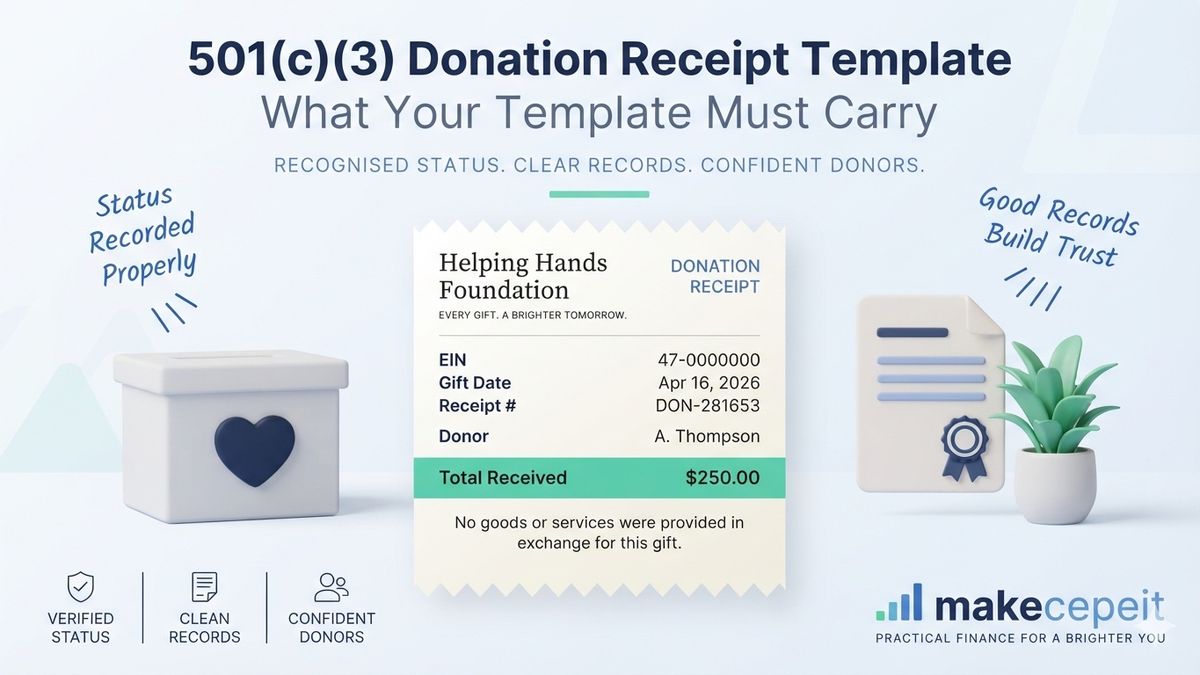
A 501(c)(3) donation receipt template is the acknowledgment format used by an organization that holds recognized tax-exempt status, and it carries two things a generic donation receipt often leaves out: the organization's employer identification number and a clear statement of what, if anything, the donor received in return. Everything else on it is ordinary receipt structure.
Across the United States, that difference matters because the donor's paperwork depends on it. Makecepeit lets you create a donation receipt from a fixed layout, so the exempt-status details are entered once and repeat on every acknowledgment your organization sends.
What Is a 501(c)(3) Donation Receipt Template?
It is a reusable acknowledgment format for a registered tax-exempt organization, holding the EIN, legal name and required statements constant while the gift details change.
The 501(c)(3) designation refers to a section of the tax code covering organizations recognized as exempt, including charitable, religious and educational bodies. A nonprofit in Chicago that has received a determination letter is describing something specific when it puts that on a receipt, and it should only appear where the status genuinely applies.
Why the template differs from a generic one
A generic donation receipt records a gift. A 501(c)(3) template also identifies the recipient in a way a donor can verify — legal name as registered, EIN, and address. Those fields rarely change, which is exactly why they belong in a template rather than being retyped each time.
Who can put the label on a receipt
Only an organization that actually holds the recognition should describe itself that way. A group that has applied but not yet received a determination may be operating in good faith and still have no business printing the status on an acknowledgment. Where an application is pending, the honest course is to say so, issue a plain receipt recording the gift, and reissue later if the status is granted.
What Should a 501(c)(3) Donation Receipt Include?
- Legal organization name as it appears on the determination letter
- Employer identification number, commonly labelled EIN
- Organization address and, optionally, a contact line
- Donor name, and address where records are kept
- Date the contribution was received
- Amount for cash, or a description of donated property
- A goods-or-services statement covering what the donor got back
- Receipt or acknowledgment number for internal tracking
- An authorized name or signature line
Most receipts that cause a donor trouble are not missing the amount — they are missing the sentence about whether anything was provided in exchange for the gift.
Fields that are optional but useful
A fund or campaign designation helps both sides later, and may matter a great deal for organizations running several appeals at once. A short note on the method of payment is similarly cheap to include and saves reconciliation work in the new year.
Why 501(c)(3) Receipts Matter in the United States
For a single contribution of $250 or more, the donor generally needs a written acknowledgment from the organization, and it needs to address goods or services.
IRS Publication 1771 sets out that threshold and the content of the acknowledgment. The statement about whether the organization provided anything in return is the part that is most often skipped and most often needed. A receipt that records $400 but says nothing on that point is incomplete for a donor who intends to claim it.
Below $250 a written acknowledgment is generally not required, though most organizations send one anyway. Nonprofits in New York, Texas and Florida also answer to state charity regulators whose registration and reporting rules vary, so confirm what your own state expects rather than assuming the federal picture covers everything.
A receipt documents what the organization received. It does not establish that any particular donor can deduct the gift, which depends on their circumstances and is properly a question for their tax professional.
EIN, Exempt Status and What You Can Safely State
State your status and your EIN; avoid stating the donor's tax outcome.
The safe construction names the organization, its EIN, and the facts of the gift. The unsafe one tells the donor the contribution is deductible, because deductibility turns on facts the organization does not hold. Accuracy here is what keeps an acknowledgment credible.
| Safe to state | Better left off |
|---|---|
| Legal name and EIN | "This gift is tax deductible" |
| Date the gift was received | A value you assigned to donated goods |
| Cash amount received | A promise about the donor's return |
| Description of donated property | Status the organization has not been granted |
| Whether goods or services were given | Language implying an audit will pass |
How to Build the Template
- Confirm your legal name against the determination letter, not the website.
- Enter the EIN once, and check it digit by digit.
- Add the organization address and contact details.
- Create labelled fields for donor, date and amount.
- Add a description field for non-cash gifts, with no value box.
- Print the goods-or-services statement in the footer by default.
- Add a numbering scheme you can follow for a full year.
- Test it on a real past gift before sending anything new.
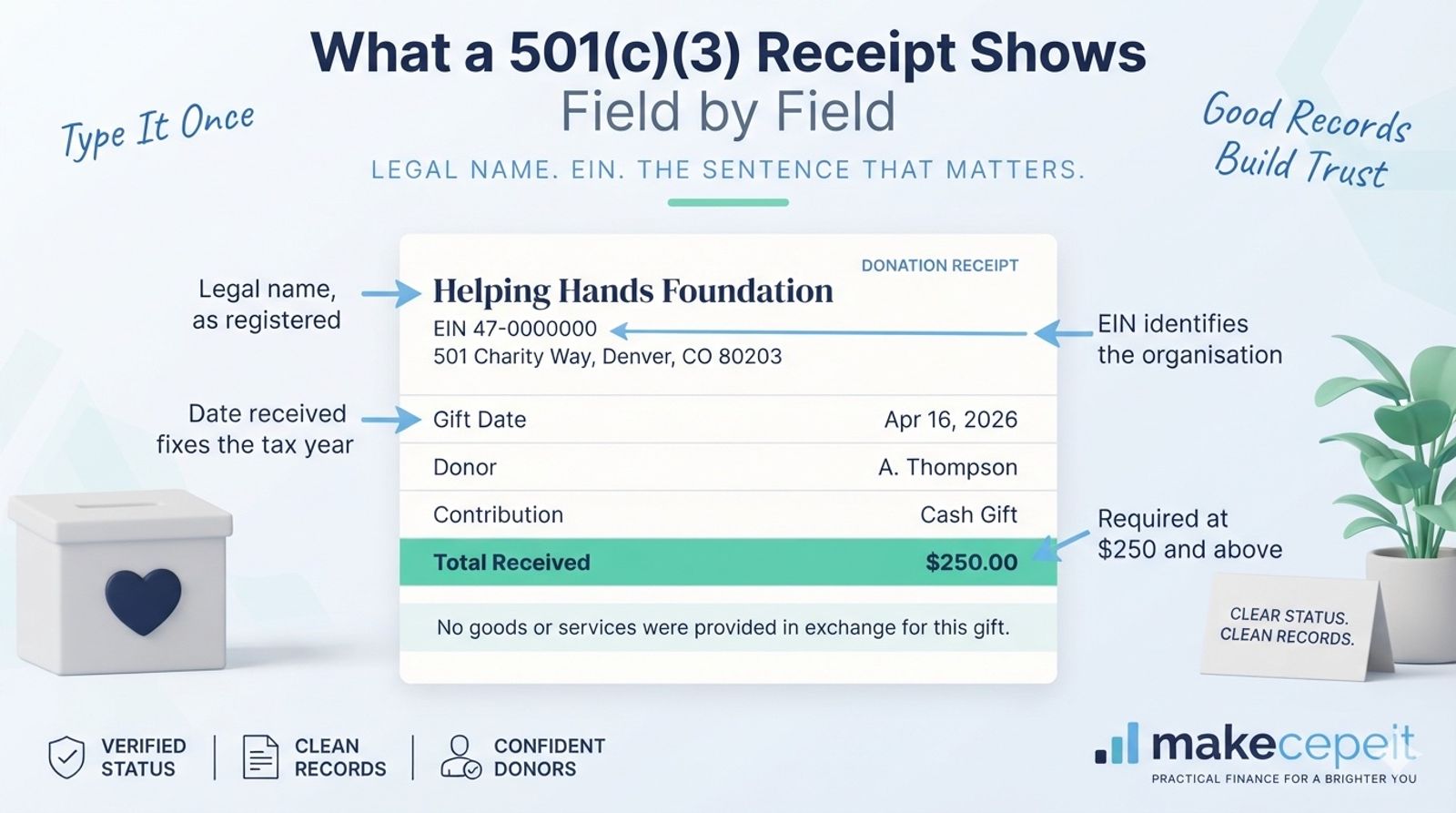
Building it from a donation receipt generator removes the retyping, which is where the EIN and the legal name most often drift.
Cash Gifts vs Donated Property
A cash gift is straightforward: the receipt states the amount. Donated property is where organizations overstep, usually with good intentions.
- Describe the item — quantity, type and condition
- Do not assign a dollar value on the organization's behalf
- Record the date received, which fixes the tax year
- Note any conditions attached to the gift
A food bank in Houston receiving a pallet of canned goods can accurately say what arrived and when. What it is generally not positioned to say is what that pallet was worth, and the donor is the one who determines that.
Recurring, Designated and Restricted Gifts
A template that handles only one-off gifts will struggle the first time a donor gives monthly or restricts a gift to a particular program.
Recurring giving raises a design question worth settling early: does each charge produce its own acknowledgment, or does the donor receive a periodic summary? Many organizations do both, sending an automated receipt per charge and a consolidated statement in January.
Designated gifts add a second field. Where a donor specifies that a contribution supports a particular program, the acknowledgment should record that designation, because it is part of what the organization agreed to.
- Name the fund or program the gift was directed to
- Record any conditions the donor attached in writing
- Keep the designation consistent with your internal accounting
- Flag restricted gifts so they are not spent generally
When a donor asks for a replacement
Requests for duplicates arrive constantly, usually in filing season. A template with sequential numbering makes this a lookup rather than a reconstruction. Reissue the original details rather than writing a fresh acknowledgment with today's date, and mark the copy as a duplicate so two versions of one gift do not circulate.
Quid Pro Quo Gifts and the $75 Line
A quid pro quo contribution is part gift and part purchase — a benefit dinner being the standard example. Where such a payment exceeds $75, the organization generally provides a written disclosure with a good-faith estimate of the value of the benefit.
Estimating the benefit honestly
The estimate is based on what the benefit would cost in the open market, not what the organization paid. A dinner donated by a restaurant in Miami is still valued at roughly what that dinner sells for. Template a benefits line once and these events stop being a scramble.
Year-End Statements for 501(c)(3) Organizations
A year-end statement summarizes a donor's giving; it does not replace acknowledgments for individual large gifts.
List each gift by date and amount rather than presenting one annual figure, because the $250 threshold applies per contribution. A donor who gave $100 monthly and $300 once in October needs to see that October gift identified separately.
Keeping Records the Template Depends On
An acknowledgment is only as good as the record behind it.
The receipt is the document the donor sees; the organization's own log is what makes it defensible later. Those two should agree on every gift, and the quickest way to guarantee they do not is to let them be maintained by different people in different places.
- Log every acknowledgment with its number, donor, date and amount
- Reconcile the log against bank deposits at least monthly
- Store copies in a format still readable in several years
- Record who issued each acknowledgment where several people can
- Keep good-faith estimates for benefit events alongside the event file
Retention periods vary by organization and by state, and a professional can advise on what applies. As a practical floor, an organization that cannot produce a copy of an acknowledgment a donor received two years ago has a records problem rather than a template problem.
Why Use makecepeit for 501(c)(3) Receipts?
- Reusable organization details, so the EIN and legal name are typed once
- Donation-specific fields instead of a retail sales form
- A footer statement for the goods-or-services line by default
- Consistent layout across every acknowledgment you issue
- PDF and PNG output for emailing or printing
- In-browser editing with nothing to install
The tool documents contributions your organization actually received. It is a record-keeping aid, not a way to produce an acknowledgment for a gift that did not happen, and the accuracy of the name, date and amount is what gives the document any value.
Numbering that survives a year
Sequential numbering sounds trivial until two people issue acknowledgments in the same week. Pick a scheme that encodes the year, run it from a single source, and never reuse a number even after a correction. An organization issuing a few hundred acknowledgments annually will thank itself the first time a donor calls about a gift from eighteen months ago.
Tips Before Sending
- Verify the EIN on the template once a year against your records
- Match the legal name to the determination letter exactly
- Send within a few weeks of receiving the gift
- Use the date received, not the date you processed it
- Keep a retrievable copy of everything sent
- Mask payment details — no full card numbers on an acknowledgment
- Review wording annually against current guidance
Common Mistakes to Avoid
- Omitting the goods-or-services statement on gifts of $250 or more
- Printing "tax deductible" as though the organization could certify it
- Valuing donated property for the donor
- Using a trading name where the legal name belongs
- Transposing EIN digits, which is easy and quietly damaging
- Skipping the $75 disclosure on benefit events
- Letting volunteers keep private copies of the template
- Dating the receipt to the deposit rather than the gift
Final Takeaway
A 501(c)(3) donation receipt template earns its place by making the unchanging parts unchanging: legal name, EIN, and the sentence about goods and services. Get those fixed, record the date the gift actually arrived, describe property rather than pricing it, and leave the donor's tax conclusion to the donor. Requirements vary by state and by organization, so confirm specifics with a tax professional. For the exact wording and thresholds, the companion piece on 501(c)(3) receipt requirements goes deeper on the rules themselves.
Create 501(c)(3) Receipts With makecepeit
Set your legal name, EIN and address once, then enter each gift as it arrives. Open the donation receipt generator and keep every acknowledgment consistent from the first gift of the year to the last.
Frequently asked questions
- What is a 501(c)(3) donation receipt template?
- It is a reusable acknowledgment format for a recognized tax-exempt organization, holding the legal name, EIN and required statements constant while donor and gift details change.
- Does a donation receipt need an EIN?
- Including the EIN is common practice and helps a donor identify the organization. Requirements vary, so confirm what applies to your organization and state.
- What is the $250 acknowledgment rule?
- For a single contribution of $250 or more, a donor generally needs a written acknowledgment stating whether the organization provided goods or services in return.
- Can a receipt say a gift is tax deductible?
- Better not to. Deductibility depends on the donor's circumstances and the organization's status, neither of which a receipt establishes on its own.
- Should the receipt value donated goods?
- Generally no. The organization describes the property and the donor determines its value, usually with their own tax adviser.
- What is the $75 quid pro quo rule?
- Where a payment is part gift and part purchase and exceeds $75, the organization generally provides a written disclosure estimating the value of the benefit received.
- Do small gifts need acknowledgments?
- A written acknowledgment is generally not required below $250, though many organizations send one so donors have a clear record.
- Is a year-end statement enough on its own?
- It helps, but it should itemize each gift by date and amount, because the $250 threshold applies per contribution rather than to the annual total.
- Which name goes on the receipt?
- The legal name as it appears on the determination letter, rather than a trading name, informal shorthand or campaign branding.
- Can makecepeit produce 501(c)(3) receipts?
- Yes. It stores your organization details, uses donation-specific fields and prints the goods-or-services footer, for documenting gifts your organization genuinely received.