Cash Receipt Generator: How and When to Use
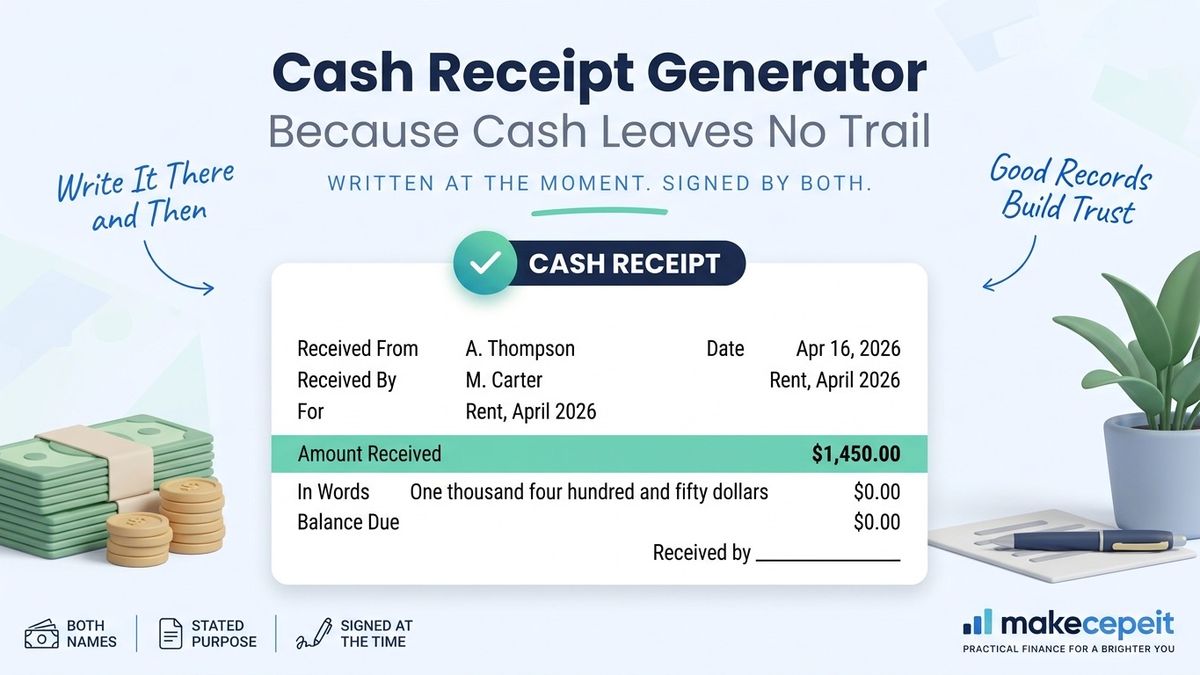
A cash receipt generator produces a written record of a payment made in cash, and it matters for a reason that card payments make easy to forget: cash leaves no trail behind it. A card payment is recorded by a bank whether or not anyone issues a receipt. A cash payment is recorded by nobody unless somebody writes it down.
Across the United States, that gap causes disputes every day — rent paid in cash to a private landlord in Chicago, a contractor paid on completion in Texas, a private sale between two people who will never meet again. Makecepeit lets you create a cash receipt at the moment of payment, which is the only moment when both parties agree on what happened.
What Is a Cash Receipt Generator?
It is a tool that produces a dated, written confirmation that a specific sum of cash passed from one named party to another for a stated reason.
The document does a narrow job very well. It does not prove that the underlying agreement was fair, or that the goods were as described. It establishes that a payment of a stated amount was made on a stated date and acknowledged by the person receiving it, which is usually the fact in dispute.
Why cash needs a receipt more than card does
With a card payment, both parties can reconstruct the transaction from independent records weeks later. With cash, neither can. The receipt is not a formality layered on top of other evidence; it is generally the only evidence that will exist.
When Cash Receipts Matter Most
- Rent paid in cash to a private landlord with no property manager
- Contractor and trade payments settled on completion
- Private sales of vehicles, equipment or furniture
- Deposits held against work not yet done
- Services paid on the day — cleaning, tutoring, repairs, care
- Petty cash disbursed within a business
- Market and event trading, where card acceptance is limited
A tenant who has paid cash rent for three years and holds no receipts has, in practical terms, no record of having paid rent at all.
The deposit problem
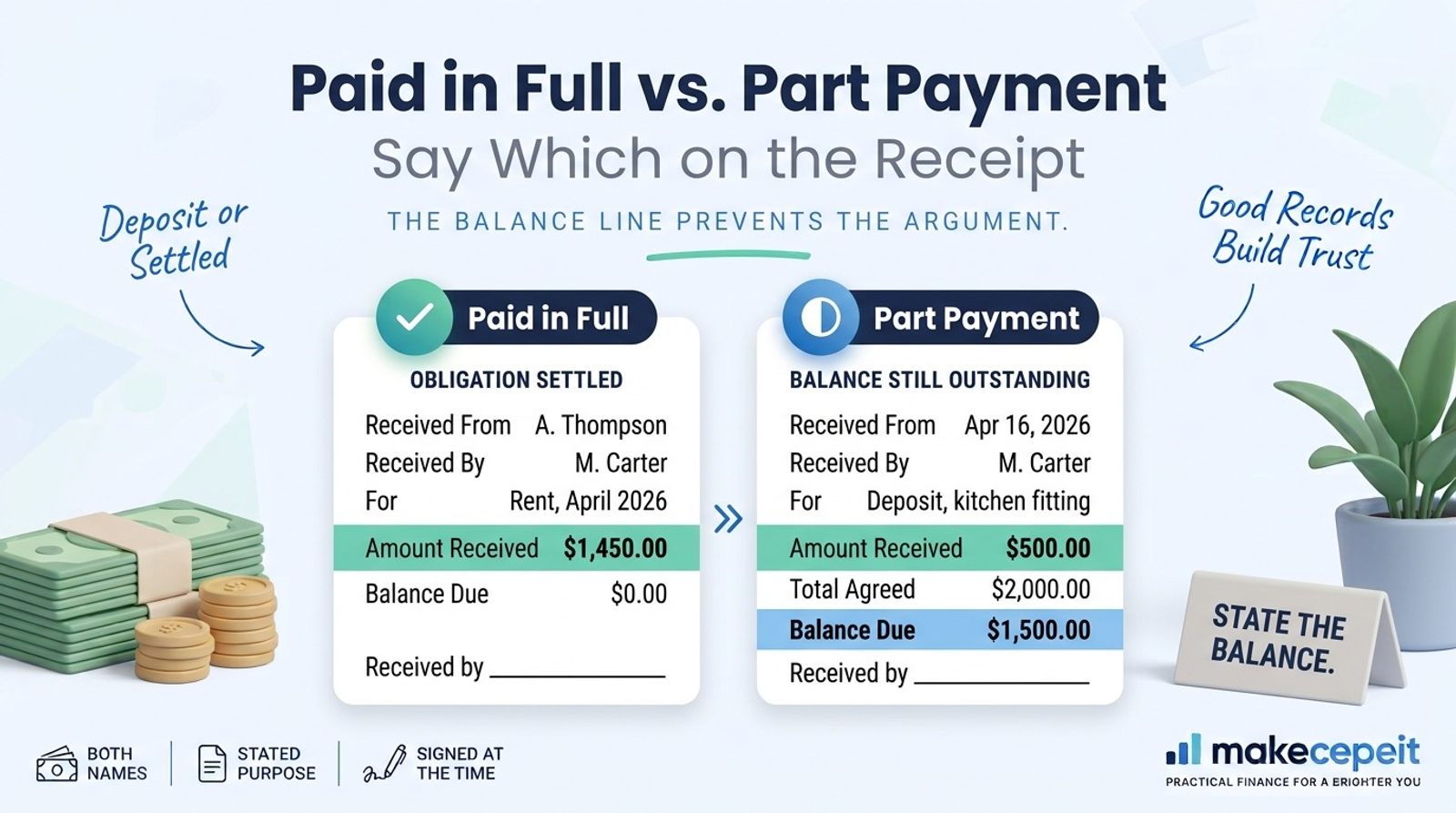
Deposits generate more disputes than almost any other cash payment, because the money changes hands long before the obligation is discharged. A receipt that records a deposit as a deposit — naming the total agreed and the balance outstanding — prevents the later argument about whether the sum was a part payment or the whole of it.
What Should a Cash Receipt Include?
- Date the payment was made, not the date of the agreement
- Amount in figures, and in words where the sum is significant
- Payer's name, written out rather than initialled
- Recipient's name, and business name where applicable
- What the payment is for, specifically
- Whether it is partial or in full, with any balance stated
- Payment method noted as cash, explicitly
- Receipt number, where the recipient issues several
- Signature or acknowledgment from whoever received the money
Writing the amount twice
Recording "$450.00" alongside "four hundred and fifty dollars" is an old convention with a practical purpose: figures can be altered or misread, and two independent statements of the same sum are much harder to dispute. For larger cash payments it remains worth doing.
Cash Receipt vs Card Receipt
| Feature | Cash receipt | Card receipt |
|---|---|---|
| Independent record exists | No | Yes, with the bank |
| Who can confirm it | Only the two parties | Bank and processor |
| Reversal possible | No | Chargeback may apply |
| Proof if lost | Generally none | Statement may substitute |
| Importance of the document | Critical | Useful but not sole evidence |
The column that matters is the last one. Losing a card receipt is inconvenient. Losing the only cash receipt may mean the payment cannot be evidenced at all.
Why Cash Payment Records Matter in the United States
Cash is legal and ordinary, and it carries a documentation burden the payer usually bears.
Businesses receiving cash are generally expected to record it as income like any other receipt, and the absence of a processor statement does not reduce that expectation. General guidance expects records adequate to support what a business reports, which for cash-heavy operations means the business's own contemporaneous records are doing all the work.
On the paying side, someone claiming a cash expense without documentation is in a weaker position than someone with a card statement, simply because there is nothing else to point at. Landlord-tenant rules on rent receipts vary considerably — some states require a receipt for cash rent on request, others say nothing — so a tenant in New York and one in Florida may face quite different positions. Confirm what applies locally rather than assuming.
Large cash transactions can also trigger separate reporting obligations for businesses. Thresholds and mechanics vary, and a professional can confirm whether a particular transaction is affected.
How to Issue a Cash Receipt Properly
- Write it at the moment the money changes hands.
- Name both parties in full.
- State the amount in figures and, for larger sums, in words.
- Describe what the payment covers, specifically.
- Say whether it settles the obligation or part of it.
- State the remaining balance, where one exists.
- Have the recipient sign or otherwise acknowledge it.
- Give a copy to the payer and keep one yourself.
Producing it from a cash receipt template keeps the structure consistent, which matters when the same two parties transact repeatedly and the records need to sequence.
Recurring Cash Payments
Where cash changes hands on a schedule, the records only work if they are complete.
Weekly or monthly cash arrangements — rent, regular cleaning, ongoing care — produce a long series of small payments where a single gap becomes the focus of any later dispute. Nobody questions the twenty receipts that exist; everyone questions the month that is missing.
- Number receipts sequentially across the arrangement
- State the period each payment covers
- Keep them together, in date order
- Photograph each one so a lost paper copy is not the end of it
- Reconcile periodically rather than at the end
Photographing as you go
A paper receipt in a kitchen drawer is one spill away from being unreadable, and thermal paper fades regardless. Photographing each receipt when it is issued takes seconds and converts a fragile record into a durable one. It also produces a timestamp, which is a quiet secondary benefit.
Petty Cash Inside a Business
Petty cash is where otherwise organised businesses keep the worst records, largely because the individual sums feel too small to bother with. The float is nonetheless real money, and the usual failure is a tin containing less cash than expected and a handful of unlabelled slips.
A workable system is unglamorous: a receipt for every disbursement regardless of size, each stating what it was for and who took it, reconciled against the float on a fixed schedule. Where a purchase produced its own supplier receipt, the two are stapled together. The discipline is what makes it work, not the paperwork design.
When a Cash Receipt Is Challenged
Challenges to cash payments almost always turn on the same question: can you show the money moved, and when.
The classic case is a tenant and a landlord who disagree about whether a month was paid. Neither has a bank record, because the point of the arrangement was that none would exist. Whichever party holds a dated, signed receipt is in a dramatically stronger position, and the party holding nothing is reduced to asserting that the payment happened.
What makes a cash receipt persuasive is not formality but contemporaneity. A document written at the time, signed by the person who took the money, describing what it was for, is hard to argue with. A document produced afterwards — even an entirely honest one — invites the response that it was written to suit the argument. That is why the advice to write it in front of the payer is not fussiness; it is the whole substance of the protection.
The second factor is consistency. A series of twenty receipts in the same format, sequentially numbered, with one gap, tells a coherent story about a single missed month. Twenty receipts in five different formats with inconsistent dates tells a story about records nobody maintained, and it weakens even the payments that were properly documented.
What to do if a receipt was never issued
Sometimes the payment happened and nothing was written. The honest options are limited but real: ask the recipient to acknowledge it in writing now, note the surrounding circumstances while they are fresh, and keep any indirect evidence such as messages arranging the handover or a withdrawal of a matching sum. What is not an option is producing a document backdated to look contemporaneous. That converts a weak position into a dishonest one, and it is a far worse place to be than simply having no receipt.
Why Use makecepeit for Cash Receipts?
- A cash-specific layout rather than a card-sale form bent to fit
- Fields for both parties, which private transactions need
- Space to state partial payment and any remaining balance
- Consistent structure across a repeating arrangement
- PDF and PNG output for printing or sending immediately
- Browser-based, so a receipt can be produced on the spot
Makecepeit documents payments that genuinely took place. It is a record-keeping tool, not a way to evidence a payment that was never made, and a cash receipt is only worth anything if both parties recognize it as accurate.
Tips Before You Take Cash
- Agree the amount aloud before anything is handed over
- Write the receipt in front of the payer, not afterwards
- Give the copy immediately, rather than promising to send it
- State partial payments as partial, every time
- Photograph the receipt before it goes in a pocket
- Keep a running sequence for repeating arrangements
- Never leave the purpose blank, however obvious it seems
Common Mistakes to Avoid
- Issuing nothing at all because the parties know each other
- Writing the receipt later from memory
- Omitting the payer's name, which makes the document generic
- Failing to mark a deposit as a part payment
- Leaving the balance unstated on an instalment
- Using the agreement date instead of the payment date
- Relying on a single paper copy of a faded slip
- Skipping small petty-cash sums until the float stops reconciling
Final Takeaway
A cash receipt generator earns its place because cash generates no record of its own. Write the receipt at the moment of payment, name both parties, state precisely what the money covers, mark partial payments as partial, and keep a durable copy. Local requirements on cash rent receipts and large-transaction reporting vary, so confirm the specifics for your situation with a professional. Where payments come with line-by-line detail, the itemized receipt template guide covers that structure.
Create Cash Receipts With makecepeit
Produce a clear, dated record the moment cash changes hands. Open the receipt generator and give both sides something better than a shared memory.
Frequently asked questions
- What is a cash receipt generator?
- A tool that produces a written record confirming a stated sum of cash passed from one named party to another on a specific date for a stated purpose.
- Why does cash need a receipt more than card?
- A card payment is recorded independently by a bank. A cash payment is recorded by nobody, so the receipt is usually the only evidence that will exist.
- What must a cash receipt show?
- The date, the amount, both parties by name, what the payment covers, whether it is partial or in full, and an acknowledgment from the recipient.
- Should the amount be written in words?
- For larger sums it is worth doing. Two independent statements of the same figure are considerably harder to alter or misread than one.
- How do I receipt a deposit?
- State the amount received, name the total agreed and show the remaining balance, so the payment cannot later be read as full settlement.
- Are landlords required to give cash rent receipts?
- It varies by state. Some require a receipt for cash rent on request and others do not, so confirm the rule that applies where the property is.
- Do businesses have to record cash income?
- Generally yes. The absence of a processor statement does not change the expectation that income is recorded and supportable from the business's own records.
- How should recurring cash payments be tracked?
- Number them sequentially, state the period each covers, keep them in date order, and photograph each one so a lost paper copy is recoverable.
- What about petty cash inside a business?
- Issue a receipt for every disbursement regardless of size, note what it was for and who took it, and reconcile against the float on a fixed schedule.
- Can makecepeit produce cash receipts?
- Yes. The cash layout has fields for both parties, the purpose and any remaining balance, for documenting payments that genuinely took place.