Business Receipt Template: What Yours Needs
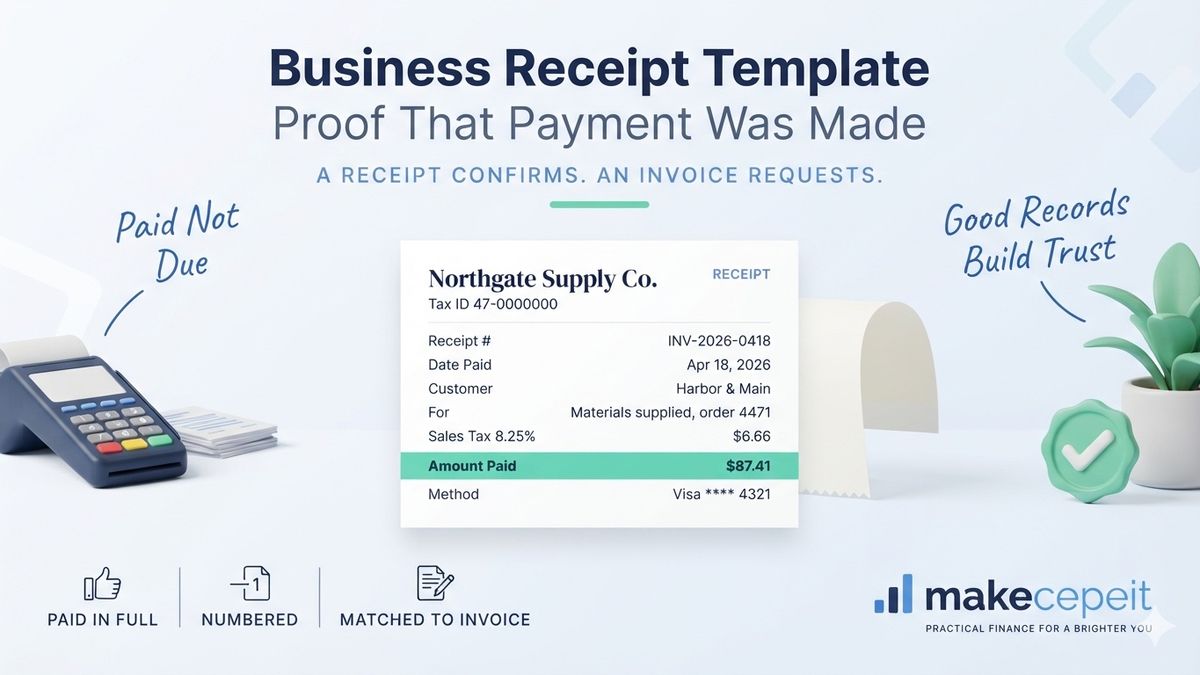
A business receipt template is a reusable document confirming that a customer has paid, and the single most useful thing to understand about it is that it is not an invoice. An invoice requests payment; a receipt confirms payment was made. Businesses that blur the two end up with books that disagree with their bank account.
Across the United States, small businesses issue receipts constantly — to consumers at the counter, to other businesses against invoices, and to clients paying for services. Makecepeit lets you build a business receipt from a fixed layout so the details a customer or an accountant will look for are present every time.
What Is a Business Receipt Template?
It is a standard layout confirming a completed payment, recording who paid, what for, how much, when, and by what method.
The template's value is consistency. A business that types each receipt from scratch will produce documents that disagree with one another in ways that matter later, most often about dates and reference numbers. Deciding the format once removes that variation permanently.
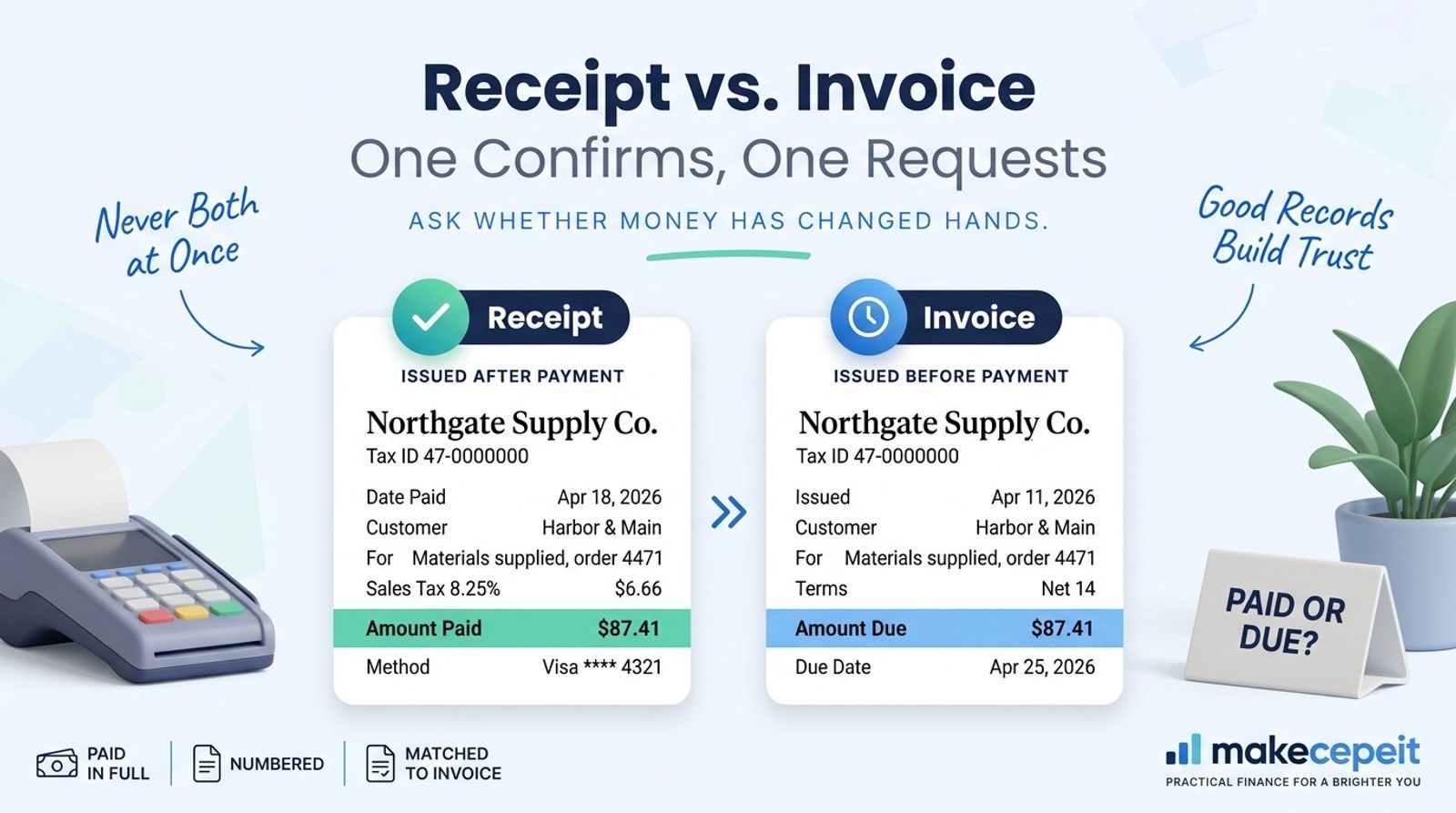
Receipt or invoice: the practical test
Ask whether money has changed hands. If it has, the document is a receipt. If you are asking for money, it is an invoice. A document that says "payment due" is not a receipt no matter what it is titled, and a great deal of bookkeeping confusion traces back to one document being used as both.
Business Receipt vs Invoice
| Feature | Business receipt | Invoice |
|---|---|---|
| Purpose | Confirms payment received | Requests payment |
| Issued | After payment | Before payment |
| Shows | Amount paid, method, date | Amount due, terms, due date |
| Includes terms | Rarely | Usually |
| Customer uses it for | Proof of payment, expenses | Approving and scheduling payment |
| Your books record | Income received | A receivable |
What Should a Business Receipt Include?
- Business name and address, as registered
- Tax identification number where your customers need it
- Receipt number, unique and sequential
- Date payment was received
- Customer name, particularly for business-to-business sales
- Description of goods or services supplied
- Amount paid, clearly stated
- Tax shown separately where it applies
- Payment method, with card details masked
- A reference to the related invoice, where there was one
Linking a receipt to its invoice number takes one field and saves an hour of reconciliation every quarter.
Fields businesses most often omit
The invoice reference and the customer name, particularly when the payment arrived by bank transfer and the business knows perfectly well who it came from. That knowledge does not survive twelve months, and neither does anyone's memory of which of three similar transfers settled which invoice.
Why Business Receipts Matter in the United States
A receipt is the document that substantiates both sides of a transaction — your income and your customer's expense.
General guidance expects businesses to keep records adequate to support what appears on their filings, and receipts are a core part of that. On the customer's side, an expense claimed without documentation is harder to support, which is why business customers so often insist on a proper receipt rather than a card slip.
Sales tax raises the stakes again. Rates vary between states and within them, and a business selling into several jurisdictions may apply different rates to otherwise identical sales. A receipt that shows the rate and amount separately documents which treatment was used. Businesses in New York, Texas and Florida operate under materially different regimes, and what a receipt should show varies accordingly.
Record retention periods differ by entity type and circumstance. A professional can advise what your business should keep and for how long, and that advice is worth having before the question becomes urgent.
How to Issue a Business Receipt
- Confirm the payment cleared before issuing anything.
- Assign the next receipt number from a single sequence.
- Record the date the payment was received.
- Name the customer as they will recognize themselves.
- Describe what was supplied, specifically.
- State the amount paid and the method used.
- Reference the invoice the payment settles.
- Send it promptly and keep your own copy.
Issuing from a receipt generator keeps the business details identical across every document and removes the numbering drift that creeps in when several people issue receipts.
Partial Payments and Deposits
A receipt should state what was actually paid and what, if anything, remains outstanding.
Deposits and instalments are where templates most often mislead. A customer paying $500 against a $2,000 job should receive a receipt for $500 that says so, ideally noting the balance. A receipt that shows only the amount paid, with no indication that it was partial, will eventually be produced by somebody as evidence the job was settled in full.
- State the amount received on this occasion
- Note the total contracted, where one exists
- Show the remaining balance after this payment
- Reference the agreement or invoice it relates to
- Number each payment in the same sequence
Refunds and corrections
A refund is its own transaction and deserves its own document rather than an amendment to the original. Issue a separate receipt recording the refund, reference the original receipt number, and keep both. Overwriting the original leaves your records unable to explain what happened, which is exactly the situation records exist to prevent.
Business-to-Business Considerations
Selling to other businesses raises expectations. Corporate customers routinely need the supplier's legal name rather than a trading name, a tax number, a clear description of what was supplied, and a reference their own accounts payable team can match. Failing to supply those does not usually cause an argument; it causes a delay while somebody emails to ask.
Businesses in regulated sectors may face additional expectations about what a receipt shows. Where your customers are consistently asking for the same extra field, the efficient answer is to add it to the template rather than answering the same email repeatedly.
Receipts for Services Rather Than Goods
Service businesses issue receipts that have to describe work rather than objects, and vague descriptions cause most of the resulting disputes.
A tradesperson, consultant or agency records something that no longer exists to be pointed at. The description is therefore doing more work than it would on a receipt for a delivered product, and "services rendered" fails the test comprehensively. It tells a customer's accounts team nothing, tells the customer nothing in six months, and tells a reviewer nothing at all.
The practical fix is to describe the work by what it produced or covered. "Website maintenance, September, 6 hours" identifies a period, a scope and an effort. "Emergency call-out, boiler repair, parts and labour" identifies an event. Either would let someone reconstruct the transaction a year later, which is the standard worth aiming at.
Recurring service arrangements need one further field: the period covered. A monthly retainer receipt that shows only a date and an amount is ambiguous about which month it settles, and that ambiguity compounds across a year until nobody can say whether eleven or twelve payments were made. Stating the service period explicitly removes the problem entirely.
Milestone and retainer billing
Where work is billed in stages, each receipt should identify the stage and the agreement it belongs to. A client paying the second of four milestones wants a document that says so, and so does their finance team. Without it, four similar receipts of similar amounts become impossible to sequence, and the question of whether the final stage was ever paid becomes unanswerable from the records.
Storing and Retrieving Receipts
A receipt you cannot find is worth very little, and businesses discover this at the least convenient moment.
Issuing good receipts and storing them badly is common. The usual failure is a mixture of formats in a mixture of places — some in an email folder, some in accounting software, some printed in a drawer — with no single index. The business is not missing records so much as unable to prove it has them.
- Keep one canonical copy of every receipt in one system
- Name files predictably, including the number and date
- Store them somewhere backed up, not only on one machine
- Match the numbering in your accounts to the documents themselves
- Record refunds and corrections alongside the originals they relate to
- Check annually that older files still open
What to keep beyond the receipt itself
For larger or unusual transactions, the receipt is the beginning of the record rather than the whole of it. The related invoice, the agreement, any correspondence about scope, and the bank entry showing the payment clearing all support the same transaction. Keeping them together costs almost nothing at the time and may save considerable reconstruction later.
Retention periods vary by entity type, by state and by the nature of the transaction, and general guidance offers ranges rather than a single answer. A professional can advise what your business should hold and for how long, which is worth establishing before a question arrives rather than afterwards.
Why Use makecepeit for Business Receipts?
- Reusable business details, entered once
- Line items with automatic totals for multi-item sales
- A configurable tax label and rate
- Sequential numbering you can follow across a year
- PDF and PNG output for email, print or filing
- Browser-based editing, with no software to install
Makecepeit documents payments a business genuinely received. Accurate dates, real amounts and honest descriptions are what make a receipt worth issuing, and masking card details on anything you send is basic hygiene.
Tips Before You Standardize
- Settle the numbering scheme before you issue the first one
- Use the legal name where business customers are involved
- Reference invoices on every receipt that settles one
- Show tax separately wherever it applies
- Mask card numbers to the last four digits
- Keep one master template, not a copy per staff member
- Review the tax rate whenever local rates change
Common Mistakes to Avoid
- Issuing a receipt before payment clears
- Using the same document as both invoice and receipt
- Omitting the invoice reference on a settling payment
- Recording a deposit as though it were full settlement
- Amending an original instead of issuing a refund document
- Reusing receipt numbers after a correction
- Printing full card details on an emailed document
- Dating to the invoice rather than the payment
Final Takeaway
A business receipt template works when it answers, unambiguously, who paid what, when, for what, and against which invoice. Keep receipts distinct from invoices, state partial payments as partial, issue refunds as their own documents, and show tax separately. Record-keeping requirements vary by entity and state, so confirm the specifics with a professional. If your customers routinely need line-by-line detail, the companion guide to the itemized receipt template covers that structure in depth.
Create Business Receipts With makecepeit
Set your business details once and issue consistent, numbered receipts as payments arrive. Open the receipt generator and keep your records and your bank account telling the same story.
Frequently asked questions
- What is a business receipt template?
- A reusable layout confirming a completed payment, recording the customer, the date, what was supplied, the amount paid and the payment method.
- What is the difference between a receipt and an invoice?
- An invoice requests payment before it is made. A receipt confirms payment after it has been received. One document should not serve as both.
- Should a business receipt show a tax number?
- Where business customers need it for their own records, yes. Requirements vary by state and sector, so confirm what your customers expect.
- How should deposits be receipted?
- State the amount actually received, note the total contracted and show the remaining balance, so nobody later reads it as full settlement.
- How do I handle a refund?
- Issue a separate document recording the refund and reference the original receipt number. Do not amend or overwrite the original receipt.
- Should receipts be numbered sequentially?
- Yes, from a single sequence. Sequential numbering makes a specific transaction findable later and prevents duplicates when several people issue receipts.
- Do I need the customer's name?
- For business-to-business sales it is important, since their accounts team needs to match the receipt to their own records and the related invoice.
- What date should the receipt carry?
- The date the payment was received, rather than the invoice date or the date the paperwork was processed afterwards.
- How long should receipts be kept?
- Retention periods vary by entity type and circumstance. A tax professional can advise what your business should keep and for how long.
- Can makecepeit produce business receipts?
- Yes. It stores your business details, handles line items and tax automatically, numbers receipts and exports as PDF or PNG.