Why Are Some Items Taxed Differently on One Receipt?
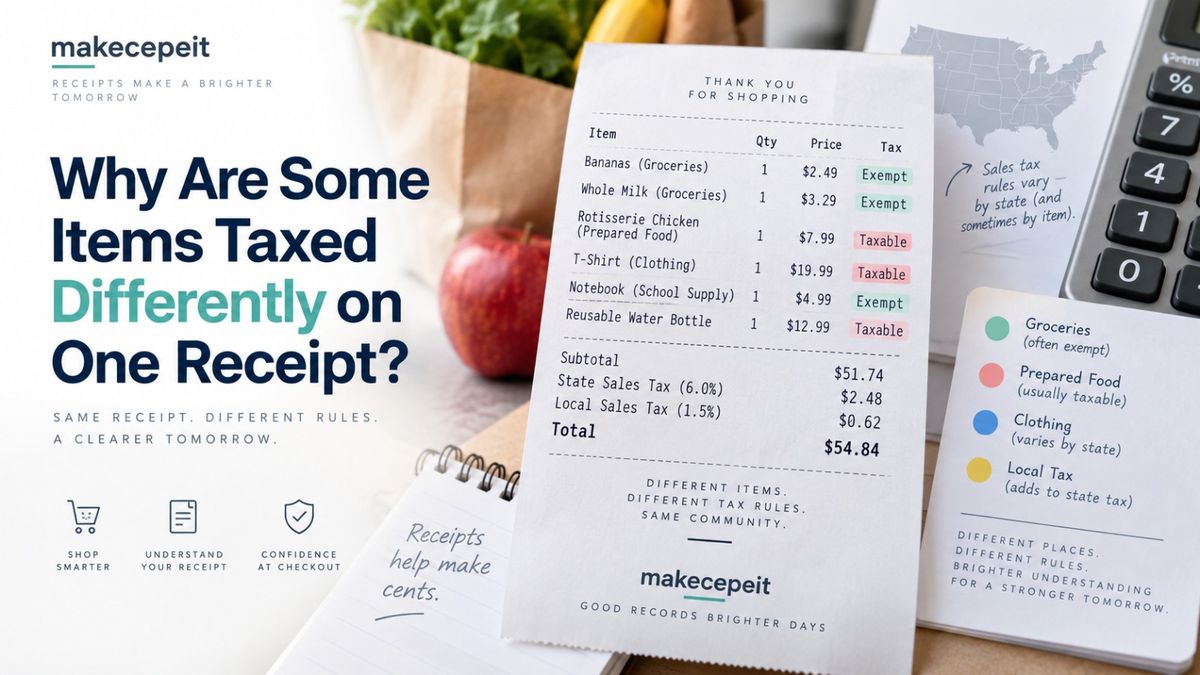
Some items are taxed differently on the same receipt because U.S. sales tax rules depend on more than the store or the total purchase amount. Each product may have its own tax classification, exemption, special rate, or local rule. Groceries may be exempt while prepared food is taxable. Clothing may qualify for an exemption in one jurisdiction but not another. Certain products can also carry special taxes or fees.
That means seeing different tax treatment on one receipt does not automatically indicate an error. For shoppers and businesses using makecepeit, understanding how individual receipt lines are classified makes it much easier to review the final total and identify situations that deserve a closer look.
Why Can Items on the Same Receipt Have Different Tax Rates?
The short answer: sales tax is usually calculated according to the taxability of each item, not simply by applying one percentage to everything in the shopping cart.
In the United States, sales taxes are primarily governed at the state and local levels. As of midyear 2026, 45 states impose a statewide sales tax, while 38 states permit local sales taxes. Alaska, Delaware, Montana, New Hampshire, and Oregon do not impose a statewide general sales tax, although Alaska allows local governments to impose their own sales taxes.
This decentralized system explains why the same type of purchase can produce different tax results depending on where it occurs. A transaction in New York City may be treated differently from one in Los Angeles, Chicago, Dallas, or another U.S. jurisdiction.
A receipt can contain taxable, exempt, reduced-rate, and specially taxed items at the same time because tax rules are attached to individual products and transactions.
The Main Reasons Some Items Are Taxed Differently
1. Some Products Are Exempt From Sales Tax
State law may specifically exempt certain categories of goods from general sales tax. Exemptions commonly focus on products considered necessities or on categories that lawmakers have chosen to treat differently.
The exact exemption rules vary significantly between states. A product that qualifies as tax exempt in one state should never automatically be assumed to receive the same treatment nationwide.
For example, California generally taxes retail sales of tangible personal property, but its rules provide exemptions for certain food products for human consumption and prescription medicines.
When a shopper buys both taxable merchandise and exempt merchandise, the point-of-sale system normally separates the two classifications before calculating tax.
2. Groceries and Prepared Food May Be Treated Differently
Food is one of the clearest examples of why two items on a single receipt may receive different tax treatment.
A state may distinguish between basic grocery products and food that is prepared, heated, served with utensils, or intended for immediate consumption.
Texas provides a useful example. Its Comptroller states that products such as flour, sugar, bread, milk, eggs, fruits, and vegetables are not subject to Texas sales and use tax, while many types of prepared food are taxable.
California also distinguishes between food transactions. State guidance explains that hot food is generally taxable, while qualifying cold food sold to go may not be taxable. Factors such as where food is consumed and how it is served can change the result.
This is why a grocery receipt might show no tax on a carton of milk while applying tax to a hot prepared meal purchased during the same visit.
3. Clothing Can Have Special Tax Rules
Clothing is another product category in which tax treatment can change according to location, price, or eligibility rules.
New York provides a good illustration. Eligible clothing and footwear costing less than $110 per item or pair are exempt from New York State sales and use tax. Local treatment can depend on whether the applicable county or city has elected to provide the corresponding local exemption.
As a result, two products that seem similar to the shopper may not necessarily have the same taxable status.
4. State and Local Taxes Can Be Combined Differently
The rate displayed on a receipt may include more than one layer of taxation.
Depending on the jurisdiction, a retailer may need to collect a combination of state, county, city, district, or other authorized local taxes. These layers can affect the final rate applied to taxable merchandise.
Location therefore matters. Even two stores belonging to the same retail chain can potentially collect different combined rates when they operate in different tax jurisdictions.
5. The Product's Tax Classification Matters
Retail systems do not decide taxability simply by looking at an item's price. Products are normally assigned tax categories or codes that tell the point-of-sale system how they should be treated.
The Streamlined Sales Tax Governing Board maintains taxability matrices showing how participating states treat defined product categories and administrative practices. This highlights how important product definitions are in determining sales tax treatment.
Small differences in a product's characteristics may therefore produce different tax outcomes.
Common Examples of Different Tax Treatment on One Receipt
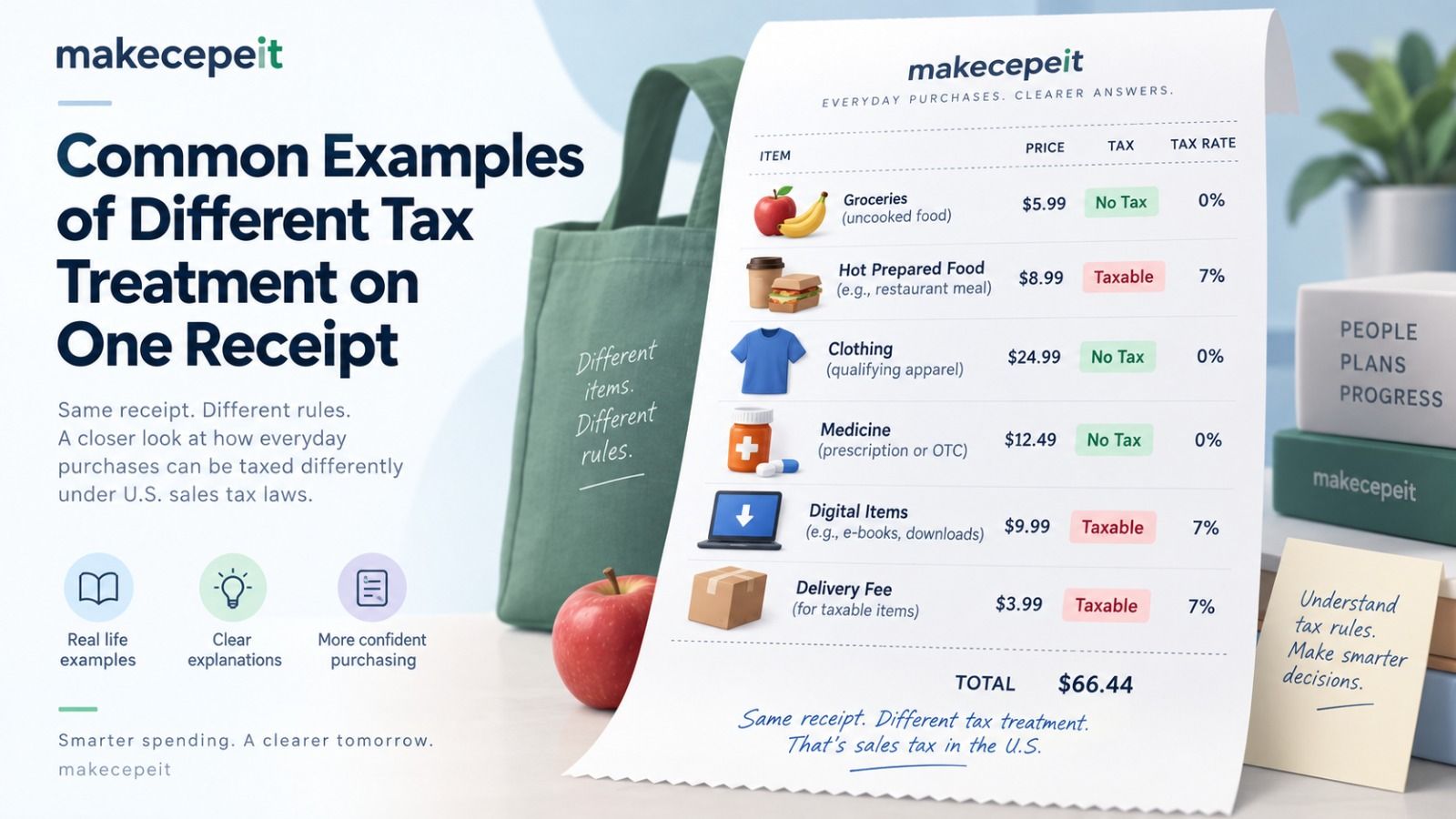
| Item or Transaction | Why Tax May Differ | What the Shopper Should Check |
|---|---|---|
| Basic groceries | May qualify for an exemption or special food rule | State definition of qualifying food |
| Hot or prepared food | May be classified differently from groceries | Preparation, temperature, utensils, and place of consumption |
| Clothing | Some jurisdictions provide exemptions or thresholds | Item price, product type, and local rules |
| Prescription medicine | May qualify for a statutory exemption | State-specific medical-product rules |
| Alcohol, tobacco, or fuel | Special taxes or fees may apply | Whether the charge is sales tax, excise tax, or another fee |
| Digital products | States classify digital goods and services differently | Product type and billing location |
| Discounted products | Discount rules can affect the taxable amount | How the discount or coupon was applied |
| Delivery or service charges | Taxability depends on jurisdiction and transaction type | Whether the charge is part of the taxable sale |
Why Does a $10 Item Sometimes Have More Tax Than Another $10 Item?
Two products with the same price can have different tax amounts because the taxable category matters more than the price alone.
Suppose you buy two $10 products. Product A qualifies for an exemption. Product B is fully taxable. Their prices are identical, but only Product B contributes to the taxable subtotal.
The receipt may therefore show a $20 merchandise total while calculating sales tax on only $10.
This distinction between the purchase subtotal and the taxable subtotal is one of the most important concepts to understand when reading a receipt.
What Is the Taxable Subtotal on a Receipt?
The taxable subtotal is the portion of a transaction to which the applicable sales tax is applied.
For example, imagine a purchase containing:
- $15 of qualifying tax-exempt groceries
- $12 of taxable household merchandise
- $8 of taxable prepared food
The total merchandise value is $35, but the taxable subtotal could be only $20 if the grocery items qualify for an exemption under the applicable jurisdiction's rules.
The actual result depends on the state and local laws governing the transaction, but this example explains why multiplying the receipt's entire subtotal by one tax percentage may produce the wrong answer.
Can Sales Tax Change Within the Same Store?
Yes. A single retailer can legitimately sell multiple categories of products that receive different tax treatment.
This frequently occurs in supermarkets, pharmacies, convenience stores, department stores, and large retailers because these businesses sell products from many tax categories.
A supermarket might sell groceries, hot meals, kitchenware, cleaning supplies, medicine, cosmetics, and other products on the same transaction. The tax engine can evaluate each line individually before calculating the total tax due.
Do Sales Tax Holidays Cause Different Tax Amounts?
Yes. A sales tax holiday can temporarily make qualifying products tax exempt even though those products would normally be taxable.
Eligibility depends on the specific state's rules. A tax holiday may apply only during a defined period and may be limited by product category, price threshold, or other conditions.
This can produce a receipt where one qualifying item receives temporary tax relief while another product remains taxable.
Can Coupons and Discounts Affect the Tax on a Receipt?
Discounts can affect the amount on which tax is calculated, but the result depends on how the discount is structured and on the applicable state rules.
A store discount, promotional reduction, loyalty reward, or manufacturer-supported coupon may not always receive identical tax treatment.
That is why calculating tax manually from the original shelf price does not always reproduce the exact figure shown by a retailer's point-of-sale system.
Are Special Fees the Same as Sales Tax?
No. A charge appearing near the tax section of a receipt is not necessarily ordinary sales tax.
Some transactions may involve excise taxes, environmental fees, bottle or container deposits, tourism-related charges, or other government-authorized assessments. Their names and treatment depend on the product and jurisdiction.
When reviewing a receipt, identify the label beside each charge before assuming that every additional amount is part of the general sales tax rate.
How to Check Whether the Sales Tax on Your Receipt Is Correct
If the tax total looks unusual, review the transaction systematically rather than applying one percentage to the entire bill.
- Identify every item. Separate groceries, prepared food, clothing, medicine, services, and other categories.
- Find the taxable subtotal. Determine which items appear to have been included in the taxable base.
- Check the purchase location. Sales tax rules can change by state, county, city, or other taxing jurisdiction.
- Look for exemptions. Verify whether any product qualifies for a food, clothing, medical, or other exemption.
- Review discounts. Check whether coupons or promotional reductions changed the taxable price.
- Separate taxes from fees. Do not automatically treat deposits or special assessments as regular sales tax.
- Compare with official guidance. Consult the state's department of revenue or tax authority if the amount still appears incorrect.
- Ask the retailer. A store can usually explain the product classification used by its point-of-sale system.
Could Different Tax Amounts Be a Point-of-Sale Error?
Yes, although different tax treatment by itself is not evidence of a mistake.
Retailers depend on product databases and tax codes to calculate sales tax. If an item is placed in the wrong product category or tax settings are outdated, the system could potentially calculate the wrong amount.
For example, a qualifying grocery item accidentally classified as prepared food could receive different tax treatment from what the applicable rules require.
If something appears inconsistent, keep the receipt and compare the product classification with official state guidance before concluding that an error occurred.
Why Sales Tax Rules Matter So Much Across the United States
The United States does not operate under one universal retail sales tax system that treats every purchase identically nationwide.
Instead, consumers and retailers operate within numerous state and local jurisdictions. Product definitions, exemptions, local rates, special taxes, and temporary tax provisions can all affect the amount collected.
This is especially important for businesses operating in multiple cities or selling online. A transaction associated with California may follow a different framework from one associated with Texas or New York.
For consumers, understanding these differences makes receipts easier to interpret. For businesses, accurate tax classification helps create clearer transaction records and reduces confusion at checkout.
Common Mistakes When Reading Sales Tax on a Receipt
- Multiplying the full subtotal by one rate. Some items may not be part of the taxable subtotal.
- Assuming every food product is tax exempt. Prepared or hot food may receive different treatment.
- Assuming the same rules apply nationwide. Taxability can change significantly between jurisdictions.
- Confusing a fee with sales tax. Deposits and special assessments may appear separately.
- Ignoring local taxes. State tax may represent only one component of the combined rate.
- Relying only on the ZIP code. Tax jurisdictions do not always align perfectly with postal boundaries.
- Assuming a different tax amount proves an error. Different product classifications often explain the difference.
Tips Before Questioning a Tax Charge
Start with the item rather than the final tax number. Ask what the product is, how it was sold, and whether a special exemption applies.
Next, confirm the location and transaction date. Tax rates, exemptions, and temporary rules can change.
Finally, use authoritative information whenever possible. State revenue departments and official tax agencies should take priority over generic online calculators when you need to verify a specific transaction.
For significant business transactions or uncertain compliance questions, consult a qualified tax professional rather than relying on a receipt calculation alone.
Why Use makecepeit When Working With Receipts?
A useful receipt should make a transaction easy to understand. That means clearly separating line items, prices, discounts, taxes, and the final total instead of presenting the customer with an unexplained number.
makecepeit fits naturally into this process by keeping the focus on clear, structured receipt information. Whether you are reviewing purchase records or working with itemized receipts, understanding which amounts represent products, taxable subtotals, taxes, and other charges can make each transaction easier to interpret.
Clear records are particularly valuable when transactions include products with different tax treatments. They give the shopper or business a practical starting point for checking unexpected amounts without assuming that every difference is an error.
Final Answer: Why Are Some Items Taxed Differently on the Same Receipt?
Items on the same receipt are taxed differently because U.S. sales tax rules classify products and transactions individually. Food, prepared meals, clothing, medicine, digital products, services, and other categories can each receive different treatment depending on state and local law.
The purchase location, product classification, exemptions, tax holidays, discounts, and special taxes or fees may also change the final amount.
If your receipt contains different tax amounts, first identify the taxable subtotal and check how each product was classified. When something still appears incorrect, verify the rule with the retailer or the appropriate state or local tax authority.
If you want receipt information that is easier to organize and review, makecepeit offers a logical next step for keeping transaction details clear and understandable.
Frequently asked questions
- Why are some items taxed while others are not?
- Some products qualify for exemptions or special tax treatment under state or local law, while other products are fully taxable.
- Can two items on the same receipt have different sales tax rates?
- Yes. Different product classifications, exemptions, local rules, or special taxes can result in different tax treatment on one receipt.
- Why are groceries sometimes not taxed but prepared food is?
- Many jurisdictions distinguish qualifying grocery products from food that is heated, prepared, served with utensils, or intended for immediate consumption.
- Why is clothing taxed differently from other products?
- Some states or local jurisdictions provide clothing exemptions, price thresholds, or temporary sales tax holidays that do not apply to other merchandise.
- Does sales tax vary by city?
- It can. Many states permit counties, cities, or other local jurisdictions to impose additional sales taxes.
- Why can online purchases have different sales tax?
- Online sales tax can depend on the customer's location, the seller's obligations, product taxability, and the applicable state and local sourcing rules.
- Can a coupon change the sales tax amount?
- Yes. A discount may change the taxable price, although the exact treatment depends on the type of discount and the jurisdiction's rules.
- Are excise taxes the same as sales tax?
- No. Excise taxes are separate taxes that may apply to particular products or activities and can appear in addition to general sales tax.
- How can I check the tax on my receipt?
- Identify taxable items, determine the taxable subtotal, check the applicable jurisdiction, and compare the calculation with official state or local tax guidance.
- What should I do if I think the sales tax is wrong?
- Keep the receipt, ask the retailer how the item was classified, and verify the applicable rule with the relevant state or local tax authority.