What Is a Refund Receipt? What It Should Include
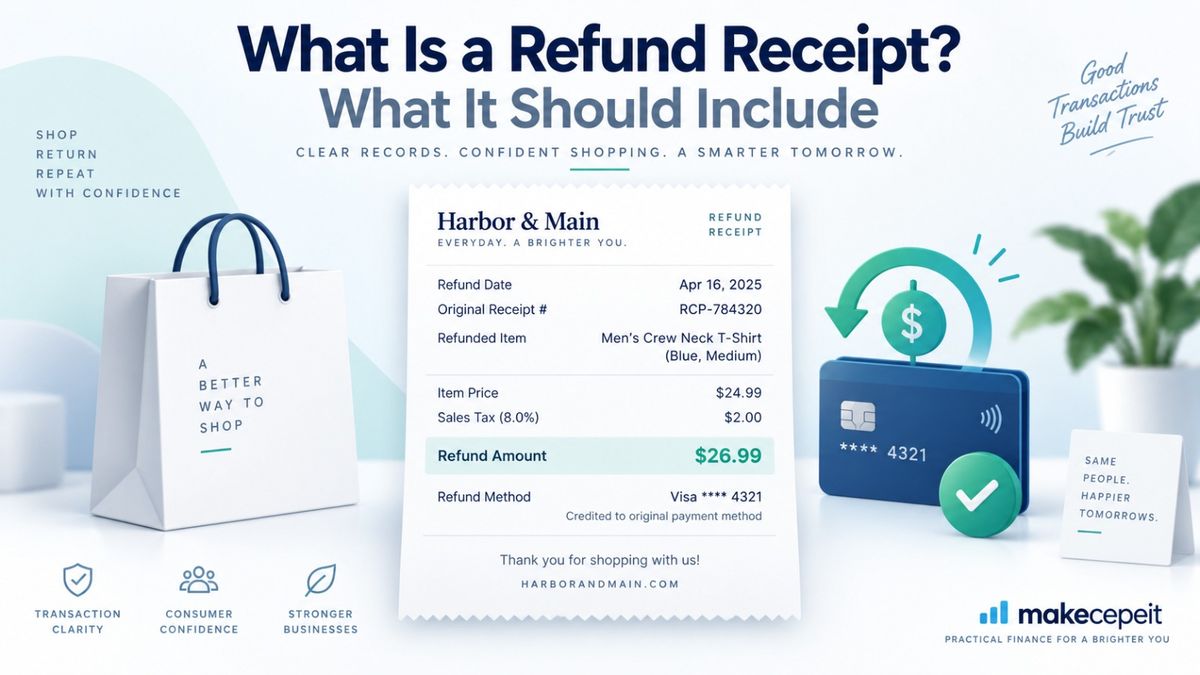
A refund receipt is a document that confirms a business has refunded all or part of a customer's original payment. It should clearly identify the merchant, the original transaction, the items or services being refunded, the refund date, any tax or fees involved, the total amount returned, and the refund method.
For U.S. retailers, service providers, restaurants, ecommerce businesses, and independent sellers, a well-prepared refund receipt creates a clear record for both the customer and the business. Tools such as makecepeit can also help businesses prepare consistent receipt documents while keeping transaction details organized.
What Is a Refund Receipt?
A refund receipt is proof that money from an earlier transaction has been returned or credited to a customer. Unlike an original sales receipt, which records money received by the business, a refund receipt documents money being returned to the buyer.
Quick answer: A refund receipt confirms a refund transaction and normally shows who issued the refund, which purchase it relates to, what was refunded, how much was returned, and how the customer received the money.
A refund may cover the entire purchase or only selected items. It may also be returned to a credit card, debit card, digital wallet, cash, or another permitted payment method. If a merchant provides store credit instead of returning money, the document should say so clearly rather than describing the transaction as a cash or card refund.
The refund receipt therefore becomes a separate transaction record connected to the original purchase.
What Should a Refund Receipt Include?
A useful refund receipt should contain enough information for the customer, merchant, accountant, or payment processor to understand exactly what happened without having to reconstruct the transaction later.
- Document title: Clearly identify the document as "Refund Receipt," "Refund Confirmation," or similar wording.
- Business information: Include the merchant or business name and appropriate contact or store-location information.
- Unique refund number: Give the refund transaction its own reference or receipt number.
- Refund date: Record when the refund was processed or issued.
- Original transaction reference: Include the original receipt, invoice, order, or transaction number whenever available.
- Refunded items or services: List the products or services being refunded and their quantities.
- Refunded subtotal: Show the amount being reversed before applicable tax or adjustments.
- Discounts or fees: Clearly identify any relevant discount reversal, restocking charge, or other adjustment permitted by the merchant's policy.
- Sales tax: Show the portion of sales tax being refunded when applicable.
- Total refund amount: Make the final amount returned to the customer easy to identify.
- Refund method: State whether the refund was issued to a card, cash, digital wallet, store credit, or another method.
- Payment reference: When useful, include a masked card reference or refund transaction ID rather than sensitive payment information.
- Refund status: Distinguish between a refund that has been initiated, processed, or otherwise completed according to the business's payment workflow.
A reason for the return, employee identifier, customer name, or internal authorization number may also be useful, but these fields are not necessary for every transaction.
Why Are Refund Receipts Important in the United States?
Refund receipts matter because they create a traceable connection between a sale and the money later returned. For customers, the document provides evidence that the merchant accepted and processed the refund. For businesses, it supports bookkeeping, reconciliation, inventory adjustments, customer service, and dispute resolution.
Good documentation is particularly important for U.S. businesses. The IRS explains that business records should clearly show income and expenses and that supporting documents such as receipts, invoices, and sales records help substantiate entries in business books and tax returns.
Refund tracking can also matter when reconciling payment-platform reporting. The IRS notes that the gross payment amount reported on Form 1099-K is not reduced by refunds, credits, fees, or similar adjustments. Businesses therefore need their own reliable records to account for refunds correctly.
Consumer return rules and merchant policies can vary by state and transaction type. California, for example, has specific disclosure requirements for certain limited retail return policies, illustrating why a business operating in Los Angeles may face different state-level considerations from a merchant in New York City, Chicago, Houston, or another U.S. market.
Businesses should therefore treat a refund receipt as operational documentation rather than assume one nationwide format satisfies every possible state, tax, or industry requirement.
Refund Receipt vs. Original Receipt vs. Credit Memo
These documents can relate to the same customer account, but they serve different purposes.
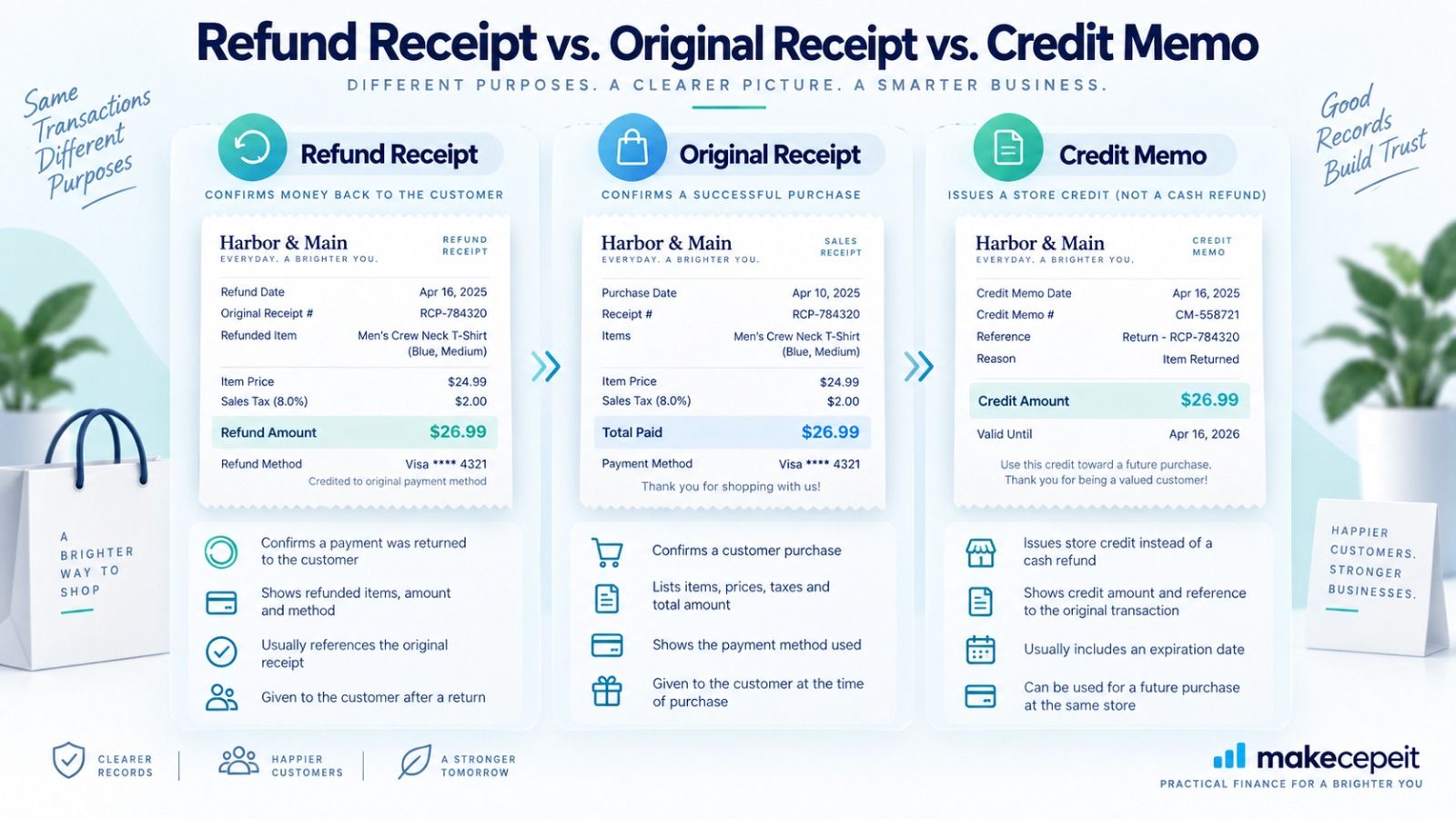
| Document | Main Purpose | When It Is Issued | What It Shows |
|---|---|---|---|
| Original sales receipt | Proves a purchase | After the original payment | Items purchased, price, tax, total, and payment method |
| Refund receipt | Proves money was returned | After a refund is processed or initiated | Refunded items, refund amount, tax, method, and original transaction reference |
| Credit memo | Reduces an amount owed or credited on an account | Commonly used in invoicing and account-based transactions | Credit applied against an invoice or customer balance |
| Store credit record | Provides value for a future purchase | When the merchant gives credit instead of returning money | Credit amount and any applicable conditions |
The most important distinction is that a refund receipt should record an actual refund transaction. It should not simply reproduce the original receipt with different numbers.
How to Create a Refund Receipt Step by Step
Creating an accurate refund receipt is straightforward when the refund is linked directly to the original transaction.
- Find the original transaction. Locate the sales receipt, invoice, order number, or payment record.
- Identify what is being refunded. Determine whether the refund covers the full purchase or only specific products or services.
- Confirm the applicable return policy. Check deadlines, product conditions, restocking terms, and other relevant rules.
- Calculate the refunded subtotal. Use the actual price paid after applicable discounts rather than automatically using the current selling price.
- Calculate tax and adjustments correctly. Separate refunded sales tax and any legitimate fees so the transaction can be understood later.
- Choose the correct refund method. Record whether the customer receives money on a card, in cash, through a wallet, or as store credit.
- Create a unique refund reference. Link that reference to the original order or receipt number.
- Issue the refund receipt. Give the customer a paper or digital copy and preserve an appropriate business record.
Do not mark a transaction as "completed" merely because a refund request was entered if your payment system still considers it pending. Accurate status wording helps prevent confusion.
How Should a Full Refund Appear?
A full refund receipt should show that the entire eligible transaction is being reversed. It should normally identify all refunded items, the refunded subtotal, applicable tax, adjustments, and the final amount returned.
For example, if the eligible original purchase consisted of merchandise plus sales tax and the full transaction is being refunded, the refund documentation should clearly separate the merchandise amount from the tax rather than displaying an unexplained single figure.
How Should a Partial Refund Appear?
A partial refund receipt should identify exactly which part of the original transaction was refunded. This is especially important when a customer purchased several items but returned only one.
The receipt should list the returned item, quantity, amount originally paid for that item, applicable tax adjustment, and final partial refund. The original order total does not become the refund total.
If a discount applied across several products, businesses should calculate the refund according to their actual pricing and return policy instead of refunding the undiscounted shelf price.
How Does Sales Tax Work on a Refund Receipt?
Sales-tax treatment should reflect the tax rules that apply to the original transaction and the jurisdiction where the sale occurred. Because U.S. sales tax is largely administered at state and local levels, businesses should avoid using one tax assumption for every state.
As one state-level example, California's rules for returned merchandise address refunds of the sale price and the associated amount designated as sales tax when the required conditions are met.
A practical refund receipt should therefore display sales tax as a separate line whenever tax is being reversed. Businesses with questions about unusual transactions, exemptions, restocking charges, or state-specific treatment should verify the rules with the relevant state tax authority or a qualified tax professional.
What Should a Credit Card Refund Receipt Show?
A credit card refund receipt should show the amount returned, refund date, original transaction reference, payment method, and a safely masked reference to the card or processor transaction when appropriate.
Avoid placing a full card number, security code, or unnecessary sensitive financial information on a customer receipt.
Debit Card Refunds
For a debit card refund, document the refund method and transaction reference in the same clear manner. Processing and posting times may depend on the merchant's processor and the customer's financial institution, so the receipt should not promise a specific bank-posting time unless the merchant can support that statement.
Cash Refunds
For cash, state the exact amount returned and identify the refund method as cash. A business may also use an employee or register reference for internal controls.
Digital Wallet and Online Refunds
For ecommerce or wallet payments, include the relevant order number and refund or processor transaction reference when available. The FTC recommends that online shoppers review seller refund policies and preserve records related to purchases and returns.
Refund Receipt Example
The following fictional example demonstrates a clear structure:
- REFUND RECEIPT
- Harbor Home Goods
- Austin, TX
- Refund Receipt: R-10482
- Refund Date: September 8, 2026
- Original Receipt: S-78124
- Returned Item: Ceramic Table Lamp
- Quantity: 1
- Refunded Subtotal: $40.00
- Sales Tax Refunded: $3.30
- Total Refund: $43.30
- Refund Method: Visa •••• 4821
- Refund Status: Processed
- Reason: Item returned
The layout is less important than accuracy. A customer should be able to understand the refund amount and connect it with the original purchase immediately.
Why Use makecepeit for Receipt Documentation?
Consistency becomes increasingly useful when a business creates receipts regularly. makecepeit provides an online receipt builder that allows users to edit business information, items, prices, tax, and payment details while viewing the receipt as it is created. The platform also supports receipt exports in formats including PDF and PNG.
For refund documentation, the same principle applies: clearly identify the document as a refund, use accurate details from the real transaction, connect it to the original sale, and retain the final record according to your business workflow.
A receipt-building tool is especially useful for small businesses, freelancers, service providers, and sellers that do not have a complex point-of-sale system but still need professional and organized transaction records.
Any generated receipt should represent a genuine transaction. Receipt tools should never be used to fabricate purchases, refunds, business expenses, return claims, tax records, or other financial evidence.
Tips Before Issuing a Refund Receipt
- Check the original purchase record before entering refund values.
- Follow the return policy that applied to the transaction.
- Check state-specific requirements when the refund involves sales tax or regulated return terms.
- Use a unique refund receipt number rather than reusing the original sales number.
- Keep the original transaction number visible for easy reconciliation.
- Separate subtotal, sales tax, fees, and total refund.
- Use only masked payment details on customer-facing receipts.
- State clearly whether the refund is full, partial, or store credit.
- Use accurate processing-status language.
- Keep refund documentation organized with the corresponding sales records.
Common Refund Receipt Mistakes to Avoid
Not Linking the Refund to the Original Sale
A refund with no original receipt, invoice, or order reference can be difficult to reconcile and harder for customer service teams to investigate later.
Showing Only the Final Amount
A single refund total may not explain what was returned. Itemizing products, tax, and adjustments creates a much clearer record.
Using the Wrong Sales Tax Amount
Tax should not be estimated casually. Base the refund on the actual transaction and the applicable state and local rules.
Confusing Store Credit With a Cash Refund
If the customer receives store credit, label it as store credit. Do not describe it as money returned to a card or bank account.
Including Sensitive Card Information
Customer-facing documents should use masked payment references and avoid exposing unnecessary financial data.
Creating a Receipt for a Transaction That Never Happened
A refund receipt is financial documentation. It should reflect an authentic refund and should never be altered or fabricated to misrepresent a purchase, return, reimbursement, or business expense.
Final Takeaway
A refund receipt is more than a message saying "refund approved." It is a structured record connecting the original sale with the amount returned to the customer.
The strongest refund receipts identify the merchant, original transaction, refunded products or services, refund date, subtotal, sales tax, adjustments, total refund, payment method, and transaction reference. Clear documentation protects the customer from uncertainty while helping the business maintain reliable financial and operational records.
If your business needs a straightforward way to prepare organized receipt documents, makecepeit provides a practical starting point for creating and exporting professional receipts. Use accurate transaction information, keep the refund clearly connected to the original sale, and preserve the final document as part of your normal recordkeeping process.
Frequently asked questions
- What is a refund receipt?
- A refund receipt is a document confirming that a merchant returned all or part of the money from an earlier customer transaction.
- What should a refund receipt include?
- It should include the merchant, refund date, refund number, original transaction reference, refunded items, tax, total refund, payment method, and relevant transaction ID.
- Is a refund receipt the same as an original receipt?
- No. An original receipt documents the sale, while a refund receipt documents money returned after that sale.
- Do I need the original receipt to issue a refund?
- That depends on the merchant's policy and applicable law. However, linking the refund to the original transaction creates a stronger and clearer record.
- What is a partial refund receipt?
- A partial refund receipt records a refund for only part of the original transaction, such as one item from a multi-item purchase.
- Should sales tax appear on a refund receipt?
- Yes, when sales tax is being refunded, showing it separately helps document the adjustment clearly. Exact tax treatment can vary by jurisdiction.
- Does a credit card refund need a receipt?
- A refund receipt is useful because it gives the customer and merchant a record of the amount, date, payment method, and related transaction.
- Is store credit considered a refund?
- Store credit can be a form of return resolution, but it should be clearly labeled as store credit rather than represented as cash or a card refund.
- How long should a business keep refund receipts?
- Retention depends on the purpose of the record and applicable tax, accounting, state, and industry requirements. Businesses should use a consistent record-retention policy.
- Can I create a refund receipt online?
- Yes. A receipt-building tool such as makecepeit can help create organized receipt documents, provided the information accurately reflects a genuine transaction.