Service Charge vs Gratuity on a Receipt: U.S. Guide
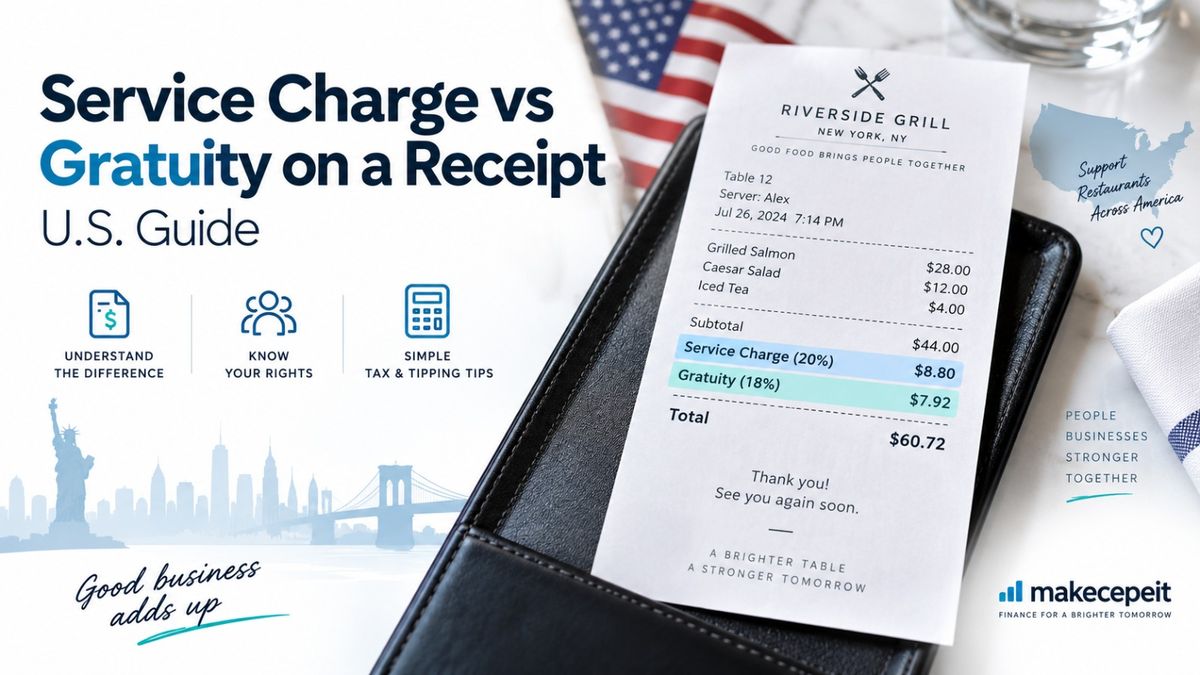
A service charge and a gratuity are not automatically the same thing on a U.S. receipt. A gratuity, or tip, is generally an optional amount that the customer chooses. A service charge is generally a mandatory amount set by the business and added to the bill. That distinction matters for customers, employees, payroll, taxes, and receipt records.
The wording can be confusing because restaurants sometimes use terms such as "automatic gratuity," "service fee," or "service charge." Under federal tax rules, however, what matters is how the payment works—not simply what the receipt calls it. Makecepeit helps businesses and customers create clearer transaction records by keeping items such as tax, tips, fees, and totals visibly separated.
Quick answer: If the customer can freely choose whether to pay an amount and decide how much to leave, it is generally a tip. If the business requires the amount and determines its value, it is generally a service charge for federal purposes.
What Is a Service Charge on a Receipt?
A service charge on a receipt is an additional amount that a business requires the customer to pay for a transaction or service. The business normally determines the charge in advance, either as a percentage of the bill or as a fixed amount.
Common examples include an 18% charge automatically added for a large restaurant party, a mandatory banquet charge, a hotel service fee, or a required charge included in a catering contract.
The IRS specifically distinguishes mandatory service charges from voluntary tips. Amounts automatically added to a customer's bill—including mandatory "auto-gratuities"—are generally treated as service charges rather than tips for federal tax purposes.
The important word is mandatory. If the customer cannot remove the charge or choose its amount, calling it a "gratuity" on the receipt does not necessarily make it a tip under federal rules.
What Is Gratuity on a Receipt?
A gratuity on a receipt normally means a voluntary tip that a customer chooses to give to a worker for service. The customer decides whether to leave a tip and, in most situations, controls the amount.
A receipt might therefore contain a blank tip line or suggested percentages such as 15%, 18%, or 20%. Suggested amounts do not automatically turn the payment into a service charge when the customer remains free to select another amount—including zero.
The IRS looks at several factors when determining whether a payment is truly a tip: it should be made voluntarily, the customer should have an unrestricted right to determine the amount, the payment should not be dictated by employer policy, and the customer generally should have the right to determine who receives it.
Service Charge vs Gratuity on a Receipt: Key Differences
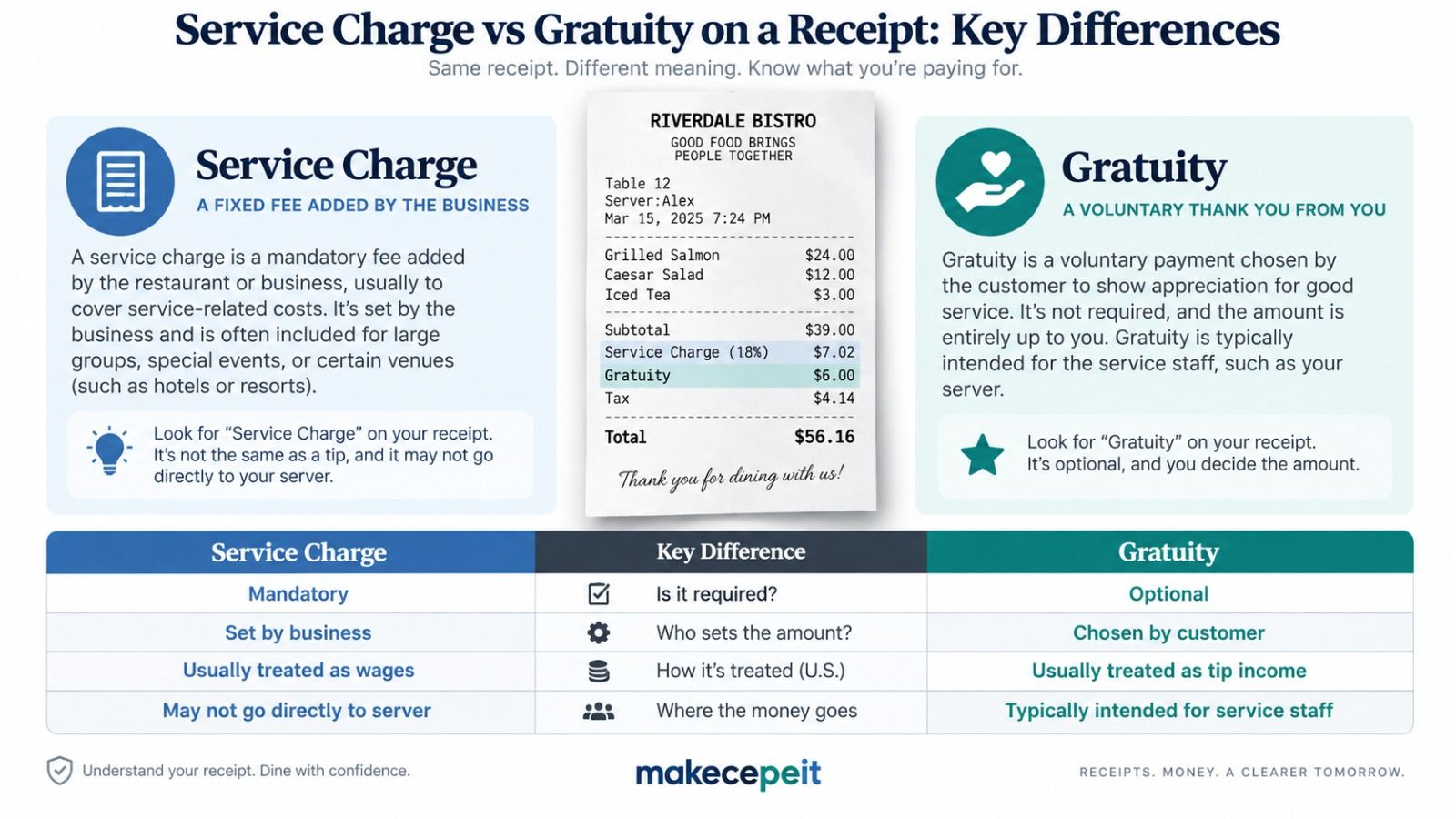
| Feature | Service Charge | Gratuity / Tip |
|---|---|---|
| Required? | Usually mandatory | Usually voluntary |
| Who sets the amount? | The business | The customer |
| Can the customer choose zero? | Usually no | Generally yes |
| Federal tax classification | Generally a service charge | Generally a tip |
| When paid to employees | Generally treated as wages | Handled as tip income |
| Does it automatically go to the server? | Not necessarily | Generally intended for the tipped worker or eligible tip pool |
| Typical receipt label | Service Charge / Service Fee | Tip / Gratuity |
The biggest practical difference is control. A customer controls a genuine tip. A business controls a mandatory service charge.
Is an Automatic Gratuity a Tip or a Service Charge?
An automatic gratuity is generally treated as a service charge under federal tax rules when the customer is required to pay it.
For example, imagine a restaurant automatically adds an 18% "gratuity" to every table of six or more guests. Because the restaurant determines the amount and the customer does not have an unrestricted choice about paying it, the IRS treats that mandatory amount as a service charge rather than a voluntary tip.
If the same customer decides to add another $20 voluntarily after paying the automatic charge, that additional $20 may qualify as a tip because the customer chose both whether to pay it and how much to leave. IRS guidance uses the same basic distinction between mandatory automatic charges and voluntary additional tips.
This is one reason businesses should avoid combining an automatic charge and an optional tip into a single unexplained line on the receipt.
Does a Service Charge Go to the Server?
Not necessarily. Customers should not automatically assume that a service charge is passed directly to their waiter, bartender, stylist, driver, or other service worker.
At the federal level, compulsory service charges are not treated as tips under the Fair Labor Standards Act. If an employer distributes money from a service charge to employees, those payments are compensation rather than tips and can affect wage and overtime calculations.
Distribution rules can also depend on state law, local law, employment agreements, and the business's disclosed policy. A receipt therefore becomes much clearer when it identifies the charge accurately instead of suggesting that every mandatory fee is automatically a tip for an employee.
If you are a customer and want to know whether staff receive the service charge, check the menu or receipt disclosure or ask the business before adding another tip.
Do You Still Tip If a Service Charge Is Included?
An additional tip is generally optional unless the business clearly states otherwise. Whether you want to leave one depends on what the existing service charge represents and how it is distributed.
Before adding another gratuity, look for wording such as "gratuity included," "service charge," "service fee," "service charge distributed to staff," or "service charge is not a gratuity."
If the receipt is unclear, asking the establishment is often better than assuming. A customer may otherwise unintentionally tip twice, while another customer may incorrectly assume a service charge went directly to the employee.
Why the Difference Matters for U.S. Businesses
The distinction between a service charge and gratuity affects much more than the wording printed near the bottom of a receipt. It can influence payroll treatment, employee records, tax reporting, customer expectations, point-of-sale configuration, and accounting records.
Payroll and Employee Compensation
When a mandatory service charge is distributed to employees, the IRS generally treats the distributed amount as wages. Employers therefore need to account for the payment through the appropriate payroll process rather than simply recording it as employee tip income.
Federal Tip Tax Treatment
Current IRS guidance also distinguishes voluntary tips from mandatory service charges when determining qualified tip treatment. Mandatory service charges and automatic gratuities do not become qualified tips merely because the receipt uses the word "gratuity."
Customer Transparency
A clearly itemized receipt reduces uncertainty. Customers should be able to tell what they purchased, what taxes were charged, which fees were mandatory, whether gratuity was already included, and what amount they voluntarily tipped.
Accounting and POS Records
Businesses should configure their point-of-sale and accounting systems so that service charges and voluntary tips are recorded separately. The IRS notes that POS records and individual receipts may be reviewed when determining how service-charge transactions were handled.
Service Charge Rules Can Vary by State and City
Federal definitions are only part of the picture. State wage laws, sales-tax rules, consumer-protection requirements, and local disclosure laws can create additional obligations.
California illustrates why businesses should avoid relying on federal terminology alone. California's Labor Commissioner notes that mandatory service charges can, in some circumstances, be treated as gratuities under state law. California also has specific price-transparency rules affecting mandatory fees, with special disclosure provisions for restaurants and certain food businesses.
New York provides another example. State hospitality rules create protections involving charges that are presented as gratuities, while New York City requires qualifying restaurant service charges to be disclosed to customers before ordering.
A restaurant in Los Angeles, a hotel in Miami, a salon in Chicago, and a catering company in New York may therefore face different state or local requirements even when their receipts contain similar language.
Businesses should verify current rules with the relevant state labor department, tax authority, or qualified professional rather than assuming a receipt practice that works in one state is automatically correct nationwide.
Is a Service Charge Taxable?
The answer depends on what type of tax you mean.
Payroll and Income Tax Treatment
When an employer distributes a mandatory service charge to an employee, the IRS generally treats that payment as wages and requires the appropriate federal income-tax, Social Security, and Medicare tax treatment.
Sales Tax Treatment
Whether a service charge is included in the taxable sales amount can depend on the state, locality, type of business, and nature of the fee. There is no safe nationwide rule stating that every service charge is taxable—or that every service charge is exempt.
Businesses should therefore configure sales tax using the rules applicable to the transaction's jurisdiction rather than applying one national setting to every receipt.
How Should a Service Charge and Gratuity Appear on a Receipt?
The best receipt is one that lets a customer understand the transaction without having to guess what each amount represents.
- List the purchased goods or services. Keep actual products or services separate from fees.
- Show the subtotal. Give the customer a clear pre-tax and pre-fee reference point where appropriate.
- Identify mandatory charges separately. Use an accurate label such as "Service Charge" when the fee is required.
- Show applicable tax clearly. Follow the correct state and local tax treatment.
- Keep voluntary gratuity separate. A customer-selected tip should not be combined with a mandatory charge.
- Show the final total. Make it easy to reconcile the receipt with the payment.
- Record the payment method appropriately. Include useful payment information without exposing sensitive card data.
For example, a restaurant receipt might show a $100 subtotal, a separately labeled mandatory service charge, applicable tax, a voluntary additional-tip line, and then the final amount paid. That structure is much clearer than one unexplained "fees and gratuity" line.
Why Use Makecepeit for Clear Receipt Documentation?
Clear receipts are useful whether you operate a restaurant, spa, salon, hotel, freelance service, transportation business, or another customer-facing company. Makecepeit provides an editable receipt builder designed to separate transaction details such as items, prices, taxes, tips, payment information, and totals.
Users can edit receipt information while viewing a live preview and export completed receipts in formats including PDF and PNG. Makecepeit also supports customizable tax information and gratuity-related fields, making it easier to document a transaction in a way that customers and internal teams can understand.
The important principle is accuracy. A generated receipt should reflect a legitimate transaction and the business's actual charges. A receipt tool is useful for documentation, record reconstruction of real purchases, business-issued receipts, expense records, and legitimate mockups—not for misrepresenting transactions that never occurred. Makecepeit's own terms prohibit fraudulent use of generated documents.
Common Mistakes to Avoid With Service Charges and Gratuities
- Assuming "automatic gratuity" always means a tip. Mandatory gratuities generally qualify as service charges for federal tax purposes.
- Assuming every service charge goes to the worker. Distribution depends on the business arrangement and applicable law.
- Combining mandatory and voluntary amounts. Keep service charges and optional tips on separate receipt lines.
- Using vague labels. Terms such as "fee" or "charge" without explanation can confuse customers.
- Applying one sales-tax rule nationwide. Service-charge tax treatment can vary by jurisdiction.
- Ignoring state and city requirements. Federal tax classification does not override more specific local labor or consumer-protection rules.
- Failing to reconcile receipts with payroll. Service charges distributed as employee compensation should be recorded correctly.
- Making customers tip twice unintentionally. Clearly disclose whether gratuity is already included.
Tips for Businesses Before Adding a Service Charge
Before implementing a mandatory service charge, decide exactly what the charge represents, how it will be disclosed, how the proceeds will be handled, and how your POS and payroll systems will record it.
Review the rules in every state or locality where you operate. Make sure menu language, online checkout pages, invoices, contracts, customer receipts, payroll records, and accounting systems use consistent terminology.
If customers may also leave an optional tip, provide a clearly separate tip field. Employees should also understand how mandatory charges are distributed so that they can answer customer questions accurately.
For tax, payroll, or labor-law decisions, consult the appropriate government guidance or a qualified tax or employment professional. Receipt formatting can improve documentation, but it does not replace jurisdiction-specific compliance advice.
Service Charge vs Gratuity: The Bottom Line
The simplest way to understand service charge vs gratuity on a receipt is to ask who controls the payment. If the business requires the charge and determines the amount, it is generally a service charge for federal purposes. If the customer voluntarily decides whether to pay and chooses the amount, it is generally a gratuity or tip.
This distinction matters because mandatory service charges and voluntary tips can receive different payroll and tax treatment. State and local rules can add another layer, so businesses should never rely on the receipt label alone.
For customers, the safest approach is to read the receipt before adding a tip. For businesses, the safest approach is transparency: identify mandatory fees clearly, keep voluntary gratuity separate, and maintain accurate transaction records.
Create Clearer Receipts With Makecepeit
When a transaction includes taxes, mandatory fees, and optional tips, clear documentation matters. With Makecepeit, you can organize legitimate transaction details, review the receipt before finalizing it, and create a clean digital record for your business or records.
Use clear labels for every charge, keep service charges separate from voluntary gratuities, verify the numbers against the actual transaction, and create a receipt that customers can understand at a glance.
Frequently asked questions
- Is a service charge the same as gratuity?
- No. A mandatory service charge is generally different from a voluntary gratuity or tip. The customer's ability to choose whether to pay and determine the amount is a key distinction.
- Is an automatic gratuity considered a tip?
- Generally not for federal tax purposes when payment is mandatory. An automatic gratuity imposed by the business is typically treated as a service charge.
- Do I need to tip if a service charge is already included?
- An additional tip is generally optional. Check the receipt or ask the business whether the service charge represents gratuity or is distributed to staff.
- Does a service charge go directly to the server?
- Not necessarily. How service charges are distributed depends on employer policy, employment arrangements, and applicable state or local law.
- Can a restaurant charge both a service charge and a tip?
- A restaurant may have a mandatory service charge while also allowing customers to leave an additional voluntary tip, subject to applicable state and local rules.
- Is a service charge taxable?
- Service charges distributed to employees are generally treated as wages for federal payroll purposes. Sales-tax treatment varies by state and transaction type.
- What does "gratuity included" mean on a receipt?
- It usually means an additional amount has already been added to the bill. If the amount was mandatory, it may be classified as a service charge for federal tax purposes even if it is called gratuity.
- What is the difference between a service charge and a service fee?
- The terms may be used differently by businesses. The important issue is whether the amount is mandatory, who sets it, what it covers, and how applicable law treats it.
- Should service charges and tips appear separately on a receipt?
- Yes. Separate lines make the transaction clearer for customers and help businesses maintain better accounting, payroll, and payment records.
- How can I create a receipt showing a service charge and gratuity clearly?
- Use separate receipt fields for purchased items, applicable tax, mandatory charges, voluntary gratuity, and the final total. Makecepeit can help create and export an organized receipt using accurate transaction details.