Sales Receipt Maker With Split Payment
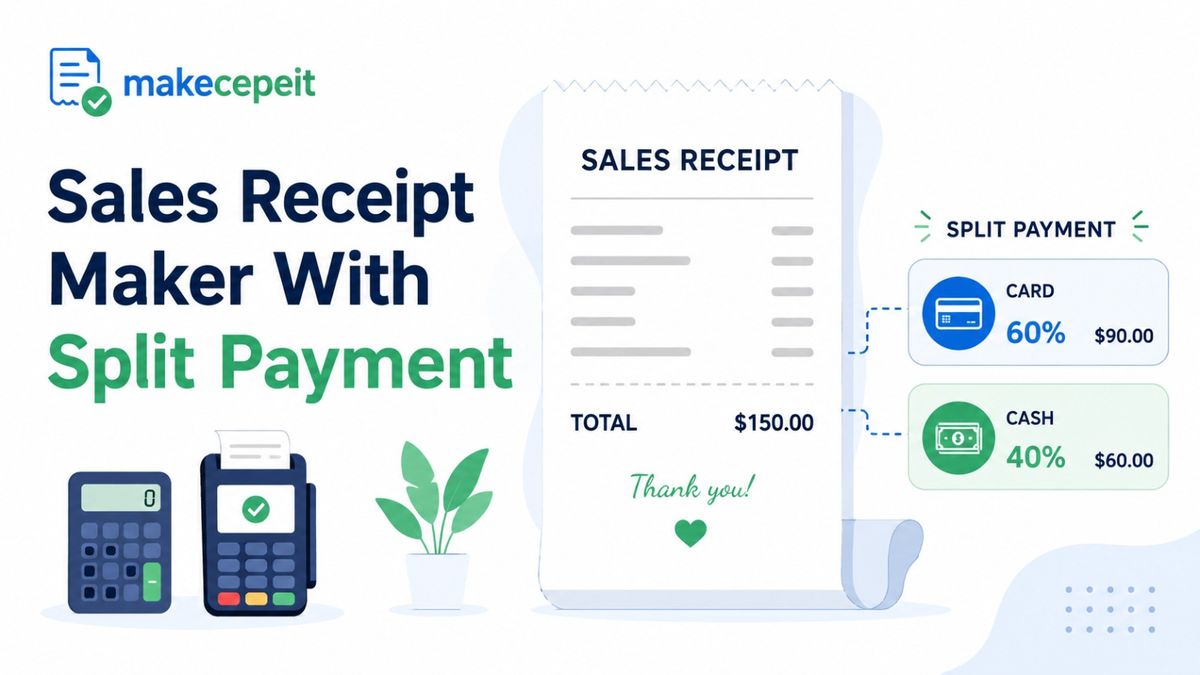
A sales receipt maker with split payment helps businesses document a legitimate purchase when a customer pays using two or more payment methods. For example, a customer might pay part of an order in cash and place the remaining balance on a credit card. A clear receipt should show the total sale, taxes where applicable, each payment method, the amount assigned to each method, and the final balance.
For U.S. businesses, accurate transaction documentation can make bookkeeping, customer service, payment reconciliation, and internal recordkeeping much easier. makecepeit can be considered by businesses looking for a convenient way to prepare organized sales receipt records while ensuring that every receipt reflects a genuine transaction and accurate payment information.
What Is a Sales Receipt With Split Payment?
A sales receipt with split payment is a transaction record showing that the customer used more than one form of payment to complete a single purchase.
Instead of displaying only one payment method, the receipt provides a breakdown of how the total amount was paid. A $150 legitimate sale, for example, might show $50 paid in cash and $100 paid by credit card.
A good split-payment receipt makes one fact immediately clear: the combined payment amounts should match the amount actually collected for the transaction.
Split payments are also commonly called split tender payments. Depending on the business, the combination might involve cash, credit cards, debit cards, gift cards, store credit, or supported digital payment methods.
How Does a Sales Receipt Maker With Split Payment Work?
A receipt maker designed for multiple payment methods organizes the transaction into separate sections. The sales portion explains what was purchased and the amount due, while the payment portion explains how that amount was actually paid.
A typical workflow is:
- Enter the seller or business information.
- Add the genuine transaction date and receipt or transaction number.
- Enter the products or services actually purchased.
- Calculate the subtotal, discounts, taxes, and total.
- Select the first payment method and enter the amount paid.
- Add the second payment method and its amount.
- Add additional legitimate payment methods if required.
- Confirm that the payment breakdown matches the transaction total.
- Review the receipt for accuracy before saving, printing, or sharing it.
The goal is not simply to produce a professional-looking document. The important part is creating an accurate record that corresponds to a real transaction.
Example of a Split Payment Receipt
Consider a U.S. retail purchase with a final total of $240. The customer decides to pay $40 in cash and the remaining $200 with a credit card.
| Receipt Detail | Example |
|---|---|
| Subtotal | $225.00 |
| Applicable tax | $15.00 |
| Total | $240.00 |
| Cash payment | $40.00 |
| Credit card payment | $200.00 |
| Total collected | $240.00 |
| Balance due | $0.00 |
The receipt makes the payment structure easy to understand without forcing the customer, employee, or bookkeeper to reconstruct the transaction later.
What Information Should a Split Payment Receipt Include?
A useful receipt should contain enough information to identify the transaction and understand exactly how payment was collected.
Business Information
Include the legitimate seller or business name and relevant business contact information. Depending on the context, this may include a business address, phone number, email address, or other appropriate identifying details.
Transaction Information
The receipt should clearly identify the real transaction. Useful fields can include:
- Transaction date.
- Receipt or order number.
- Products or services purchased.
- Quantity and unit price.
- Subtotal.
- Discounts, when applicable.
- Applicable sales tax.
- Final transaction total.
Payment Breakdown
This is the most important section for split tender transactions. Each payment method should appear separately alongside the amount actually collected through that method.
For example:
- Cash: $25.00.
- Visa ending in 1234: $75.00.
- Total paid: $100.00.
- Balance: $0.00.
When referencing a payment card, businesses should avoid displaying unnecessary sensitive card information. Only limited identifiers that are appropriate for the business record should be used.
Common Types of Split Payments
Split payments can happen in many ordinary U.S. retail and service transactions.
Cash and Credit Card
One of the simplest examples involves a customer paying part of the total in cash and charging the remainder to a credit card.
Cash and Debit Card
The same approach can be used when the remaining portion of a purchase is paid with a debit card.
Two Payment Cards
A customer may ask a business to divide one genuine purchase between two cards. The receipt should display the amount applied to each approved transaction.
Gift Card and Another Payment Method
If the purchase exceeds the remaining value of a gift card, the customer may use the gift card first and pay the remaining balance with cash or another supported method.
Store Credit and Card
Some merchants allow valid store credit to cover part of an order, with the remaining amount charged using another payment method.
Why Split Payment Receipts Matter for U.S. Businesses
Clear receipts are particularly valuable in the United States because businesses frequently accept several forms of payment, while tax and recordkeeping requirements can vary by jurisdiction and business type.
Sales tax rules, for example, differ between states and local jurisdictions. A receipt maker should therefore allow the business to enter the correct tax treatment for the genuine sale instead of assuming that every transaction uses the same tax rate.
Accurate split-payment records can also simplify several operational tasks:
- Reconciling cash drawer totals.
- Matching card payments with processor records.
- Reviewing daily sales activity.
- Answering customer questions about a payment.
- Investigating legitimate refunds or returns.
- Maintaining organized bookkeeping records.
This can be useful for retailers in New York, restaurants in Chicago, service businesses in Los Angeles, independent sellers in Texas, and other businesses throughout the United States.
Split Payment Receipt vs Standard Sales Receipt
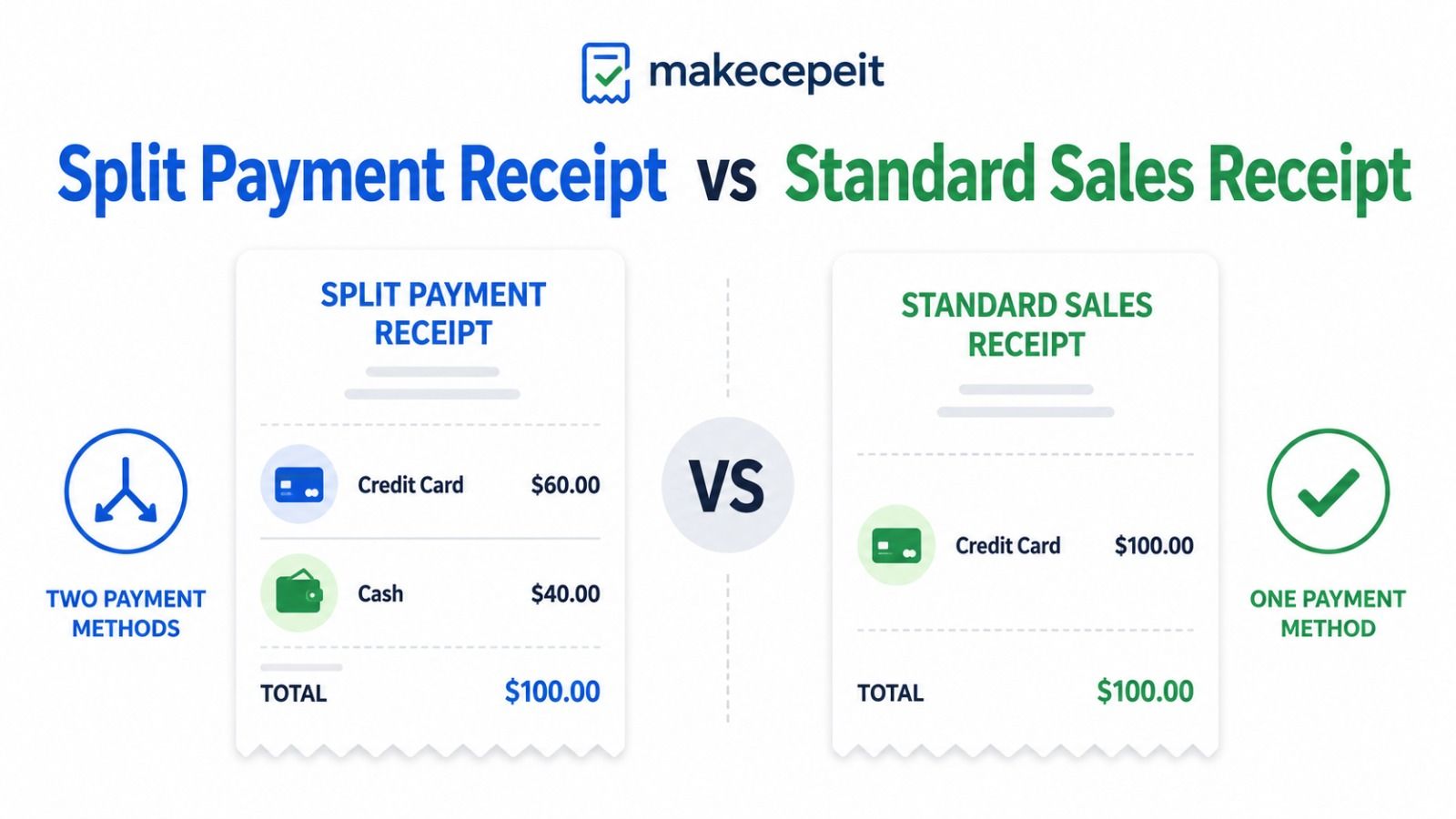
| Feature | Standard Sales Receipt | Split Payment Receipt |
|---|---|---|
| Number of payment methods | Usually one | Two or more |
| Payment breakdown | Simple | Detailed by method |
| Cash and card combination | Not normally required | Clearly documented |
| Reconciliation | Single payment source | Multiple payment sources |
| Best use | Single-tender transaction | Split-tender transaction |
The products and total may be identical on both types of receipts. The difference is how the payment section records the funds received.
Benefits of Using a Receipt Maker for Multiple Payment Methods
Creates a Clear Payment Trail
A payment breakdown shows immediately where the money came from. This is easier to review than placing an unexplained note at the bottom of a generic receipt.
Reduces Manual Calculation Errors
When preparing receipts manually, it is easy to accidentally enter payment amounts that do not equal the total. A structured workflow encourages the user to verify the transaction before completing the receipt.
Makes Customer Records Easier to Understand
A customer who later reviews the receipt can see whether a purchase was divided between cash, card, credit, or another payment method.
Helps With Reconciliation
Separating payment methods can help a business compare recorded sales with cash totals and legitimate card or payment-processor transactions.
Creates Consistent Business Documentation
Using the same receipt structure across transactions can make records easier to review than creating a different document format for each customer.
How to Make a Cash and Card Receipt Correctly
The simplest approach is to calculate the entire sale first and divide the payment only after confirming the final amount due.
- Calculate the sale total. Add the actual items or services, applicable discounts, and taxes.
- Record the first payment. Enter the amount actually received in cash.
- Calculate the remaining balance. Subtract the cash amount from the total.
- Record the card transaction. Enter only the amount actually processed on the card.
- Confirm the totals. Make sure all payment amounts equal the amount collected.
- Save the completed record. Keep the receipt consistent with the underlying transaction records.
For example, when the final amount is $120 and the customer gives $20 in cash, the second payment should account for the remaining $100 if the transaction is being paid in full.
What to Look for in a Split Payment Receipt Generator
Choosing a receipt-making tool should be based on practical documentation needs rather than appearance alone.
Consider whether the tool makes it easy to:
- Enter multiple legitimate payment methods.
- Assign a separate amount to each payment method.
- Show subtotal, tax, discounts, and total clearly.
- Add actual business and transaction details.
- Review payment totals before completing a receipt.
- Create a document that remains readable on desktop and mobile devices.
- Save or print records when needed.
Businesses should also consider their own accounting, payment-processing, tax, and record-retention requirements when deciding how receipts should be created and stored.
Why Consider makecepeit for Sales Receipt Creation?
makecepeit is relevant to users searching for a straightforward way to prepare sales receipt documentation, including situations where a legitimate transaction involves more than one payment method.
For a small business, freelancer, retailer, or service provider, the priority should be clarity. A useful workflow should make it easy to present the transaction total and its payment breakdown in a format that customers and business teams can understand.
When using makecepeit or any other receipt-making solution, always enter information from the actual transaction. A receipt should document a real purchase or payment rather than create evidence for a transaction that never happened or misrepresent amounts, merchants, dates, taxes, or payment methods.
Important Tips Before Creating a Split Payment Receipt
Use the Actual Transaction Date
The date on the receipt should correspond to the genuine business transaction rather than an arbitrary date.
Check the Final Total First
Do not divide payments until the subtotal, discounts, taxes, and total have been verified.
Match Payment Amounts to Actual Records
If $80 was processed through a card terminal, the receipt should not show $100 simply to make the document easier to format.
Use Accurate Tax Information
U.S. sales tax treatment varies by location and transaction type. Businesses should use the rate and tax treatment that actually applies to the transaction and consult a qualified professional when tax treatment is uncertain.
Protect Sensitive Payment Information
A customer receipt should not expose unnecessary card numbers, bank account information, authentication data, or other sensitive payment credentials.
Common Mistakes to Avoid With Split Payment Receipts
Payment Amounts Do Not Match the Total
If the receipt total is $200 but the listed payment methods add up to $190 or $210, the document creates confusion. Always reconcile the figures before completing it.
Using One Payment Method for the Entire Transaction
If the customer actually used cash and a card, recording only the card payment removes an important part of the transaction history.
Forgetting Discounts or Taxes
The payment breakdown should be calculated from the true final amount after applicable adjustments.
Adding Unnecessary Card Details
Receipts should contain only appropriate payment identifiers and should never expose sensitive authentication or complete financial account data unnecessarily.
Creating Receipts for Transactions That Did Not Occur
A receipt maker should be used for legitimate recordkeeping. Creating a receipt to falsely represent a purchase, expense, refund, merchant, payment, or transaction can create serious legal, financial, or compliance problems.
Who Can Benefit From a Split Payment Receipt Maker?
A split payment receipt tool may be useful whenever a real business accepts several payment options.
- Retail stores.
- Restaurants and cafés.
- Freelancers and independent professionals.
- Repair and maintenance businesses.
- Salons and personal service providers.
- Small local businesses.
- Event vendors.
- Professional service companies.
- Online and offline sellers.
The exact receipt format may differ by industry, but the underlying principle remains the same: document what was sold, how much was due, and how the customer actually paid.
How Split Payment Receipts Support Better Business Records
A receipt is only one part of a business's transaction history. Its value increases when the information agrees with related records such as point-of-sale reports, cash totals, payment processor statements, invoices, refund records, and accounting entries.
For example, if a store records $600 in cash sales during the day, split transactions that contain a cash component should be reflected accurately when employees reconcile the cash drawer.
The same principle applies to card transactions. The amount described as a card payment on a receipt should correspond with the legitimate amount processed through the business's payment system.
This consistency creates records that are easier to understand and reduces the need to reconstruct transactions later.
Sales Receipt Maker With Split Payment: Final Takeaway
A sales receipt maker with split payment is useful when a genuine purchase is completed with two or more payment methods. The best receipt format clearly separates the sale total from the payment breakdown, identifies each payment method, and confirms that the amounts reconcile correctly.
For businesses in the United States, accurate receipts can support clearer customer communication, bookkeeping, cash reconciliation, and everyday transaction management. Whether a customer pays with cash and card, two cards, store credit and cash, or another supported combination, the receipt should always represent what actually occurred.
If you need a practical way to organize legitimate sales receipt information, explore makecepeit and create your next receipt using accurate transaction details, clear payment breakdowns, and records that are easy to understand.
Frequently asked questions
- What is a sales receipt with split payment?
- It is a receipt documenting a genuine sale where the customer uses two or more payment methods to complete one transaction.
- Can a sales receipt show cash and card payments together?
- Yes. A receipt can show the amount paid in cash and the amount legitimately processed by card as separate payment entries.
- What is a split tender payment?
- A split tender payment occurs when more than one payment method is used for a single purchase, such as cash plus a credit card.
- Can one purchase be divided between two credit cards?
- Yes, if the merchant's payment system allows it. The receipt should show the amount actually processed on each card or payment source.
- What should a split payment receipt include?
- It should normally include transaction details, products or services, subtotal, applicable taxes or discounts, total, individual payment methods, payment amounts, and remaining balance.
- Should payment amounts equal the receipt total?
- For a fully paid transaction, the amounts collected through all listed payment methods should reconcile with the final amount due.
- Can a gift card be part of a split payment?
- Yes. A customer may use an eligible gift card for part of a transaction and another accepted payment method for the remaining balance.
- Is sales tax the same everywhere in the United States?
- No. Sales tax treatment can vary by state, locality, product, service, and transaction circumstances, so businesses should use the rules that apply to the actual sale.
- Why is a payment breakdown useful on a receipt?
- It helps customers and businesses understand how the transaction was funded and can make reconciliation and recordkeeping easier.
- Can makecepeit be used for split payment receipt records?
- makecepeit is relevant for users looking to organize sales receipt information. Any receipt created should accurately reflect a legitimate transaction and its real payment details.