Pharmacy Receipt Generator with Itemized Products
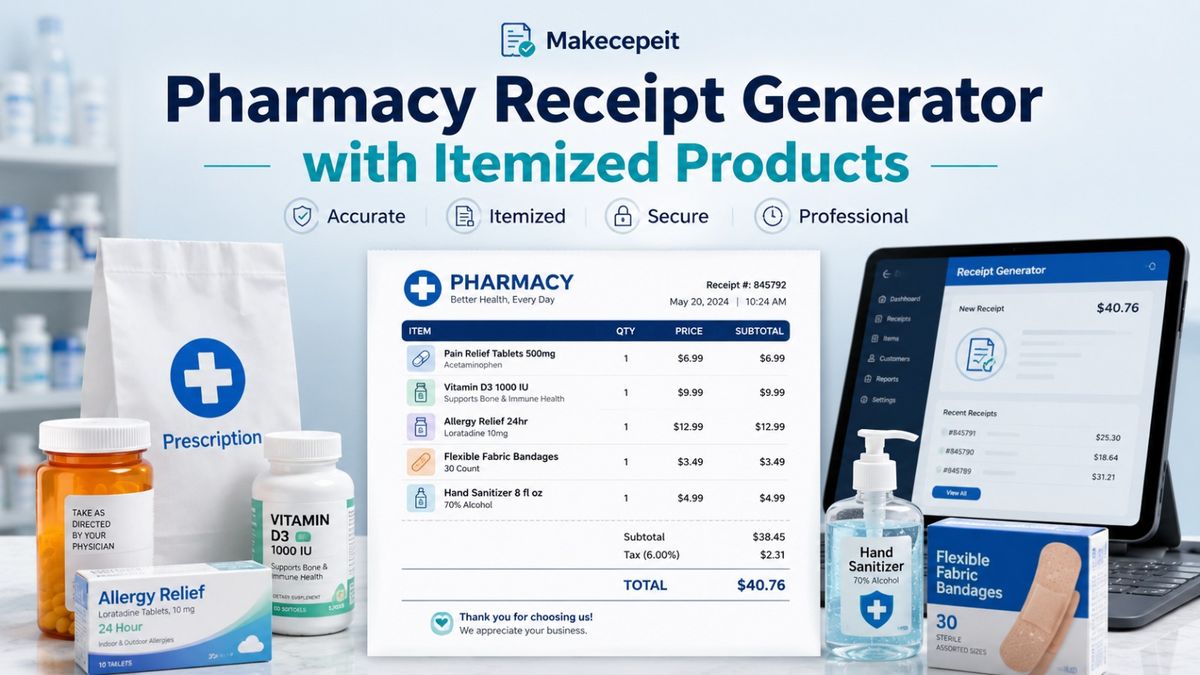
A pharmacy receipt generator with itemized products helps create organized transaction records that show each legitimate pharmacy purchase separately, including the product name, quantity, unit price, subtotal, applicable tax, and final total. For businesses, independent pharmacies, recordkeeping teams, and users creating documentation from real transaction data, Makecepeit provides a practical way to organize pharmacy purchase information into a clear receipt format.
The key advantage of an itemized receipt is transparency. Instead of displaying only a final amount, it explains exactly what contributed to the transaction total. A well-structured pharmacy receipt can distinguish prescription-related purchases, over-the-counter products, personal-care items, medical supplies, discounts, taxes, and payment information without making the document unnecessarily complicated.
Important: A receipt generator should be used only for legitimate records, examples, internal documentation, estimates, testing, or recreating documentation from an actual transaction. It should never be used to fabricate purchases, impersonate a real pharmacy, alter transaction values, or submit false information to an insurer, employer, tax authority, health plan, reimbursement program, or other third party.
What Is a Pharmacy Receipt Generator with Itemized Products?
A pharmacy receipt generator is a tool for organizing transaction information into a receipt-style document. The "itemized products" element means that every product is displayed as an individual line rather than combining the entire purchase into a single total.
For example, a legitimate pharmacy transaction might contain an OTC pain reliever, a first-aid product, toothpaste, and another health-related product. An itemized pharmacy receipt can list each item individually with its quantity and price, making the transaction easier to review later.
This type of organization is useful because pharmacies in the United States frequently sell much more than prescription medication. A transaction may contain OTC medications, vitamins, personal-care products, medical supplies, household products, and other retail items. Itemization helps prevent confusion when someone later needs to understand exactly what was included in the purchase.
What Should an Itemized Pharmacy Receipt Include?
An itemized pharmacy receipt should identify the transaction and clearly separate each purchased product, its quantity, price, and contribution to the total. The exact fields depend on the purpose of the document, but a practical structure normally includes the following information.
| Receipt Field | Purpose |
|---|---|
| Business or pharmacy name | Identifies the seller associated with the actual transaction |
| Transaction date | Shows when the purchase occurred |
| Receipt or transaction reference | Helps organize legitimate internal records |
| Product name | Identifies each purchased item |
| Quantity | Shows the number of units purchased |
| Unit price | Displays the price for each unit |
| Line total | Shows quantity multiplied by applicable unit price |
| Discount | Documents a legitimate discount when applicable |
| Subtotal | Summarizes item totals before applicable taxes or adjustments |
| Applicable tax | Records tax information from the real transaction when required |
| Total | Displays the final legitimate transaction amount |
| Payment method | Indicates cash, card, or another real payment method without exposing sensitive payment credentials |
A receipt does not need every possible field simply because the generator makes it available. Include information that serves a legitimate documentation purpose and avoid unnecessary personal, health, or financial details.
Why Itemized Pharmacy Receipts Are More Useful Than Simple Totals
A receipt that displays only "Total: $84.25" provides very little context. Itemization makes the document easier to understand because the reader can see how the total was calculated.
- Clear product identification: Each product is separated instead of being hidden inside a combined total.
- Easier expense review: Users can identify which part of a transaction relates to a specific category.
- Better internal records: Businesses can keep more understandable purchasing documentation.
- Simple error detection: Incorrect quantities or prices are easier to notice.
- More organized documentation: Product-level information is easier to reference later.
This is particularly useful when one pharmacy transaction contains both health-related products and general retail merchandise.
How to Create an Itemized Pharmacy Receipt
The safest workflow is to start with information from a real transaction or clearly labeled sample data and then organize that information into a consistent receipt format.
- Identify the purpose. Decide whether the receipt is for legitimate internal records, customer documentation, bookkeeping, testing, training, or a clearly marked example.
- Enter the actual seller information. Use business information only when you are authorized to use it.
- Add the transaction date. For a real receipt record, use the date of the actual transaction rather than changing dates to create a misleading history.
- Enter each product individually. Add product names, quantities, and genuine transaction prices.
- Review discounts and adjustments. Only include discounts that actually applied to the transaction.
- Calculate the subtotal. Confirm that all line totals add up correctly.
- Add applicable tax information. Use the tax information associated with the real purchase rather than guessing a rate.
- Enter the final total. The final amount should reconcile with the transaction data.
- Select the payment description. Keep payment information minimal and do not expose full card credentials or security codes.
- Review before saving or sharing. Check calculations, spelling, dates, and sensitive information.
Prescription, OTC, and Retail Products: Keep Categories Clear
One reason a pharmacy receipt generator with itemized products can be useful is that pharmacy transactions often contain multiple types of merchandise.
Prescription-related purchases
Prescription information deserves additional privacy consideration. A legitimate transaction record may require certain product information, but users should avoid adding unnecessary medical details merely to make a receipt look more complete.
Over-the-counter products
OTC products can usually be itemized like other retail products: product description, quantity, unit price, and line total. Examples can include pain-relief products, allergy products, first-aid supplies, and other nonprescription goods.
Personal-care and general retail products
Many U.S. pharmacies also sell personal-care items, toiletries, household products, snacks, and similar merchandise. Separating these lines can make expense records considerably easier to understand.
Privacy Matters When Creating Pharmacy Receipts in the United States
Pharmacy documentation can involve sensitive information, so privacy should be considered before entering, storing, downloading, or sharing receipt data. The U.S. Department of Health and Human Services explains that the HIPAA Privacy Rule protects individually identifiable health information held or transmitted by covered entities and their business associates. HHS also emphasizes limiting certain uses and disclosures of protected health information to the minimum information necessary for the intended purpose.
HIPAA does not automatically mean that every receipt created by every person or software tool is protected health information. Whether HIPAA applies depends on who holds the information, the relationship involved, and how the data is used. The practical rule for a receipt creator is simpler: do not include sensitive health information unless the legitimate purpose of the document requires it.
The Federal Trade Commission similarly advises businesses to understand what personal information they possess, keep only information they need, protect retained information, and dispose of information appropriately.
Avoid unnecessary sensitive information
When possible, a pharmacy receipt created for general recordkeeping should avoid unnecessary fields such as:
- diagnosis information;
- medical history;
- insurance credentials that are not required;
- full payment card numbers;
- card security codes;
- unnecessary patient identifiers;
- unrelated prescription or treatment information.
If the receipt will contain real health or customer information, the organization responsible for that information should follow its applicable privacy, security, retention, and access-control requirements.
Protect Payment Information on Pharmacy Receipts
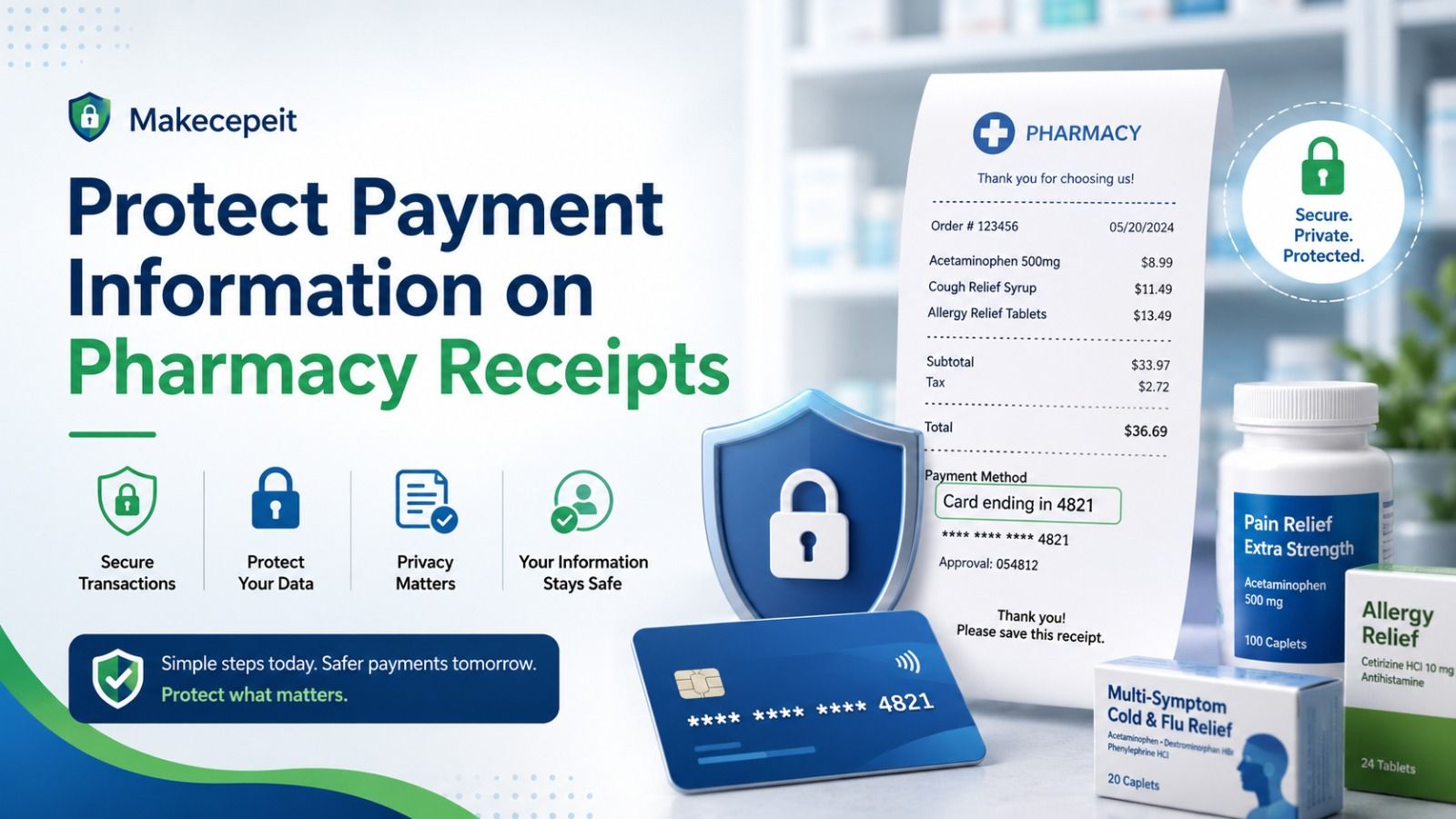
Payment information should be minimized as well. A receipt generally does not need complete card credentials. The PCI Security Standards Council publishes security standards intended to protect payment account data and specifically treats cardholder data as sensitive information requiring appropriate protection.
For a practical receipt record, descriptions such as "Credit Card," "Debit Card," or a properly masked account reference are preferable to exposing sensitive credentials. Never place a card verification code or other sensitive authentication data on a generated receipt.
Legitimate Uses for an Online Pharmacy Receipt Maker
A pharmacy receipt maker can support several legitimate documentation workflows when the information is accurate or clearly identified as sample data.
Internal business records
Small businesses may need standardized documentation when recording legitimate pharmacy or medical-supply purchases for internal accounting workflows.
Customer receipt formatting
An authorized business may need a readable receipt layout that separates products and totals clearly.
Expense organization
Itemization can help someone categorize purchases from a genuine transaction before entering them into an expense-management system.
Software testing and demonstrations
Developers, designers, trainers, and support teams sometimes need fictional receipt samples for interface testing or demonstrations. In these cases, the receipt should use fictional information and be clearly identified as a sample when there is any possibility of confusion.
Recreating a lost internal record from verified transaction data
An organization may sometimes need to reproduce internal documentation when it possesses reliable records of the original transaction. The regenerated document should accurately reflect those records rather than inventing missing amounts or transaction details.
Can a Generated Pharmacy Receipt Be Used for Insurance or Reimbursement?
A generated receipt should not be presented as original proof of purchase unless it truthfully represents a real transaction and the receiving organization accepts that form of documentation.
Insurance companies, employers, flexible spending programs, health plans, tax professionals, and other reimbursement administrators can have their own documentation requirements. A recreated template does not automatically satisfy those requirements.
If documentation is needed for a formal claim, the appropriate approach is to obtain an original or officially reissued receipt or statement from the pharmacy whenever possible.
Never change product names, purchase dates, quantities, prices, patient information, or totals to make a transaction appear eligible for a payment, claim, tax benefit, or reimbursement that it was not actually eligible to receive.
Why Use Makecepeit for Itemized Pharmacy Receipt Formatting?
Makecepeit is useful when the goal is to turn legitimate transaction information into an organized receipt structure without manually building every line from scratch.
For an itemized pharmacy receipt, flexibility matters more than decorative design. Users need to organize individual products, quantities, prices, adjustments, and totals in a format that remains readable on both desktop and mobile devices.
A practical receipt workflow should make it easy to:
- organize multiple products on separate lines;
- record product quantities and prices clearly;
- separate subtotal, discounts, taxes, and totals;
- keep receipt information consistent;
- review transaction details before finalizing the document;
- create sample documents without copying the proprietary branding of an unrelated pharmacy.
The goal is not to make a fabricated document appear authentic. The goal is to make legitimate transaction information easier to organize and understand.
Tips for Creating a Professional Pharmacy Purchase Receipt
Use recognizable product descriptions
A product description should be specific enough to identify the purchased item without including unnecessary medical information.
Keep quantities separate from prices
Do not combine quantity, unit price, and total into one unclear field. Separate columns make mistakes easier to identify.
Verify the math
Calculate every line total first, then verify the subtotal, legitimate discount, applicable tax, and final total.
Use consistent currency formatting
For U.S.-focused receipts, use consistent U.S. dollar formatting throughout the document.
Keep the layout simple
A useful pharmacy receipt prioritizes transaction information. Excessive decoration can make product lines and totals more difficult to scan.
Label samples clearly
If a receipt is created for a demonstration, software test, portfolio, or training exercise, use fictional information and label it "SAMPLE," "DEMO," or similar wording where appropriate.
Common Pharmacy Receipt Generator Mistakes to Avoid
- Using a real pharmacy's identity without authorization: Do not imitate another business in a way that suggests it issued the document.
- Inventing a purchase: A receipt should not be created to falsely establish that a transaction occurred.
- Backdating transactions: Changing dates can make otherwise harmless documentation misleading.
- Adding nonexistent products: Itemized lines should reflect actual transaction data or clearly fictional sample data.
- Changing prices for reimbursement: Never modify totals to increase a claim or expense reimbursement.
- Including excessive medical information: More information is not always better, particularly when health data is involved.
- Exposing card data: Keep payment credentials out of receipt templates.
- Forgetting to reconcile totals: Subtotals and totals should match the individual product lines.
- Assuming a generated receipt is official documentation: Formal reimbursement programs may require documentation directly from the pharmacy.
Example Structure for an Itemized Pharmacy Receipt
The following is a generic structure for organizing legitimate transaction data. It is intentionally not modeled on any specific U.S. pharmacy brand.
| Product | Qty. | Unit Price | Line Total |
|---|---|---|---|
| OTC Product A | 1 | $8.50 | $8.50 |
| First-Aid Product B | 2 | $4.25 | $8.50 |
| Personal-Care Product C | 1 | $6.75 | $6.75 |
| Subtotal | $23.75 |
Actual receipts may contain additional legitimate fields depending on the transaction and business workflow. Sample documents should remain obviously fictional and should not be represented as documentation issued by an actual pharmacy.
Choosing the Right Pharmacy Receipt Generator
The right tool should make transaction information easier to organize without encouraging unnecessary complexity. Before choosing a pharmacy receipt generator, consider whether it supports itemized lines, quantities, pricing, calculations, transaction references, and readable formatting.
Privacy should also influence the decision. Avoid entering confidential health, insurance, or payment information unless it is necessary for a legitimate workflow and you understand how that information will be handled.
Finally, decide whether you actually need a generated receipt. If you need official proof of a real pharmacy purchase, requesting a duplicate receipt or transaction record directly from the pharmacy is often the more appropriate option.
Final Thoughts
A pharmacy receipt generator with itemized products can simplify legitimate transaction documentation by turning individual products, quantities, prices, discounts, taxes, and totals into a clean, readable record. Itemization is especially valuable for pharmacy purchases because a single transaction can contain several different categories of products.
The most important rule is accuracy. Generated documentation should reflect a genuine transaction or be clearly identified as fictional sample material. Privacy and payment information should be minimized, calculations should be verified, and generated documents should never be altered or presented to misrepresent a purchase.
For users who need a straightforward way to organize legitimate pharmacy transaction details, Makecepeit provides a practical starting point for creating clear itemized receipt documentation. Enter only the information you need, review each product line carefully, and use the finished receipt responsibly.
Frequently asked questions
- What is a pharmacy receipt generator with itemized products?
- It is a tool that organizes pharmacy transaction information into a receipt where each legitimate purchased product is shown separately with details such as quantity, price, and line total.
- What information should an itemized pharmacy receipt contain?
- Common fields include the seller name, transaction date, receipt reference, product descriptions, quantities, unit prices, subtotal, applicable tax, total, and a non-sensitive payment-method description.
- Can I include several products on one pharmacy receipt?
- Yes. Itemized receipts are specifically designed to display multiple products as separate transaction lines.
- Can an itemized receipt include OTC products?
- Yes. Legitimate OTC purchases, first-aid products, personal-care items, and other retail merchandise can be itemized when they were part of the transaction.
- Should prescription information appear on a generated receipt?
- Only include information required for the legitimate purpose of the document. Avoid unnecessary patient, prescription, diagnosis, or other sensitive health information.
- Can I use Makecepeit to organize pharmacy purchase records?
- Makecepeit can be used to format legitimate transaction information into a clear itemized receipt structure for appropriate documentation purposes.
- Can I generate a pharmacy receipt for a purchase that never happened?
- No. Creating a receipt to falsely establish a transaction or obtain money, reimbursement, benefits, or another advantage would be misleading and potentially fraudulent.
- Is a generated receipt automatically valid for insurance reimbursement?
- No. Insurers and reimbursement programs can require specific official documentation. Check their requirements and obtain a duplicate or official record from the pharmacy when necessary.
- Should a pharmacy receipt contain a full card number?
- No. Sensitive card credentials should not be included. Keep payment information limited to what is legitimately required for the receipt.
- What should I check before finalizing an itemized receipt?
- Verify the transaction date, product descriptions, quantities, prices, calculations, total, payment description, and any sensitive information before saving or sharing it.