How to Correct an Issued Receipt: U.S. Guide
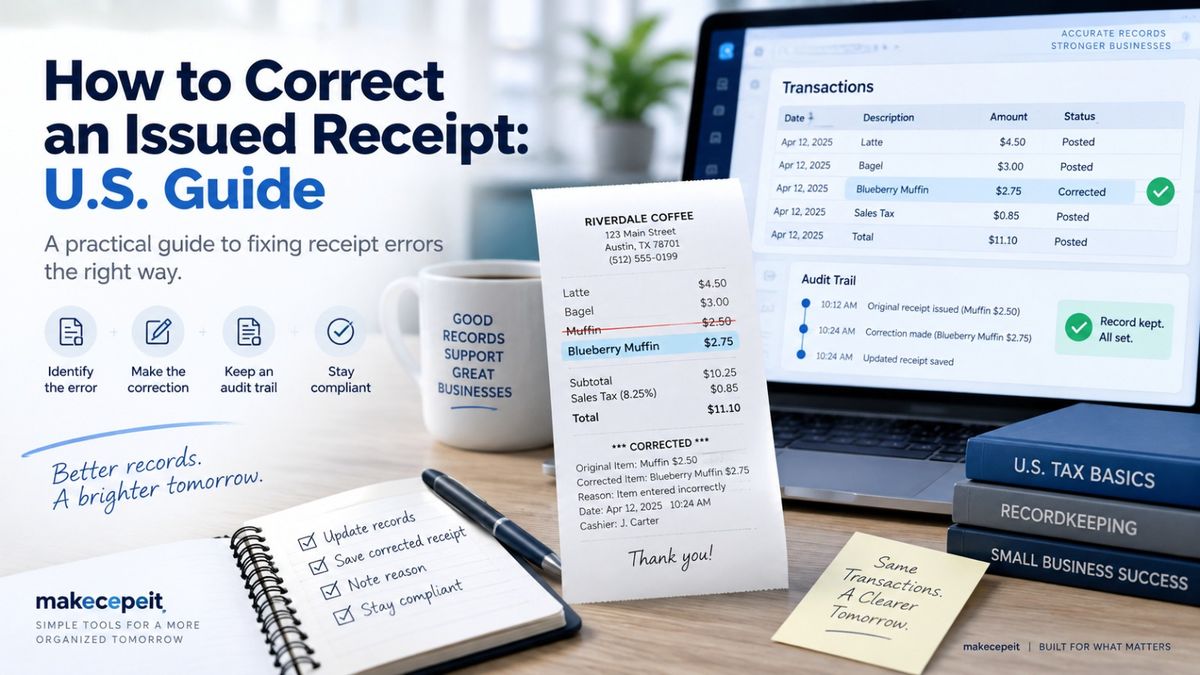
Yes, a receipt can usually be corrected after it has been issued, but the safest method is not to erase or secretly overwrite the original transaction. In most business situations, you should preserve the original record, document what was wrong, and then create a correction, void, refund, or replacement receipt that can be linked back to the original transaction.
For businesses in the United States, maintaining that audit trail is especially important because receipts may support bookkeeping, expense reporting, sales tax records, refunds, and federal or state tax documentation. Tools such as Makecepeit can help authorized users create a clear replacement or corrected receipt when accurate documentation of a genuine transaction is needed.
What Is the Correct Way to Fix an Issued Receipt?
The correct approach is to preserve the original transaction and create a traceable correction. What that correction looks like depends on the type of mistake and the capabilities of your POS, accounting, or receipt system.
- Locate the original receipt and transaction record.
- Identify exactly what information is incorrect.
- Determine whether the error affects the transaction amount, tax, inventory, or payment.
- Use your POS or accounting system's correction, void, refund, or adjustment function when available.
- Keep the original record rather than deleting it.
- Create a corrected or replacement receipt containing accurate information.
- Reference the original transaction or receipt number whenever possible.
- Give the corrected copy to the customer and retain the supporting records required by your business.
The IRS explains that businesses should maintain records supporting income and expenses, including documents such as receipts, invoices, sales slips, deposit records, and other transaction documentation.
Can You Simply Edit the Original Receipt?
Usually, editing the only existing copy of a completed transaction is not the best recordkeeping practice. An issued receipt represents a transaction at a particular moment. Changing that record without preserving what originally occurred can create inconsistencies between the receipt, payment processor, POS system, accounting ledger, inventory records, and sales tax reports.
If the mistake is purely presentational—for example, a spelling error in an authorized business document—your system may allow you to generate a corrected copy. Even then, it is wise to retain enough information to connect the replacement to the original transaction.
If the error changes money, tax, quantities, refunds, or payment information, the transaction usually requires a formal adjustment rather than a cosmetic edit.
A useful rule is simple: correct the documentation without destroying the history of what happened.
When Should You Void and Reissue a Receipt?
Void and reissue a receipt when the original transaction contains a material error that cannot safely be corrected through a simple documented adjustment.
This may apply when the wrong customer was charged, the transaction total is incorrect, the wrong items were entered, the payment needs to be reversed, or the sale itself should not have been completed.
Typical reasons to void a receipt
- An item was entered that the customer did not purchase.
- The wrong quantity was charged.
- The entire transaction was entered twice.
- The wrong customer transaction was processed.
- A payment was recorded even though the sale was canceled.
- Your POS system requires a void before creating the corrected transaction.
When a transaction is voided, keep the void record and issue the replacement as a new transaction if required by your system. Where possible, record the reason for the void and link the new receipt number to the old one.
How to Correct Different Types of Receipt Errors
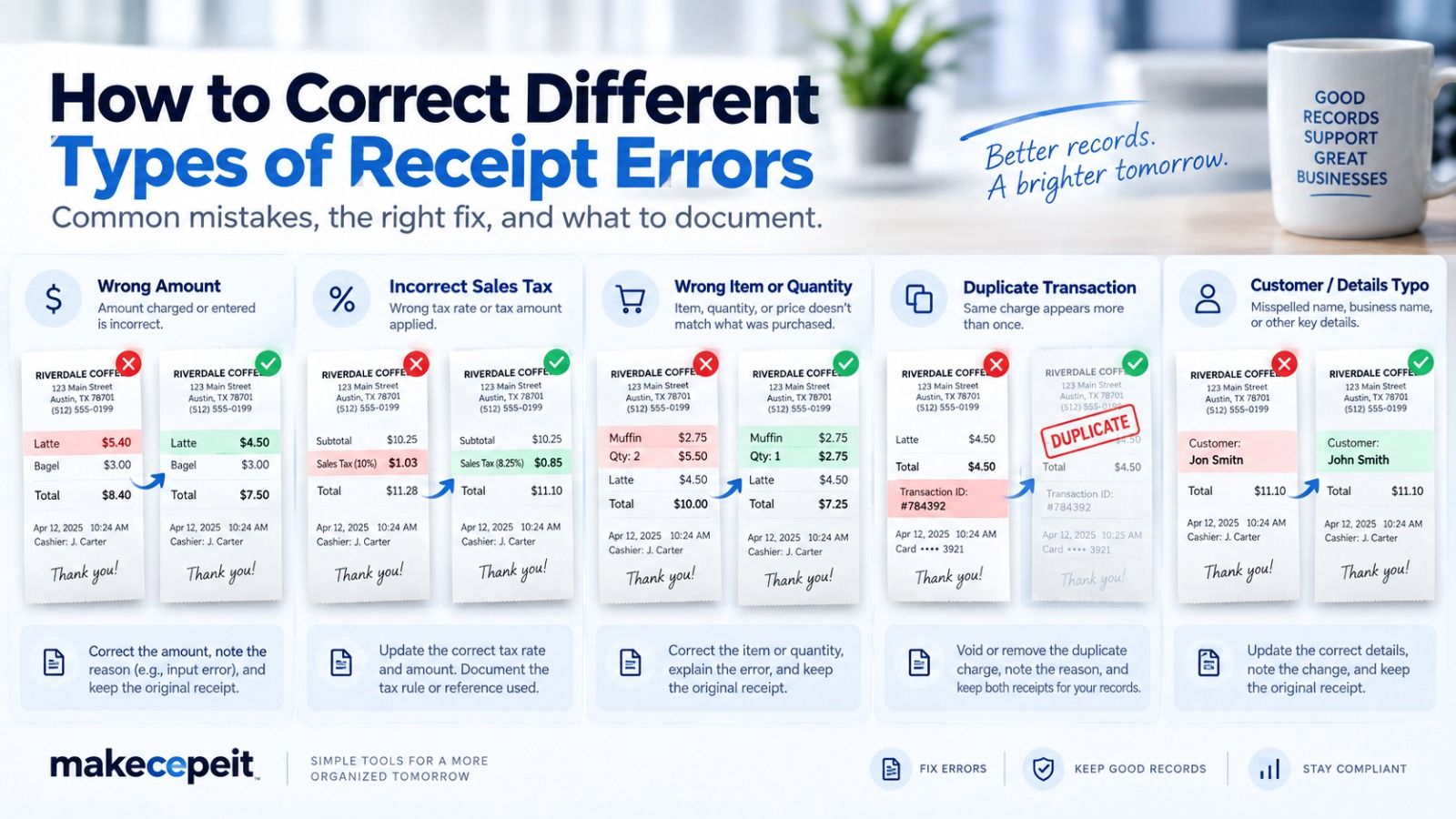
| Error | Recommended Action | Important Record |
|---|---|---|
| Customer or description typo | Create a corrected copy if permitted | Original transaction reference |
| Wrong item or quantity | Adjust, refund, or void and reissue | Original and corrected transaction |
| Wrong total | Reverse or adjust the financial transaction | Adjustment or refund record |
| Incorrect sales tax | Recalculate tax and process the required adjustment | Tax calculation and corrected receipt |
| Wrong payment method | Follow POS or processor correction procedures | Payment and transaction records |
| Duplicate receipt | Void the duplicate if it represents a duplicate transaction | Void record and valid receipt |
How to Correct a Receipt With the Wrong Amount
If the total amount is wrong, do not change the displayed number without correcting the underlying transaction. First determine why the amount is incorrect.
The error might come from an incorrect item price, quantity, discount, tax calculation, tip, service fee, or data-entry mistake. Recalculate the transaction from its individual components before creating the corrected document.
For example, verify:
- quantity multiplied by unit price;
- subtotal;
- discounts;
- taxable amount;
- sales tax;
- tip or gratuity where applicable;
- final amount paid.
If the customer was actually overcharged or undercharged, the correction may also require a refund, additional payment, credit, or accounting adjustment. The corrected receipt should match what ultimately happened financially.
How to Correct Sales Tax on an Issued Receipt
Sales tax errors require extra care because U.S. sales tax rules are primarily administered at the state and local level. The correct tax may depend on the type of product or service, where the transaction occurred or was delivered, applicable exemptions, and the state or local tax rate.
Do not simply replace the sales tax figure on a receipt while leaving the accounting record unchanged. Confirm the correct taxable amount and rate, then make the corresponding adjustment within your POS or bookkeeping system.
Requirements also vary by state. For example, New York requires registered sales tax vendors to maintain detailed sales records and true copies of receipts or similar sales documents, and POS records must contain enough information to determine the taxability of individual sales and the tax collected.
Texas likewise requires certain sales and use tax records, including sales receipts, invoices, or equivalent documentation showing tax collected, with applicable records generally retained for at least four years under the cited state provision.
Because requirements differ across states, businesses operating in places such as New York City, Los Angeles, Houston, Chicago, Miami, or multiple states should verify the rules applying to the specific transaction instead of relying on a single nationwide sales tax procedure.
Why Keeping the Original Receipt Matters
The original receipt provides the starting point of the audit trail. Keeping it allows a business to explain what changed, why it changed, and how the corrected amount reached the accounting system.
This matters when reconciling:
- daily sales reports;
- cash register totals;
- credit card settlements;
- inventory movements;
- refunds and returns;
- expense documentation;
- sales tax returns;
- business income records.
The IRS states that supporting documents such as sales slips, invoices, receipts, deposit slips, and canceled checks contain information used to support entries in business books and tax returns.
Deleting an incorrect transaction instead of documenting its correction can make reconciliation harder and may remove information that your accountant, tax professional, auditor, or state authority later needs.
What Should a Corrected Receipt Include?
A corrected receipt should contain enough information to identify the genuine transaction and explain its final, accurate details.
Include these fields when applicable
- business name and location;
- transaction date and time;
- corrected receipt number or transaction ID;
- reference to the original receipt;
- accurate items and quantities;
- unit prices;
- discounts;
- subtotal;
- sales tax;
- tip or other legitimate charges;
- final total;
- payment method;
- a notation such as "Corrected Receipt" or "Replacement Receipt" when appropriate.
A receipt number is particularly useful because it connects the customer-facing document with the transaction stored in a POS or accounting system.
Corrected Receipt vs. Reprinted Receipt vs. Refund Receipt
These documents are related but not identical.
| Document | Purpose |
|---|---|
| Reprinted receipt | Produces another copy of the same unchanged transaction. |
| Corrected receipt | Documents accurate information after an error has been identified. |
| Void receipt | Shows that the original transaction has been canceled. |
| Refund receipt | Records money returned to the customer. |
| Replacement receipt | Provides a new copy when the original was lost, damaged, or replaced with authorized documentation. |
The correct document depends on what actually happened. A simple reprint should not be used to disguise a financial correction, and a corrected receipt should not suggest that a refund occurred unless money was actually returned.
How Makecepeit Can Help With Legitimate Receipt Corrections
Makecepeit can be useful when an authorized business or user needs to create accurate receipt documentation for a genuine transaction. Its receipt builder allows fields such as business information, line items, prices, tax, tips, payment details, and dates to be customized with a live preview. The platform also supports exports including PDF and image formats.
This can be helpful when recreating an authorized replacement copy, preparing records for a real transaction, replacing a damaged or faded document, or producing a corrected receipt after the underlying accounting adjustment has already been handled.
Makecepeit also states that its receipt tools are intended for legitimate purposes such as recordkeeping, expense documentation, and design use—not for creating deceptive transactions.
The distinction is important: a receipt generator should document reality, not change it.
What to Check Before Issuing the Corrected Receipt
Before giving the customer a replacement document, compare it against the underlying transaction.
- Verify the original sale. Confirm the date, items, customer payment, and original receipt number.
- Identify the exact error. Avoid changing unrelated information.
- Check the payment record. The corrected receipt should agree with what was charged, refunded, or subsequently adjusted.
- Recalculate tax. Use the correct jurisdiction and taxable amount.
- Preserve the original. Do not destroy the transaction history merely because a new copy exists.
- Label the replacement clearly. Use "corrected," "replacement," or another designation appropriate to your system.
- Update bookkeeping records. Make sure the accounting entry agrees with the final transaction.
Common Mistakes to Avoid When Correcting a Receipt
Deleting the original transaction
Removing the source record can break the audit trail. Preserve it and document the correction instead.
Changing the receipt without changing the accounting record
If price, tax, refund, or payment information changes, the underlying financial records normally need to reflect the same change.
Reusing the original receipt number incorrectly
Your POS or accounting system may require a new number. When a new receipt is issued, reference the original number whenever possible.
Guessing the sales tax rate
U.S. sales tax can vary by jurisdiction and transaction type. Verify the applicable rate and taxability before issuing the correction.
Backdating or changing information to create a false record
A replacement receipt should accurately document a real transaction. Never alter a receipt to claim an expense that did not occur, increase reimbursement, obtain an improper refund, misrepresent tax information, or deceive another person or organization.
Confusing a replacement with a refund
Creating another receipt does not itself reverse a payment. Process the actual refund or payment adjustment through the appropriate financial system.
Why Receipt Corrections Matter for U.S. Businesses
Receipt accuracy affects more than customer service. For U.S. businesses, receipts may become supporting documents for bookkeeping, tax reporting, expense reimbursement, inventory management, payment disputes, warranty claims, returns, and audits.
State requirements can also differ substantially. New York, for example, requires detailed records capable of connecting POS transactions and receipts with sales tax information and generally requires covered sales tax records to be retained for at least three years.
That is why a small mistake on a receipt should be corrected systematically rather than treated as a document-design problem.
Final Checklist for Correcting an Issued Receipt
- Confirm that the original transaction genuinely occurred.
- Keep the original receipt or transaction record.
- Identify whether the error is clerical or financial.
- Use a POS adjustment, void, or refund where required.
- Recalculate totals and sales tax accurately.
- Create the corrected receipt only after the transaction records are accurate.
- Reference the original transaction when possible.
- Store both records according to your accounting and state requirements.
- Never create or alter receipts for deceptive purposes.
Conclusion
Knowing how to correct a receipt after it has been issued comes down to one principle: preserve the original transaction and make the correction traceable. A spelling mistake may require only a corrected copy, while an incorrect price, sales tax amount, payment, or quantity can require a formal adjustment, refund, void, or completely reissued transaction.
For businesses in the United States, keeping a reliable audit trail helps protect the accuracy of bookkeeping, tax reporting, payment reconciliation, and customer records. Always follow your POS procedures and applicable federal, state, and local requirements when the correction affects financial or tax information.
If you are authorized to document a genuine transaction and need a clean corrected or replacement receipt, Makecepeit provides editable receipt fields, live previews, and downloadable formats that can help you prepare an accurate final document. Make the accounting correction first, verify every detail, then create the receipt that reflects what actually happened.
Frequently asked questions
- Can I correct a receipt after it has already been issued?
- Yes. Preserve the original record and issue a documented correction, adjustment, void, refund, or replacement depending on the type of error.
- Should I delete an incorrect receipt?
- Generally, no. Keeping the original helps preserve the audit trail and makes the correction easier to explain and reconcile.
- Can I change the amount on an issued receipt?
- Only if the underlying transaction is corrected as well. Do not change the displayed total while leaving payment or accounting records inconsistent.
- What should I do if sales tax is wrong?
- Determine the correct taxable amount and applicable rate, process the required accounting adjustment, and issue corrected documentation. State requirements may vary.
- Is a corrected receipt the same as a reprinted receipt?
- No. A reprint duplicates the original transaction, while a corrected receipt reflects an authorized correction to inaccurate information.
- Do I need a new receipt number?
- Often, yes, especially when a new transaction is created. Follow your POS or accounting system and reference the original receipt number when possible.
- What if the customer was overcharged?
- Process the appropriate refund or adjustment first. The corrected receipt should then reflect the final financial outcome accurately.
- Can I recreate a lost receipt?
- A replacement may be created for a genuine transaction when authorized, but it should accurately represent the original purchase and should never be fabricated to obtain an improper benefit.
- How long should businesses keep corrected receipts?
- Retention requirements depend on the purpose and jurisdiction. Federal and state tax rules can differ, so businesses should follow applicable IRS, state, accounting, and industry requirements.
- Can Makecepeit be used to create a corrected receipt?
- Makecepeit can help authorized users prepare accurate documentation for legitimate transactions. Any replacement receipt should reflect a real transaction and should not be used to misrepresent expenses, refunds, purchases, or tax records.