How Discounts and Coupons Should Appear on Receipts
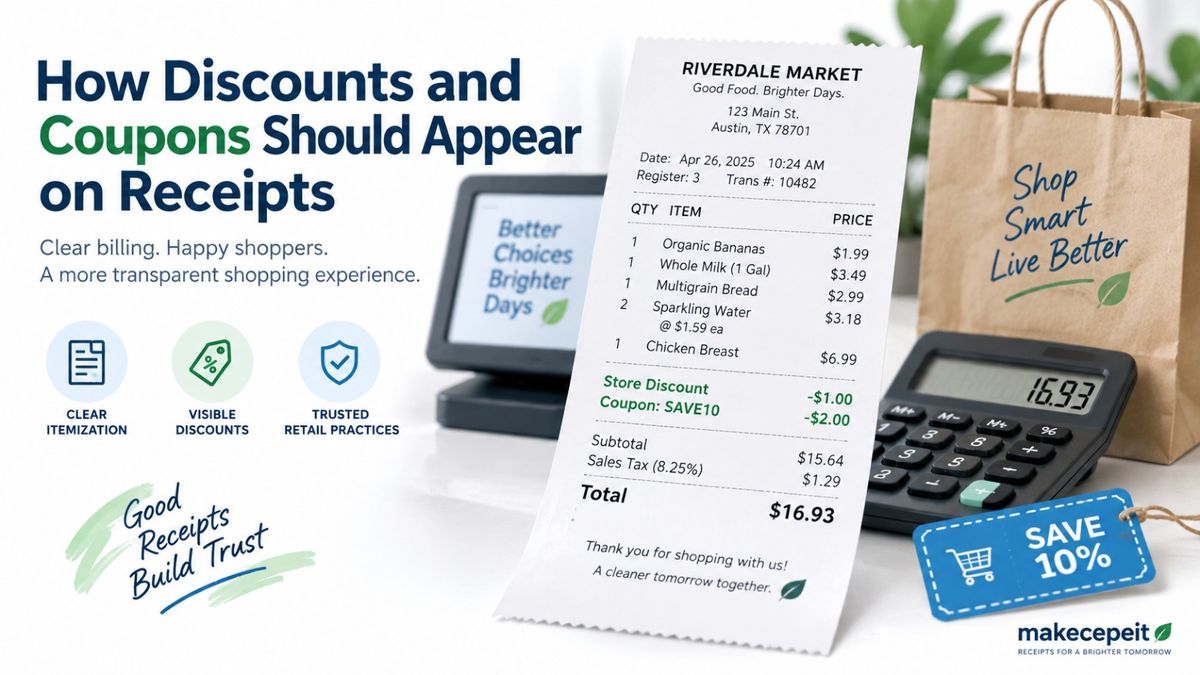
Discounts and coupons should appear clearly on an itemized receipt as separate reductions from the original price or subtotal, rather than being hidden inside the final amount. A well-structured receipt should allow the customer to see what each item originally cost, which discount or coupon was applied, how much was deducted, the taxable amount when relevant, the sales tax, and the final amount paid.
For businesses and consumers in the United States, this clarity is especially important because the sales-tax treatment of coupons can vary by state and by the type of promotion. Using a receipt-building tool such as makecepeit can help organize line items, discounts, tax, and payment information into a readable transaction record.
What Is the Correct Way to Show a Discount on an Itemized Receipt?
The clearest method is to show the original charge first and the discount immediately below the affected item or in a separate discount section beneath the subtotal. The discount should normally be displayed as a negative dollar amount or as a clearly labeled reduction.
For example, if a product normally costs $30 and a customer receives a $5 store discount, a readable receipt could display:
Product A — $30.00 · Store Promotion — -$5.00 · Net Item Price — $25.00
This format gives the customer an immediate explanation of why the amount charged is different from the listed price. It also makes the transaction easier to review later for returns, reimbursement requests, bookkeeping, or expense documentation.
If a promotion applies to the entire purchase rather than one particular item, it generally makes more sense to show the discount after the merchandise subtotal.
Should Coupons Appear as Separate Lines on a Receipt?
Yes. Whenever practical, a coupon should appear as a separately labeled line showing its value and, when useful, the promotion or coupon name.
A clear coupon line might look like:
- Store Coupon SAVE10: -$10.00
- Loyalty Discount: -$4.50
- Promotional Code WELCOME20: -$8.00
- Manufacturer Coupon: -$2.00
Showing the coupon separately is usually more transparent than silently changing the product price. Customers can confirm that the promotion was actually applied, while merchants retain a more useful transaction record.
The distinction between a retailer-funded discount and a manufacturer-funded coupon can also matter for sales-tax purposes in some states, making clear labeling useful for more than customer experience.
Where Should Discounts Appear: Before or After the Subtotal?
The correct location depends on what the promotion applies to.
Item-Level Discounts
An item-specific discount should normally appear directly beneath or beside the product it reduces. This connects the reduction to the correct merchandise and avoids confusion when multiple products are purchased.
Order-Level Discounts
A coupon or promotion applying to the entire transaction should usually appear after the merchandise subtotal and before the final total.
A useful order is:
- Individual products or services
- Quantity and unit price
- Item-level discounts
- Subtotal
- Order-level coupon or promotional discount
- Applicable taxable amount
- Sales tax
- Other legitimate charges, when applicable
- Grand total
- Payment method
This hierarchy lets the reader understand how the receipt moved from individual prices to the amount ultimately paid.
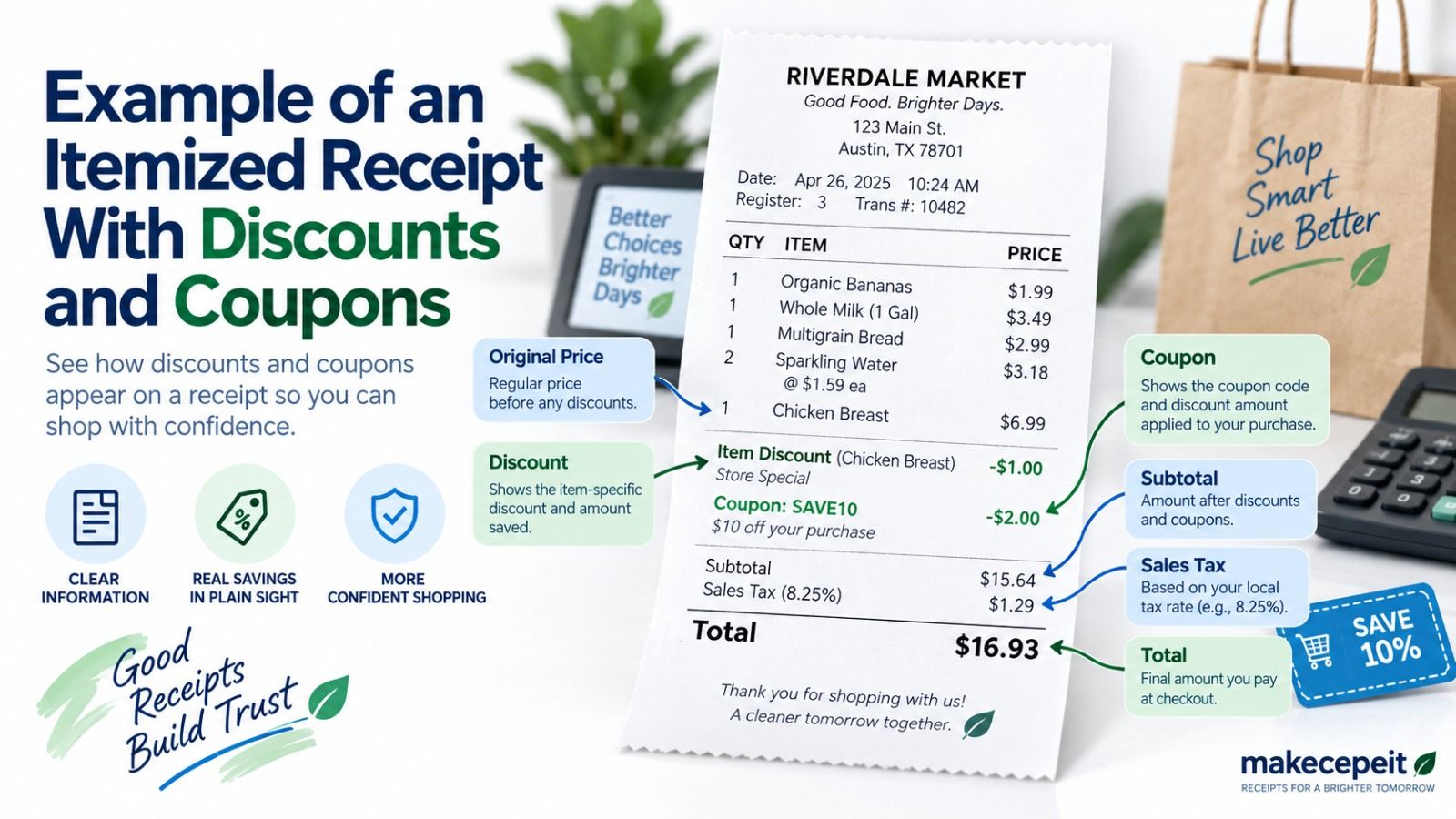
Example of an Itemized Receipt With Discounts and Coupons
Consider a simple retail transaction in which one discount applies to an individual product and another promotion applies to the order.
| Receipt Entry | Amount | Recommended Presentation |
|---|---|---|
| Product A | $29.99 | Original item price |
| Item Promotion | -$5.00 | Directly below Product A |
| Product B | $14.00 | Original item price |
| Subtotal After Item Discount | $38.99 | Separate subtotal line |
| Order Coupon | -$3.90 | Clearly labeled reduction |
| Adjusted Amount | $35.09 | Amount before applicable tax |
| Sales Tax | Calculated under applicable rules | Separate tax line |
| Total | Final amount due | Visually prominent |
The important principle is traceability. Someone reading the receipt should be able to reconstruct the transaction without guessing how the merchant reached the total.
How Do Discounts and Coupons Affect Sales Tax in the United States?
There is no single coupon-tax rule that should be assumed for every U.S. transaction. The tax treatment can depend on the state, the nature of the discount, and whether a retailer receives reimbursement from a manufacturer or another third party.
New York guidance, for example, explains that discounts that genuinely reduce the selling price can reduce the taxable receipt. It also notes that store-issued coupons generally reduce the taxable receipt while manufacturer coupons can receive different treatment because the merchant may be reimbursed.
California similarly distinguishes retailer-funded discounts from certain manufacturer coupons and third-party reimbursements. The California Department of Tax and Fee Administration explains that manufacturer reimbursement can be included in taxable sales under applicable circumstances.
Texas guidance for grocery and convenience stores states that cash discounts reduce the item's price and treats coupons as cash discounts in that context, with tax collected on the resulting price.
These differences are why a business operating in New York City, Los Angeles, Austin, Chicago, or another U.S. market should configure its POS or receipt workflow according to the rules that apply to the actual transaction rather than relying on a generic national assumption.
A clear receipt should document what happened commercially. The tax calculation behind that receipt should then follow the applicable state and local requirements.
What Types of Discounts Should Be Identified on a Receipt?
Different promotions should be labeled in a way that makes their purpose understandable. Common categories include:
- Item discount: A reduction attached to one specific product or service.
- Store coupon: A merchant-funded coupon that lowers the customer's charge.
- Manufacturer coupon: A coupon associated with a product manufacturer and potentially reimbursed to the retailer.
- Order discount: A percentage or dollar reduction applied to the overall qualifying purchase.
- Loyalty discount: A reduction connected to a rewards or membership program.
- BOGO promotion: A buy-one-get-one or similar multi-item promotion.
- Promotional code: An online or in-store code such as SAVE10 or WELCOME20.
Specific labels are preferable to vague wording such as simply "Adjustment." The receipt should tell the customer what changed and why.
Why Clear Discount Itemization Matters in the United States
Receipt clarity has practical value for both customers and businesses. American consumers commonly use receipts for returns, warranties, reimbursements, budgeting, and expense reports. Businesses rely on transaction records for accounting, reconciliation, customer service, and tax documentation.
The IRS explains that supporting documents for business purchases and expenses should help establish information such as the payee, amount paid, payment evidence, date, and a description of what was purchased. Cash-register receipts, credit-card receipts, and invoices can form part of those records.
While that does not create a universal federal format for displaying every coupon, it illustrates why detailed transaction documentation is more useful than a receipt showing only a final total.
Good itemization also reduces customer-service friction. A buyer can immediately determine whether a $10 coupon was accepted instead of contacting the merchant because the expected discount cannot be identified.
What Information Should Accompany a Discount on a Receipt?
A receipt does not need excessive detail, but the discount entry should contain enough information to explain the reduction.
Depending on the transaction, useful fields include:
- Original item price
- Product or service description
- Quantity
- Discount or coupon name
- Dollar value of the discount
- Percentage discount, when helpful
- Promotion code, if relevant
- Subtotal before an order-wide reduction
- Adjusted or taxable subtotal where appropriate
- Sales-tax amount
- Final transaction total
There is usually no benefit in cluttering a customer-facing receipt with internal campaign IDs or accounting codes unless they have a genuine operational purpose.
How Should Percentage Discounts Be Displayed?
A percentage discount should ideally show both the percentage and the dollar amount deducted.
For example:
Seasonal Discount (20%) — -$12.00
Displaying only "20% OFF" forces the customer to calculate the savings independently. Showing the actual dollar reduction makes the receipt easier to verify.
When the percentage applies only to selected items, placing the discount near those items is clearer than placing it at the bottom of the receipt without explanation.
How Should Buy-One-Get-One Promotions Appear?
BOGO transactions should preserve the connection between the qualifying products and the promotion.
One readable approach is:
Item A — $12.00 · Item A — $12.00 · BOGO Promotion — -$12.00
Another valid layout may show the second qualifying item at $0.00 with a label such as "BOGO Promotional Price." What matters is that the receipt clearly explains why one item's effective price was reduced.
Businesses should still verify how the promotion affects the taxable amount in their jurisdiction rather than assuming the visual receipt format determines tax treatment.
Common Mistakes When Showing Discounts on Receipts
Hiding the Discount Inside the Final Price
Changing a $50 product to $40 without showing the $10 promotion can make it difficult for customers to verify whether the intended offer was applied.
Using Unclear Labels
Entries such as "MOD," "ADJ," or unexplained internal codes can confuse customers. Use recognizable descriptions whenever possible.
Applying a Transaction Coupon to the Wrong Item
If an order-level discount is displayed next to one unrelated product, the receipt can imply that only that product received the reduction.
Mixing Tax and Discount Lines
Sales tax should remain identifiable as its own amount rather than being combined with discounts or other adjustments.
Assuming Every Coupon Has the Same Tax Treatment
Store discounts, manufacturer coupons, rebates, loyalty offers, and third-party promotions can be treated differently depending on state law and the structure of the program.
Creating a Receipt That Does Not Match the Real Transaction
A receipt should accurately document a legitimate transaction. Never alter or generate receipt information for the purpose of misleading an employer, merchant, insurer, tax authority, financial institution, or other party.
Best Practices Before Finalizing an Itemized Receipt
Before issuing or saving a receipt containing promotions, review it from the perspective of someone who did not witness the transaction.
- Confirm every product or service appears with the correct quantity and price.
- Check that item-specific discounts are attached to the correct products.
- Display transaction-wide coupons after the appropriate subtotal.
- Use recognizable discount and coupon labels.
- Show the dollar amount deducted even when a percentage is displayed.
- Keep sales tax on a separate line.
- Verify that the tax calculation follows the applicable state and local rules.
- Confirm the final total matches the amount actually paid.
- Include the appropriate transaction date and merchant details.
- Keep the layout simple enough to read on paper and digital screens.
Why Use makecepeit for Clear Itemized Receipts?
For users who need to build a clear receipt from legitimate transaction information, makecepeit provides a receipt-building workflow where business details, line items, prices, tax, tips, and payment information can be customized while viewing the receipt as it is created. The platform also supports downloadable receipt formats such as PDF and image files.
This type of visual workflow is useful when discounts need to remain understandable alongside the original merchandise, subtotal, tax, and final amount. Instead of treating the total as a single number, the receipt can be structured as a sequence that explains how the transaction was calculated.
For businesses, freelancers, and consumers, the goal should always be accurate documentation. A professional-looking receipt is valuable only when the underlying transaction information is truthful and consistent with applicable accounting and tax requirements.
A Simple Formula for Organizing Receipt Totals
For many straightforward retailer-funded promotions, the visual structure can be understood as:
Line Items → Item Discounts → Subtotal → Order Discounts → Applicable Taxable Amount → Sales Tax → Other Applicable Charges → Final Total
This is a presentation framework, not a universal sales-tax formula. The actual taxable base may depend on the jurisdiction and the source or structure of the promotion.
Final Takeaway
Discounts and coupons on an itemized receipt should be visible, clearly labeled, and easy to connect to the products or subtotal they reduce. Item-level discounts belong near the affected item, while order-wide coupons are generally easier to understand when shown beneath the subtotal. The receipt should then identify the relevant taxable amount, sales tax, and final total without forcing the customer to reverse-engineer the transaction.
For U.S. transactions, businesses should pay particular attention to the distinction between retailer discounts, manufacturer coupons, rebates, and third-party promotions because their sales-tax treatment can vary by jurisdiction.
When you need to create a clear record of a legitimate transaction, makecepeit offers a practical way to organize itemized charges, discounts, taxes, and payment details into a readable receipt. Review every figure against the real transaction and applicable local tax rules before using the finished document.
Create a Clearer Receipt With makecepeit
If you need to organize a legitimate transaction into a professional itemized receipt, use makecepeit to structure the items, discounts, tax, and payment details clearly. Enter the real transaction information, review the totals carefully, and create a receipt that is straightforward for customers, bookkeeping, and recordkeeping.
Frequently asked questions
- How should discounts appear on an itemized receipt?
- Show the original price and display the discount as a clearly labeled negative amount. Item-specific discounts should appear near the relevant product.
- Should coupons be listed separately on a receipt?
- Yes. A separate coupon line makes it easier to verify the promotion and understand how the final total was calculated.
- Should a coupon appear before or after the subtotal?
- Item-level coupons usually belong beside the affected item. An order-wide coupon is generally clearest when shown after the merchandise subtotal.
- Is sales tax calculated before or after a coupon?
- It depends on the jurisdiction and coupon type. Retailer discounts and manufacturer-funded coupons can receive different tax treatment under state rules.
- How should a percentage discount appear?
- Show both the percentage and the dollar reduction when possible, such as "20% Promotion — -$10.00."
- How should a manufacturer coupon appear on a receipt?
- Label it clearly as a manufacturer coupon rather than a generic discount, especially where reimbursement may affect the taxable amount.
- Should the receipt show the original price before the discount?
- Yes, when practical. Showing the original price makes the customer's savings transparent and helps explain the transaction.
- How should a BOGO discount appear?
- Show both qualifying items and either list the promotional reduction separately or clearly identify the free item's promotional price.
- What should an itemized receipt include?
- A useful receipt typically includes merchant information, transaction date, individual items, quantities, prices, discounts, subtotal, tax, total, and payment information.
- Are coupon rules the same in every U.S. state?
- No. Sales-tax treatment can vary by state, locality, coupon type, and whether a third party reimburses the retailer.