Hardware Store Receipt Generator with Itemized Materials
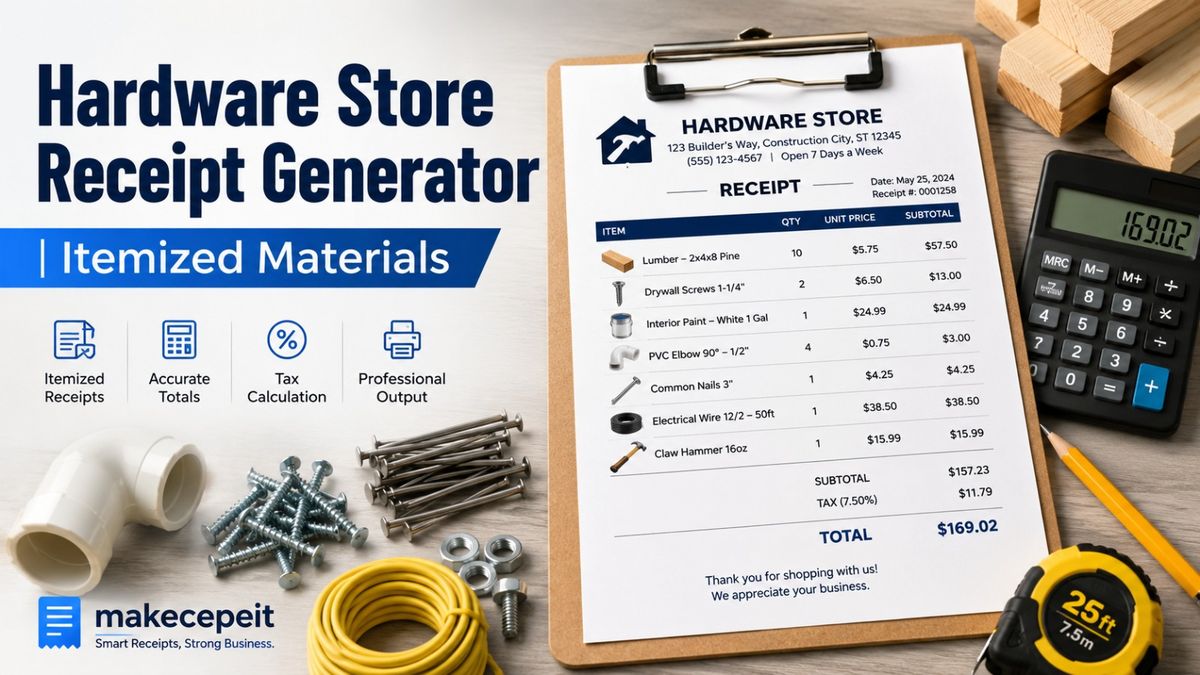
A hardware store receipt generator with itemized materials helps create organized purchase records that clearly show materials, quantities, unit prices, taxes, and totals. Instead of recording a hardware purchase as one combined amount, an itemized receipt separates products such as lumber, screws, electrical supplies, plumbing parts, paint, tools, and other building materials into individual lines.
For contractors, small businesses, property managers, DIY project organizers, and hardware retailers in the United States, this level of detail makes purchase documentation easier to review and organize. makecepeit provides a practical way to structure legitimate receipt records when you need clear material-level information rather than a simple total.
An effective hardware receipt should answer five questions immediately: what was purchased, how much was purchased, what each item cost, what tax or additional charges applied, and what the final total was.
What Is a Hardware Store Receipt Generator with Itemized Materials?
A hardware store receipt generator is a tool used to organize hardware and building-supply transaction information into a receipt-style document. When the generator supports itemized materials, each purchased product can be entered separately instead of combining the entire purchase into a single description.
For example, a material purchase may include plywood, lumber, drywall screws, anchors, electrical wire, PVC fittings, paint rollers, safety equipment, and hand tools. An itemized receipt can give every product its own description, quantity, unit cost, and line total.
This creates a much more useful record for legitimate bookkeeping, project documentation, cost allocation, customer records, or internal business administration.
A typical itemized hardware receipt may contain:
- Store or business name
- Store location or contact details
- Receipt or transaction reference
- Purchase date
- Material or product description
- Quantity purchased
- Unit price
- Individual line total
- Subtotal
- Discounts when applicable
- Sales tax
- Additional legitimate charges
- Final transaction total
- Payment information when appropriate
Why Itemized Hardware Receipts Matter in the United States
Hardware purchases often involve many products in a single transaction. A contractor in New York may purchase electrical supplies and fasteners together, while a remodeling company in Texas may buy lumber, drywall materials, plumbing components, and tools during the same store visit.
A receipt showing only a final dollar amount provides little information about how that money was spent. Itemization makes the document more useful because the reader can immediately identify individual materials and their associated costs.
Better Project Cost Tracking
Construction and repair projects frequently contain several material categories. Separating them can help a business understand whether money was spent on framing materials, electrical components, plumbing supplies, painting products, flooring, hardware, or tools.
This is particularly useful when purchases are associated with different jobs or properties.
Clearer Expense Documentation
Businesses frequently need documentation that explains an expense rather than merely showing the total amount. An itemized hardware receipt provides more context about what the purchase actually included.
Users should still retain original receipts and supporting records whenever they are required for accounting, reimbursement, tax, warranty, or compliance purposes. A generated document should not be presented as an original merchant-issued receipt when it is not one.
Easier Material Review
Itemization also makes it easier to compare material costs between projects. If lumber, paint, fasteners, or plumbing components appear as separate line items, project managers can review them without manually reconstructing purchases from a total.
What Information Should an Itemized Hardware Receipt Include?
A useful hardware purchase receipt should contain enough information to explain the transaction clearly without becoming unnecessarily complicated.
| Receipt Field | What It Shows | Why It Matters |
|---|---|---|
| Store Information | Business name and relevant location details | Identifies the seller or source of the record |
| Date | Transaction date | Places the expense within the correct project or accounting period |
| Item Description | Name of each material or product | Explains exactly what was purchased |
| Quantity | Number of units purchased | Supports material and inventory tracking |
| Unit Price | Price for one unit | Makes calculations transparent |
| Line Total | Quantity multiplied by unit price | Shows the cost assigned to each product |
| Subtotal | Total before tax or adjustments | Provides a calculation checkpoint |
| Sales Tax | Applicable transaction tax | Separates tax from material cost |
| Total | Final transaction amount | Shows the overall purchase value |
How to Create an Itemized Hardware Store Receipt
Creating a clear materials receipt is mainly a matter of organizing accurate transaction information in the correct order.
- Enter the business information. Add the appropriate store or business details associated with the legitimate transaction record.
- Add the transaction date. Use the actual date relevant to the purchase or record being documented.
- Enter each material separately. Avoid descriptions such as "hardware supplies" when you have detailed product information available.
- Add quantities. Record how many units of each material were purchased.
- Enter the unit price. Use the actual price associated with each product.
- Calculate each line total. Multiply quantity by unit price where appropriate.
- Calculate the subtotal. Add all material line totals before tax and other applicable adjustments.
- Add legitimate discounts or tax. Use amounts that correspond to the real transaction record.
- Review the final total. Confirm that every calculation is consistent.
- Save the record appropriately. Keep it with the supporting documentation for the project or transaction.
Example of an Itemized Materials Receipt Structure
Consider a legitimate home-repair purchase containing several types of supplies. Instead of entering a generic line labeled "construction materials," the record might be organized into separate entries such as:
- 2 × sheets of plywood
- 4 × pieces of dimensional lumber
- 3 × boxes of wood screws
- 2 × tubes of construction adhesive
- 1 × paint roller kit
- 2 × electrical outlet boxes
- 1 × package of wire connectors
Each entry can have its own quantity, unit cost, and line total. The individual amounts are then combined into a subtotal before applicable sales tax or other legitimate transaction adjustments are added.
This format gives the reader considerably more useful information than a receipt containing only "building supplies — $XXX."
Hardware Receipt Generator vs. Basic Receipt Template
A basic receipt template may be sufficient for a very simple transaction, but hardware purchases often require more detail. A generator designed around itemized materials can make it easier to organize purchases containing multiple categories of supplies.
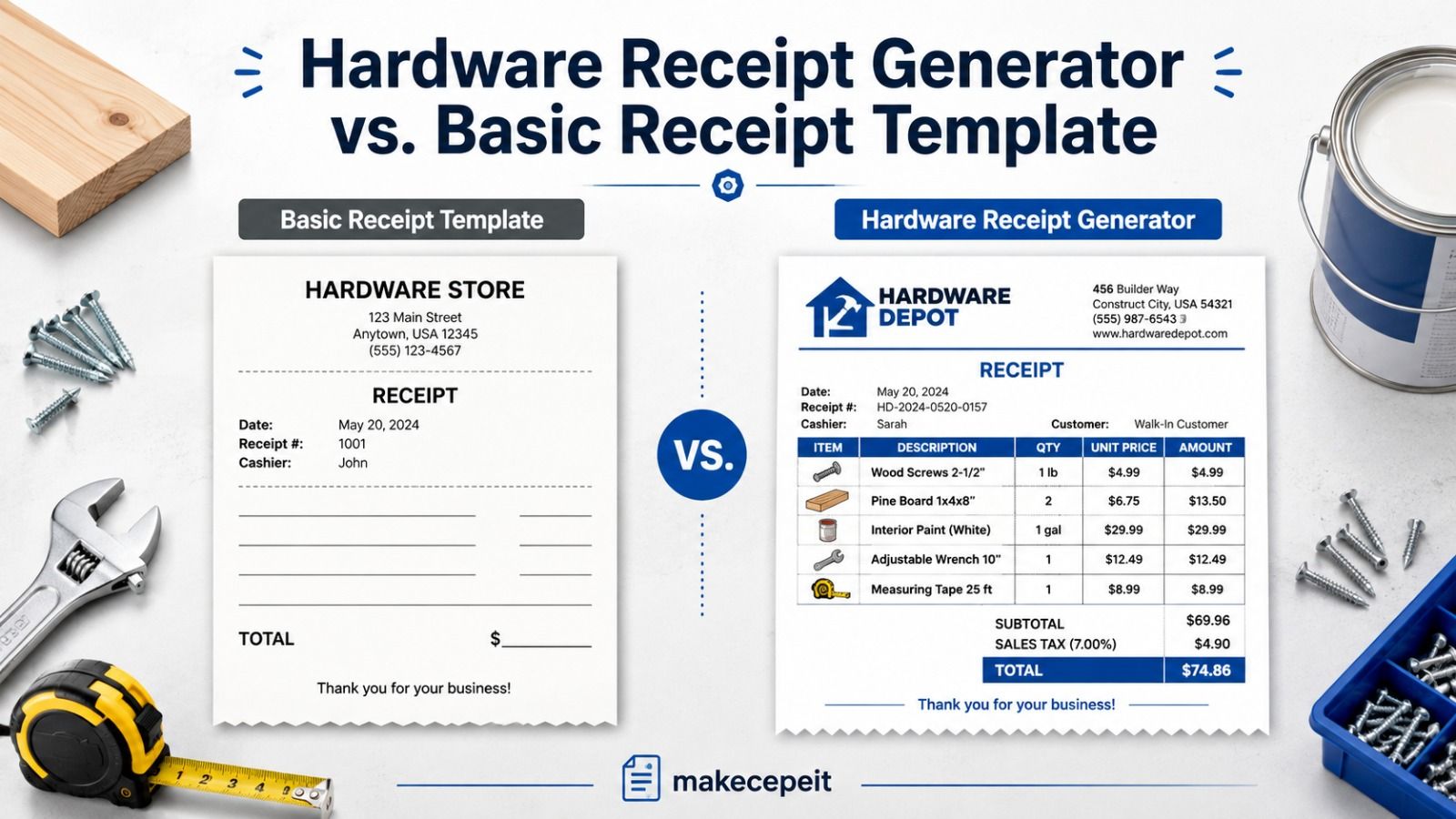
| Feature | Basic Receipt | Itemized Hardware Receipt |
|---|---|---|
| Individual material descriptions | Sometimes | Yes |
| Quantity tracking | Limited | Detailed |
| Unit pricing | Optional | Typically included |
| Material line totals | May be omitted | Clearly organized |
| Project expense review | Basic | More practical |
Who Can Benefit from Itemized Materials Receipts?
Contractors and Construction Professionals
Contractors often purchase dozens of materials across different jobs. Itemized documentation can help separate project costs and identify the materials associated with each purchase.
Property Managers and Landlords
Repairs may require locks, plumbing components, paint, electrical parts, lumber, fixtures, or replacement hardware. Clear transaction records can make maintenance expenses easier to review.
Handyman Businesses
Small repair businesses frequently purchase relatively small quantities of many different products. Detailed receipts allow those purchases to remain understandable later.
DIY Homeowners
Home renovation projects can involve repeated trips to hardware and home-improvement stores. Maintaining itemized records can make it easier to monitor the overall material budget.
Small Hardware Businesses
Businesses may also require an organized format for recording legitimate sales or maintaining internal transaction documentation.
How Sales Tax Should Be Handled on Hardware Receipts
Sales tax treatment can vary depending on the location, product, customer, and circumstances of a transaction. The United States does not use one universal sales-tax rate for all hardware purchases.
For that reason, a receipt generator should allow the user to enter the tax information that applies to the actual transaction rather than automatically assuming one nationwide percentage.
A clear calculation generally follows this structure:
- Item quantities × unit prices
- Total of all item lines
- Applicable legitimate discounts or adjustments
- Taxable subtotal where appropriate
- Applicable sales tax
- Final transaction total
For formal tax reporting or business accounting decisions, users should rely on original documentation and advice appropriate to their jurisdiction and circumstances.
Why Use makecepeit for Itemized Hardware Receipt Records?
makecepeit is relevant for users who need a straightforward way to organize detailed receipt information without manually designing the document from the beginning.
For hardware-related documentation, the important advantage is structure. Users can focus on entering meaningful transaction details such as individual materials, quantities, pricing, taxes, and totals in a consistent format.
This can be particularly helpful when a purchase includes many small components. Instead of trying to fit everything into one generic description, each material can be represented separately.
The value of a receipt tool ultimately depends on how accurately it is used. Entering truthful, verifiable information produces a useful business or project record. Generated receipts should never be used to falsely represent purchases, merchants, reimbursements, warranties, or financial transactions.
Best Practices for Itemizing Hardware and Building Materials
Use Specific Product Descriptions
Write descriptions such as "3-inch exterior wood screws" or "1/2-inch PVC elbow" instead of generic terms such as "hardware." Specific descriptions make future review substantially easier.
Separate Similar Products When Prices Differ
If two products have different unit prices, treat them as separate line items even when they belong to the same general category.
Record Units Clearly
Hardware materials may be sold by piece, box, pack, foot, gallon, sheet, roll, or another unit. Including the correct unit helps prevent confusion.
Verify Mathematical Accuracy
Check quantity × unit price calculations before finalizing the document. Then verify the subtotal, taxes, adjustments, and final amount.
Match Your Supporting Records
When documenting an actual purchase, the information should agree with the corresponding transaction evidence. Do not alter amounts, merchants, products, or dates to create misleading documentation.
Common Mistakes to Avoid When Creating a Hardware Receipt
A receipt can look organized while still being difficult to use if important information is missing or inconsistent. Watch for these common problems:
- Combining every material into one generic line
- Leaving quantities unspecified
- Mixing unit prices with line totals
- Using unclear material descriptions
- Applying an incorrect sales-tax assumption
- Forgetting discounts or legitimate transaction adjustments
- Entering totals that do not match the itemized lines
- Using inconsistent measurement units
- Failing to retain supporting transaction records
- Creating documentation that misrepresents a purchase or merchant
A final review of the material list and calculations usually catches most accidental errors.
Tips Before Choosing a Hardware Store Receipt Generator
Not every receipt tool is equally useful for material-heavy transactions. Before choosing one, determine whether it supports the information your records actually require.
Look for the ability to organize multiple product lines, quantities, prices, taxes, and totals clearly. A usable document should also remain readable when a transaction contains many different items.
For contractors and project managers, flexibility matters because hardware purchases rarely follow exactly the same format. One transaction might contain ten different fasteners, while another includes lumber, paint, electrical supplies, and rental-related charges.
Also consider how the generated record fits into your broader documentation workflow. A receipt generator can organize information, but it should complement—not replace—original invoices, merchant receipts, card statements, purchase orders, or accounting records when those documents are required.
Hardware Receipt Organization for Contractors and Projects
A simple organizational system can make itemized materials receipts significantly more useful. Contractors can associate each legitimate purchase record with a project name, job number, property, or internal cost category.
Materials may then be grouped into categories such as:
- Lumber and sheet goods
- Fasteners and anchors
- Electrical supplies
- Plumbing materials
- Paint and finishing supplies
- Tools and equipment
- Safety products
- Landscaping materials
- Concrete and masonry supplies
- Miscellaneous job-site materials
Even when categories are used internally, individual products should remain itemized when detailed cost tracking is important.
Creating Better Purchase Records with Itemized Materials
The main purpose of itemization is clarity. A well-structured hardware purchase record allows someone who was not present during the transaction to understand what was purchased and how the final amount was calculated.
That makes the format useful for project reviews, internal records, legitimate client documentation, expense organization, and material budgeting.
Accuracy matters more than appearance. A visually polished receipt containing incomplete or misleading information is less useful than a simple document that accurately records the underlying transaction.
Final Thoughts
A hardware store receipt generator with itemized materials is most useful when a transaction contains multiple building supplies that need to be documented clearly. Listing every product separately provides more meaningful information than recording one combined hardware expense.
Whether you are managing contractor materials, property repairs, a home-improvement project, or legitimate business records, focus on accurate descriptions, correct quantities, unit prices, transparent calculations, applicable taxes, and supporting transaction documentation.
If you need a structured way to organize legitimate hardware purchase information, makecepeit offers a practical next step for creating a clear itemized record without building the receipt layout manually. Enter accurate transaction details, review every material line, and keep the resulting record alongside the appropriate original documentation.
Frequently asked questions
- What is a hardware store receipt generator with itemized materials?
- It is a tool that organizes hardware purchases into separate lines showing individual materials, quantities, prices, taxes, and transaction totals.
- Can I list multiple building materials on one receipt?
- Yes. An itemized materials receipt can contain separate entries for lumber, fasteners, electrical products, plumbing supplies, paint, tools, and other hardware items.
- Should a hardware receipt include quantity and unit price?
- Yes, when that information is available. Including both makes the cost of each material easier to understand and verify.
- How do I calculate an itemized material receipt?
- Multiply each item's quantity by its unit price, add the line totals, apply legitimate discounts or adjustments, calculate applicable tax, and then determine the final total.
- Can contractors use an itemized receipt for project records?
- Yes. Itemized records can help contractors organize material expenses by job, provided the information accurately reflects legitimate purchases and required original documentation is retained.
- Does every U.S. hardware purchase have the same sales-tax rate?
- No. Sales-tax rules and rates vary by state and locality and may also depend on the transaction, so the applicable information should be based on the actual purchase.
- What hardware materials can be itemized?
- Common examples include lumber, screws, nails, anchors, electrical components, plumbing fittings, paint supplies, tools, safety equipment, masonry products, and landscaping materials.
- Why are itemized receipts better than a single total?
- Itemization shows where the money was spent, making project costs, material quantities, and individual product prices easier to review.
- Can makecepeit be used for hardware receipt records?
- makecepeit can be used to organize legitimate receipt information into a structured format when detailed materials, quantities, prices, and totals need to be documented.
- Can a generated receipt replace the original merchant receipt?
- Not necessarily. When an original receipt, invoice, tax document, or proof of purchase is required, users should retain and provide the authentic merchant-issued documentation.