Dental Payment Receipt Generator
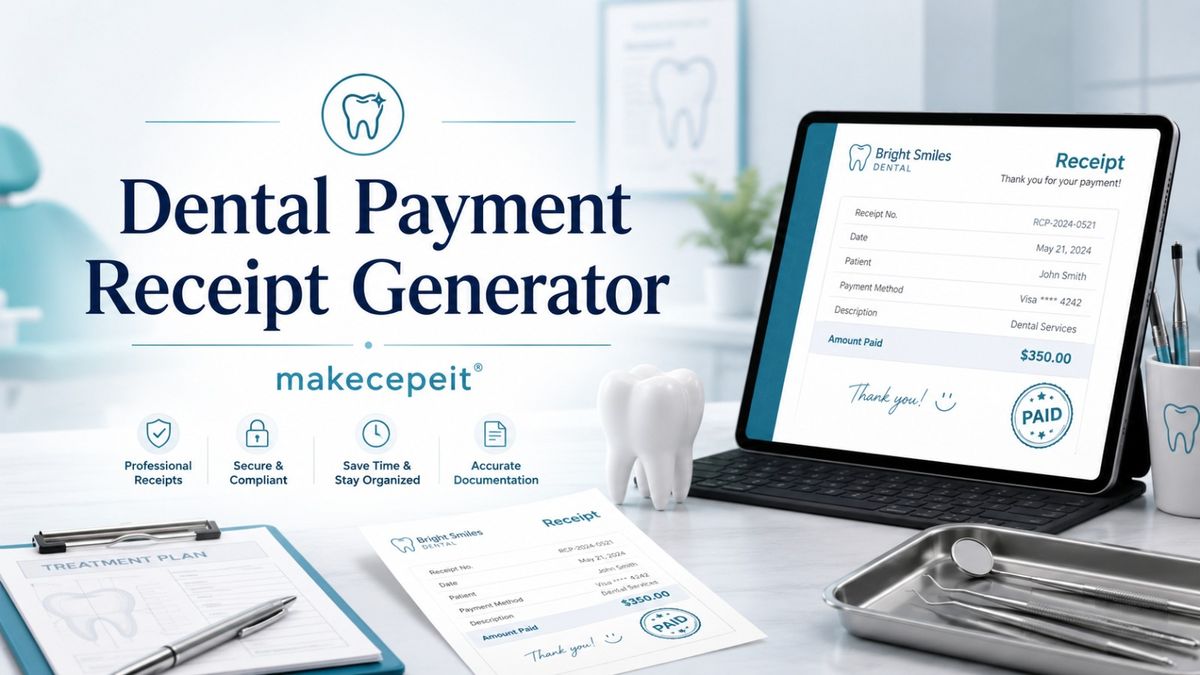
A dental payment receipt generator helps create a clear record showing that a patient paid a specific amount for dental services. A useful receipt normally identifies the dental practice, patient, payment date, amount paid, payment method, relevant treatment or service description, and any remaining balance. Patients, dental offices, independent practitioners, and administrative staff may use receipts for personal records, reimbursement documentation, bookkeeping, or payment confirmation.
With a tool such as makecepeit, users can prepare a structured dental payment receipt without building the document manually from scratch. The important goal is not simply making a receipt look professional. The information must accurately reflect a real transaction and should contain only the patient and treatment information that is genuinely necessary for the intended purpose.
What Is a Dental Payment Receipt Generator?
A dental payment receipt generator is an online tool used to prepare documentation confirming payment for dental services. Instead of manually formatting a receipt in a word processor or spreadsheet, the user enters the relevant transaction information and creates a structured document that can be saved, printed, or shared when appropriate.
Dental payments can involve cleanings, examinations, fillings, crowns, root canal treatment, orthodontic services, dentures, implants, emergency treatment, and many other types of care. A payment receipt provides a record of the financial transaction associated with those services.
Quick answer: A dental payment receipt proves or documents that money was paid. It is different from a treatment estimate, invoice, insurance claim form, or Explanation of Benefits.
The distinction matters. The American Dental Association describes the ADA Dental Claim Form as a standardized format for reporting dental services to a patient's dental benefit plan, while an Explanation of Benefits is issued after a payer processes a claim and explains the benefit determination. A payment receipt serves a different purpose: documenting the payment transaction itself.
What Should a Dental Payment Receipt Include?
A useful dental receipt should make the transaction understandable without adding unnecessary information. The exact fields may vary depending on the practice, payer, reimbursement request, or accounting system.
Dental practice information
Include the dental practice or provider name and appropriate contact information. A practice may also include its business address or telephone number when those details are useful for verifying the transaction.
Patient information
The receipt should identify the patient sufficiently for its intended purpose. Avoid adding unnecessary medical or personal information simply to make the document appear more detailed.
Receipt number
A unique receipt or transaction number can make recordkeeping easier. It helps a patient or dental office identify a particular payment if questions arise later.
Payment date
Record the actual date the payment was received rather than automatically using the date the document was generated.
Dental service description
A brief description can identify what the payment relates to, such as a dental examination, cleaning, filling, crown, orthodontic payment, or other service. Whether procedure codes or additional clinical details are appropriate depends on the purpose of the document.
Amount charged and amount paid
When applicable, distinguish between the original charge, insurance adjustment or payment, patient payment, and remaining balance. This prevents a receipt from incorrectly suggesting that the full account was paid when the transaction covered only part of the balance.
Payment method
The receipt may indicate whether payment was made by cash, credit card, debit card, check, or another accepted method. For security, a receipt should not display full payment-card details.
Remaining balance
If the payment was partial, clearly showing the remaining balance can reduce confusion for both the practice and patient.
Dental Receipt vs. Invoice vs. EOB vs. Claim Form
Patients often encounter several documents during dental treatment, and they are not interchangeable.
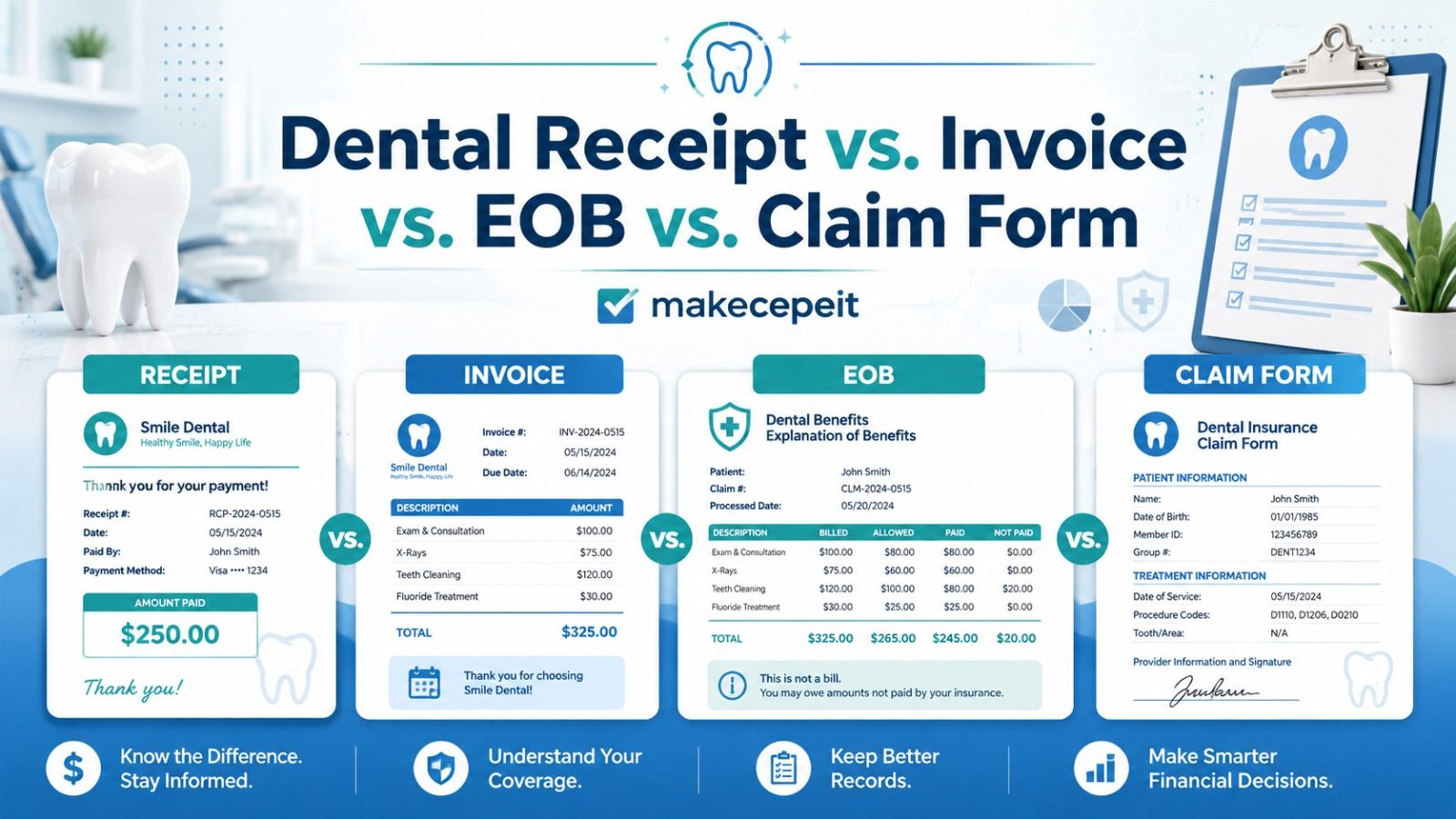
| Document | Main Purpose | Usually Created By |
|---|---|---|
| Dental Payment Receipt | Confirms a payment transaction | Dental provider or authorized payment recipient |
| Dental Invoice | Requests or details money owed | Dental provider |
| Treatment Estimate | Shows expected treatment and anticipated charges | Dental provider |
| Dental Claim Form | Reports dental services to a benefit plan | Provider or authorized submitter |
| Explanation of Benefits | Explains how an insurance or benefit claim was processed | Third-party payer or benefit plan |
A patient who has already paid a dental bill generally needs a payment receipt when the goal is to document that payment. Someone trying to understand what an insurer covered may instead need the EOB. The ADA explains that an EOB communicates benefit determinations after a claim has been adjudicated.
How to Create a Dental Payment Receipt
Creating a dental receipt is straightforward when the transaction information is available. Accuracy matters more than decorative formatting.
- Identify the dental provider. Enter the legitimate dental practice or provider information associated with the transaction.
- Add the patient information. Include only the information necessary to identify the patient for the intended use.
- Enter the real payment date. Use the date the payment actually occurred.
- Describe the dental service. Add a concise and accurate description of the treatment or payment category.
- Enter the amount. Clearly distinguish the amount charged from the amount actually paid when they differ.
- Select the payment method. Record an appropriate payment method without exposing sensitive financial information.
- Add the remaining balance. Include it when the payment does not settle the full account.
- Review every field. Check names, dates, amounts, spelling, and calculations.
- Generate the receipt. Use a dental receipt generator such as makecepeit to produce the finished document.
- Store or share it appropriately. Protect documents containing patient or health-related information.
Why Dental Payment Receipts Matter in the United States
Dental care in the United States often involves multiple financial parties. A dental practice may charge a patient, receive payment from a dental benefit plan, apply contractual adjustments, and then collect a remaining patient responsibility. Clear payment documentation makes those transactions easier to understand.
A receipt may also become useful when a patient reviews previous payments, communicates with a dental office, submits documentation to a reimbursement program, organizes personal financial records, or discusses a payment with an insurer or benefits administrator.
The IRS currently publishes guidance covering qualifying medical and dental expenses for federal tax purposes. Whether a particular expense receives specific tax treatment depends on the individual circumstances and current rules, so a receipt should be viewed as supporting documentation rather than proof that an expense automatically qualifies for a deduction or reimbursement.
This is particularly relevant in large U.S. markets such as New York, Los Angeles, Chicago, Houston, Miami, and Dallas, where patients may interact with dental groups, independent practices, specialists, insurance networks, and employer-sponsored benefit arrangements. Regardless of location, accurate payment records make it easier to reconstruct what was paid and when.
Can a Dental Receipt Be Used for Insurance Reimbursement?
Sometimes, but a receipt alone may not satisfy every insurer or benefit administrator. Requirements vary by plan and reimbursement process.
An administrator may request additional documentation such as provider information, dates of service, procedure details, claim information, an itemized statement, or an Explanation of Benefits. Therefore, patients should check the exact documentation requirements before assuming that a basic receipt will be sufficient.
For dental benefit claims, the ADA Dental Claim Form provides a standardized format for reporting dental services to benefit plans. That claim documentation serves a different function from a payment receipt.
Dental Receipts for HSA, FSA, and Tax Records
A dental payment receipt can help a patient maintain organized documentation for medical spending. However, generating a receipt does not determine whether the expense is eligible for an HSA, FSA, reimbursement arrangement, or federal tax deduction.
Eligibility depends on the expense, plan terms, applicable rules, and the patient's circumstances. The IRS maintains guidance covering medical and dental expenses and separately directs taxpayers to relevant resources concerning HSAs and FSAs.
For that reason, an accurate receipt should document the real transaction instead of being modified to make an expense appear eligible for a reimbursement or tax benefit.
Patient Privacy and Dental Receipt Information
Dental receipts can contain health-related or personally identifiable information. Dental practices and other organizations subject to HIPAA should handle protected health information according to their applicable privacy and security obligations.
HHS explains that HIPAA rules apply to covered entities and business associates, and healthcare providers may use or disclose protected health information for permitted treatment, payment, and healthcare operations under applicable requirements.
For practical receipt creation, the safest principle is data minimization: include what is necessary for the receipt's purpose and avoid unnecessary clinical details, Social Security numbers, complete card numbers, insurance identifiers, or unrelated medical history.
Anyone using a third-party document generator for real patient information should also determine whether that service is appropriate for the type of data being entered. A receipt generator should never automatically be assumed to be suitable for storing or processing protected health information simply because it can create healthcare-related documents.
Benefits of Using an Online Dental Receipt Generator
Faster document creation
A generator removes much of the repetitive formatting involved in creating receipts manually. Users can focus on entering accurate transaction details rather than aligning tables and text fields.
Consistent formatting
Using the same structure for multiple transactions can make receipts easier to review. Practice information, dates, payment amounts, service descriptions, and balance fields can follow a predictable order.
Clearer patient documentation
A professionally structured receipt is easier for patients to understand than an informal note stating only that money was received.
Printable records
Digital receipts can be useful for electronic recordkeeping, while printable versions remain helpful when patients or administrative departments request physical documentation.
Reduced manual errors
A structured template can remind users to review important information such as dates, payment amounts, receipt numbers, and balance details. It does not eliminate human error, so the final document should always be checked before use.
Why Use makecepeit for a Dental Payment Receipt?
People searching for a dental payment receipt generator usually want a faster alternative to designing a receipt manually. makecepeit provides a practical route for users who need to prepare a structured receipt document based on their own transaction information.
The main advantage of using a generator is workflow simplicity. Rather than building formatting from scratch, users can concentrate on the elements that matter: identifying the payment, entering accurate amounts, describing the transaction clearly, and reviewing the final document.
makecepeit should be used as a document-creation tool, not as a way to invent or alter financial or medical history. A professionally formatted receipt is valuable only when the underlying transaction information is accurate.
Who Can Use a Dental Receipt Generator?
A dental receipt template or generator may be useful in several legitimate situations:
- Dental practices documenting patient payments.
- Dental administrators preparing transaction records.
- Independent dental professionals organizing legitimate business documentation.
- Patients creating a personal record from verified payment information.
- Bookkeepers organizing dental practice payment documentation.
- People assembling documentation requested for a reimbursement process.
The person creating the receipt should have legitimate access to the underlying payment information and should not misrepresent who issued the document.
Tips Before Generating a Dental Payment Receipt
Use the actual transaction date
Do not confuse the date the receipt is generated with the date payment occurred. If a receipt is recreated later, the transaction date should still reflect the underlying record.
Separate charges from payments
A patient may have a $1,000 account balance but make only a $250 payment. The receipt should make that distinction obvious.
Keep service descriptions concise
Add enough detail to identify the reason for the payment without inserting unnecessary clinical information.
Check reimbursement requirements first
If the receipt will be submitted to an insurer, employer benefit program, HSA/FSA administrator, or another organization, review its documentation rules before creating the document.
Keep copies securely
Receipts associated with healthcare services should be stored with appropriate care, particularly when they contain patient-identifying or treatment-related information.
Common Dental Receipt Mistakes to Avoid
- Using an incorrect payment date: Always match the date to the actual transaction.
- Showing the full charge as paid: Clearly identify partial payments when applicable.
- Confusing a receipt with an invoice: An invoice describes an amount due; a receipt documents a payment.
- Calling a receipt an EOB: An EOB comes from a payer after processing a claim.
- Adding unnecessary patient information: Include only what is relevant.
- Displaying sensitive payment data: Never place full payment-card information on the receipt.
- Ignoring remaining balances: A patient should be able to tell whether an additional amount may still be owed.
- Submitting fabricated documentation: Never create or modify a receipt to falsely represent a dental treatment or payment that did not occur.
How to Make a Dental Receipt Easier to Verify
A strong receipt allows another person to understand the transaction quickly. Clear provider identification, a unique receipt number, patient identification appropriate to the purpose, payment date, amount paid, payment method, service description, and balance information create a useful audit trail.
Consistency also matters. If a practice generates multiple receipts, using predictable field names and formatting makes records easier to reconcile with bookkeeping systems and patient account histories.
However, visual professionalism should never replace factual accuracy. A polished document containing incorrect payment information is still incorrect.
When a Dental Receipt Is Not Enough
A dental payment receipt proves or records a payment, but another organization may need different evidence.
You may need additional documentation when:
- An insurance company requests an itemized dental statement.
- A payer needs an official dental claim form.
- A benefits administrator requires an Explanation of Benefits.
- A patient disputes the treatment or account balance.
- A reimbursement program requests specific procedure or provider information.
- A tax professional requests supporting documents in addition to payment confirmation.
When in doubt, ask the organization requesting documentation exactly what it requires rather than adding unnecessary information to the receipt.
Create a Clear Dental Payment Record With makecepeit
A dental receipt does not need to be complicated. It needs to be accurate, readable, appropriately detailed, and connected to a legitimate payment transaction.
A dental payment receipt generator can simplify the process by organizing provider details, patient information, payment amounts, dates, service descriptions, and balances into a structured document. It can be useful for dental practices, administrative staff, and individuals who need reliable documentation of an actual dental payment.
For users who want to avoid manually designing a receipt from the beginning, makecepeit offers a straightforward next step: enter the verified transaction information, review every field carefully, and create a dental payment receipt that clearly reflects the real payment.
Frequently asked questions
- What is a dental payment receipt generator?
- A dental payment receipt generator is a tool that helps create a structured document recording payment for dental services, including details such as the provider, patient, date, amount, and payment method.
- What information should be on a dental receipt?
- A dental receipt commonly includes provider information, patient identification, receipt number, payment date, service description, amount paid, payment method, and any remaining balance.
- Is a dental receipt the same as an invoice?
- No. An invoice generally shows money that is owed, while a receipt documents money that has already been paid.
- Is a dental receipt the same as an Explanation of Benefits?
- No. An EOB is issued by a benefit payer after processing a claim and explains how benefits were applied. A receipt documents a payment transaction.
- Can I use a dental receipt for insurance reimbursement?
- Possibly. Some reimbursement processes accept payment documentation, while others require an itemized statement, claim form, EOB, or additional provider information.
- Can a dental receipt be used for HSA or FSA documentation?
- It can help document an expense, but eligibility and required documentation depend on the plan and applicable rules. A receipt alone does not establish eligibility.
- Can I create a printable dental receipt online?
- Yes. An online dental receipt generator can be used to prepare a structured receipt that can then be stored or printed when the tool supports the required output.
- Should a dental receipt include treatment details?
- Include enough information to explain the payment's purpose, but avoid unnecessary clinical or personal information. More detail may be required for certain reimbursement requests.
- Can I create a receipt for a partial dental payment?
- Yes. Clearly show the amount actually paid and, when appropriate, the remaining account balance so the document does not imply full payment.
- Can I use makecepeit to create a dental payment receipt?
- makecepeit can be used as a practical receipt-creation option for organizing legitimate dental payment information into a structured document. Always verify the details before using or sharing the finished receipt.