Credit Receipt vs Refund Receipt: Key Differences
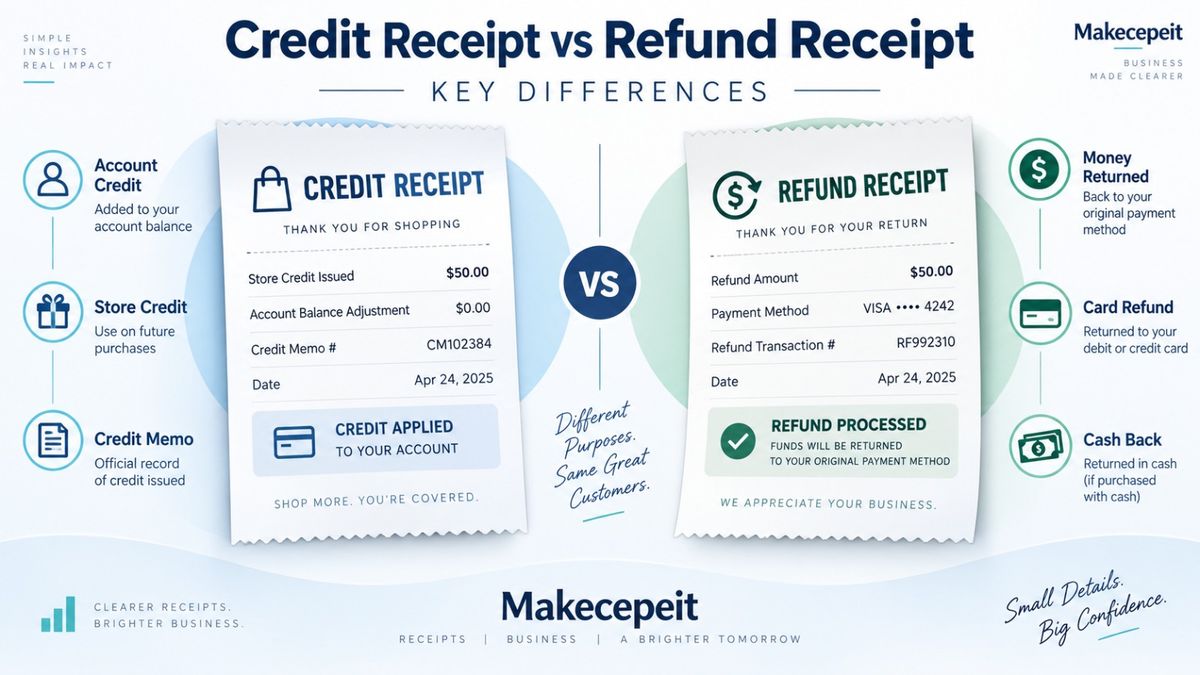
A credit receipt generally documents value credited to a customer's account, while a refund receipt documents money returned to the customer. The simplest difference is cash movement: a refund normally sends funds back, while a customer credit may remain available for a future purchase or reduce an amount still owed.
For U.S. businesses, understanding credit receipt vs refund receipt is important for customer service, bookkeeping, payment reconciliation, and clear transaction records. Makecepeit can help businesses create organized receipt records, but the document chosen should always match what actually happened in the underlying transaction.
Credit Receipt vs Refund Receipt: Quick Answer
A credit receipt records credit given to a customer without necessarily returning money immediately. A refund receipt confirms that money has actually been returned or a refund transaction has been initiated.
There is one important terminology issue. "Credit receipt" is not used consistently across every U.S. accounting or POS system. Many platforms instead use terms such as credit memo, credit note, customer credit, or store credit. QuickBooks, for example, distinguishes a credit memo from a refund receipt, while Stripe similarly explains that a credit memo can reduce an invoice or create a customer balance without itself sending money back.
Therefore, when your POS system displays "credit receipt," verify whether it means account credit, store credit, or a card-related transaction before recording it.
What Is a Credit Receipt?
A credit receipt is commonly understood as documentation showing that a business has credited an amount to a customer's account instead of immediately returning the money. In formal accounting workflows, the corresponding document is often called a credit memo or credit note.
A business may issue customer credit after a returned product, billing adjustment, service problem, overcharge, or negotiated price reduction. The credit might reduce an unpaid invoice or remain on the customer's account for use against a future purchase.
Example of a Credit Receipt
Suppose a customer has a $300 unpaid invoice and the business agrees to credit $50 because part of the service was not delivered. Instead of sending the customer $50, the business reduces the balance owed to $250. Documentation of that adjustment functions as a customer credit or credit memo.
If the customer already paid, a merchant may sometimes leave the amount as store or account credit rather than issue a cash refund, provided that approach is consistent with the merchant's policies and applicable law.
What Is a Refund Receipt?
A refund receipt is a document confirming a refund transaction in which money is returned to a customer. The refund may go back to a credit card, debit card, bank account, digital payment method, or another permitted payment channel.
For example, QuickBooks Online uses a refund receipt to document and process refunds for returned items or services. Its guidance distinguishes this from a credit memo and specifically warns users against creating both for the same refund because doing so could duplicate the accounting effect.
Example of a Refund Receipt
A customer purchases merchandise for $80 using a credit card and later returns the entire order. The merchant processes an $80 refund to the customer's card and generates documentation showing the amount, date, transaction reference, and payment method. That document is a refund receipt.
Credit Receipt vs Refund Receipt: Comparison Table
| Feature | Credit Receipt | Refund Receipt |
|---|---|---|
| Main purpose | Documents customer credit or a balance adjustment | Documents money returned to the customer |
| Money returned immediately | Usually no | Yes, or a refund is formally processed |
| Common accounting term | Credit memo or credit note | Refund receipt |
| Typical use | Invoice reduction, account credit, store credit | Returned goods, canceled services, repayment |
| Effect on customer balance | Reduces amount owed or creates available credit | Returns funds and closes or reverses the relevant payment amount |
| Payment method involved | Not always | Normally tied to the refund method |
Why the Difference Matters for U.S. Businesses
The distinction is more than wording. Businesses across the United States—from independent stores in Texas to service providers in New York or online merchants serving customers nationwide—need transaction records that accurately describe what happened.
Accurate Bookkeeping
A refund and a customer credit can affect accounting records differently. A credit memo may reduce accounts receivable or create a customer credit balance, while a refund involves an actual movement of funds. Mixing the two can create reconciliation problems or make customer balances inaccurate.
Clear Customer Communication
Customers should be able to tell whether they are receiving money back or receiving credit they can use later. A receipt labeled clearly with the transaction type, amount, date, and reference number reduces confusion.
Better Business Records
The IRS states that businesses should maintain supporting documents such as receipts, sales slips, invoices, and payment records because they support entries in business books and tax returns. Electronic records generally follow the same fundamental recordkeeping principles as paper documents.
Sales Tax Considerations
Returns and refunds can also affect sales tax records. Because U.S. sales tax requirements vary by state and sometimes by locality, businesses should use the rules applicable to the jurisdiction where the transaction is taxable rather than assuming one nationwide procedure.
When Should You Use a Credit Receipt?
Use documentation for customer credit when the transaction creates or adjusts a credit rather than directly sending money back.
- A customer receives store credit after an eligible return.
- An unpaid invoice needs to be reduced because of an overcharge.
- A customer receives a post-sale price adjustment.
- Part of a service is canceled before the invoice is fully paid.
- A business grants a customer balance that can be applied to a later purchase.
- A billing mistake requires reducing accounts receivable.
The document should reference the original transaction whenever possible so employees, customers, and bookkeepers can trace the adjustment.
When Should You Use a Refund Receipt?
Use a refund receipt when funds are actually being returned to the customer.
Common situations include a full product return, a partial refund for several returned items, cancellation of a prepaid service, correction of an accidental duplicate charge, or repayment of an eligible customer overpayment.
The refund receipt should accurately show the amount returned. If only part of the original purchase is refunded, do not represent the transaction as a full reversal.
How to Choose Between a Credit Receipt and a Refund Receipt
You can usually identify the correct document by following five simple steps:
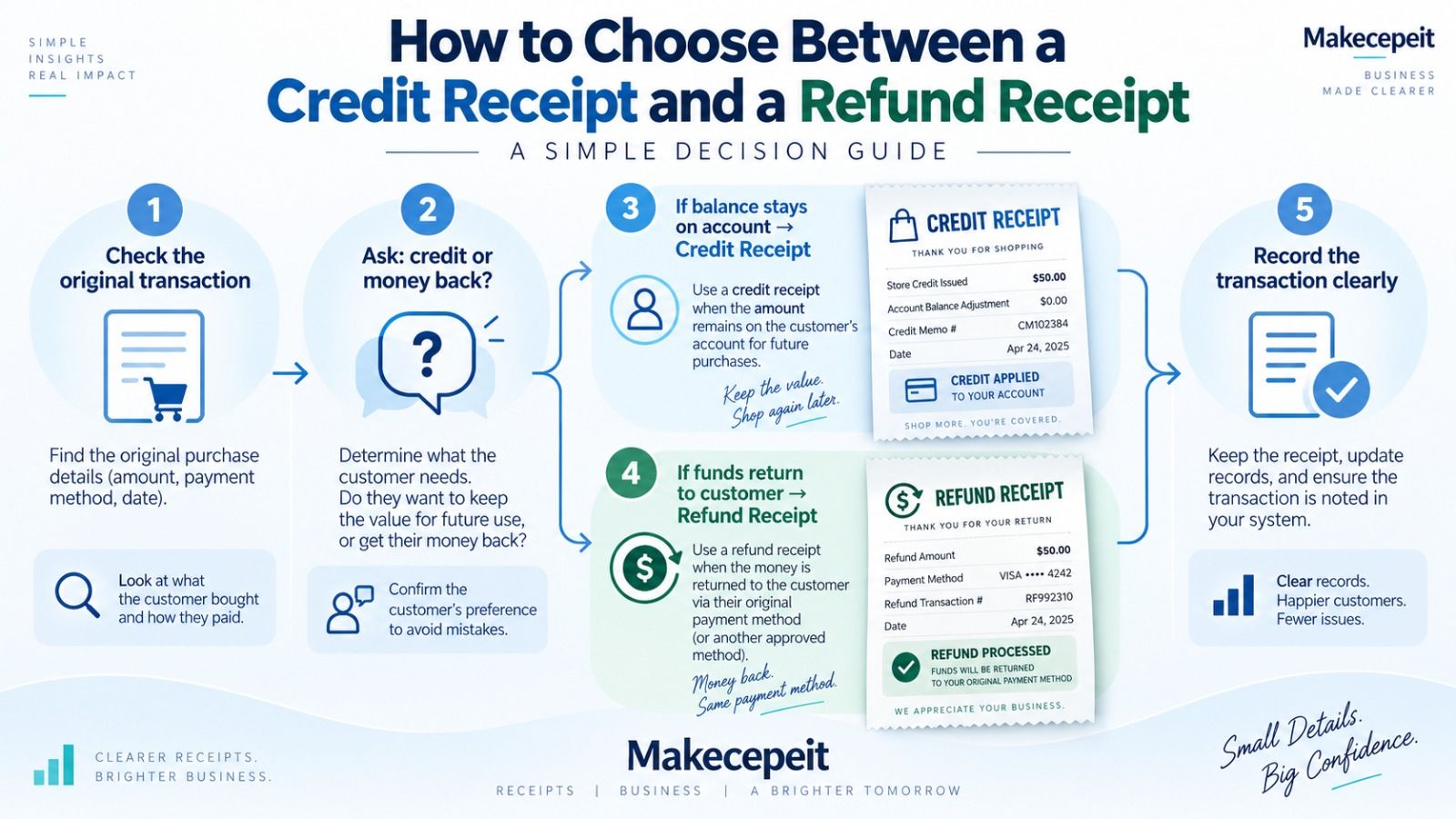
- Check whether the customer already paid. Determine whether there is an outstanding invoice or completed payment.
- Identify what the customer will receive. Decide whether the outcome is account credit, store credit, or money returned.
- Confirm whether funds are moving. If money is being sent back, you generally need refund documentation.
- Reference the original sale. Connect the adjustment or refund with the original receipt, invoice, or transaction ID.
- Record the transaction once. Avoid creating both a credit and refund entry unless your accounting workflow specifically requires both stages.
What Information Should a Credit or Refund Receipt Include?
A useful receipt should make the transaction understandable without requiring additional explanation. Depending on the situation and software used, include the business name, transaction date, unique receipt or reference number, customer information when appropriate, original transaction reference, returned or adjusted items, subtotal, applicable tax adjustment, credit or refund amount, payment method, and a short explanation of the transaction.
If a payment card is referenced, display only information appropriate for a customer receipt, such as masked card details rather than sensitive payment information.
Makecepeit describes transaction identifiers, line items, totals, tax, and payment details as core receipt fields and provides editable receipt layouts that allow those elements to be organized clearly.
Credit Receipt, Refund Receipt, and Chargeback Are Not the Same
A chargeback should not be confused with either customer credit or a normal merchant refund. A refund is initiated by the merchant, while a chargeback generally results from a cardholder dispute handled through the card payment system.
That difference matters because a merchant refund is part of the business's normal return or adjustment workflow. A dispute introduces additional records, deadlines, and communication with the payment processor or financial institutions involved.
Benefits of Documenting Credits and Refunds Correctly
Correct documentation creates a cleaner audit trail and makes everyday operations easier. Employees can confirm what was promised to the customer, accounting teams can reconcile balances, and customers have written evidence of the adjustment.
Consistent receipt records also help prevent the same return from being processed twice. For growing businesses with multiple locations, employees, sales channels, or payment methods, standardized documentation becomes increasingly valuable.
Why Use Makecepeit for Clear Receipt Documentation?
Makecepeit provides an online receipt builder with editable business information, line items, tax details, payment information, and live previews. Receipts can be exported in formats including PDF and high-resolution images, making the platform useful when a business needs an organized digital transaction record.
The practical advantage is flexibility: a business can structure a receipt so the transaction type, amounts, dates, taxes, and payment details are easy to understand rather than relying on an unclear generic document.
Any receipt created with Makecepeit should represent a legitimate transaction accurately. Generated or recreated receipts should never be used to invent purchases, falsify expense claims, misrepresent tax records, or create false proof of payment.
Tips Before Issuing a Credit or Refund
Start by reviewing the original transaction instead of creating a new document from memory. Confirm the amount paid, returned products or canceled services, taxes, discounts, and payment method.
Use consistent terminology throughout your business. If your accounting software calls the document a "credit memo," use that term internally rather than switching between credit note, credit receipt, and refund receipt without explanation.
For transactions involving accounting treatment, sales tax, or unusual customer agreements, verify the procedure with your accounting professional and applicable state requirements.
Common Credit and Refund Receipt Mistakes to Avoid
One common mistake is labeling store credit as a cash refund. Another is issuing a refund receipt before the refund has actually been submitted through the appropriate payment system.
Businesses should also avoid entering the same adjustment twice, forgetting to reference the original transaction, omitting returned items, recording the wrong tax amount, or failing to distinguish a full refund from a partial refund.
Finally, never delete or alter legitimate transaction history simply to make records appear cleaner. Maintaining a traceable record of the original sale and subsequent adjustment usually provides a clearer bookkeeping trail.
Credit Receipt vs Refund Receipt: Which One Do You Need?
The decision comes down to what happens to the customer's money. If the customer receives a balance reduction or credit for future use, the transaction is generally documented through a credit memo, account credit, or what some systems call a credit receipt. If money is returned to the customer, use a refund receipt or equivalent refund transaction record.
Because terminology differs between POS and accounting systems, focus on the financial event rather than the document label alone: credit changes a balance; refund returns money.
Clear records protect both sides of the transaction and make bookkeeping, customer support, reconciliation, and future reviews easier.
Create Clear, Professional Receipt Records with Makecepeit
When you need a clean receipt that accurately reflects a real transaction, Makecepeit makes it easier to organize business details, items, tax, payment information, totals, and transaction references in one readable document. Review the original transaction first, choose the appropriate receipt type, and create a record that clearly communicates what occurred.
Use Makecepeit to create professional receipt documentation that matches your legitimate business transaction and keeps important details easy to reference.
Frequently asked questions
- What is the main difference between a credit receipt and a refund receipt?
- A credit receipt generally documents customer credit or a balance adjustment. A refund receipt documents money returned to the customer.
- Is a credit receipt the same as a refund?
- No. Customer credit can remain on an account or reduce an invoice without money being returned immediately. A refund involves returning funds.
- Is a credit receipt the same as a credit memo?
- Often, yes in practical usage, but terminology varies. Many U.S. accounting systems use "credit memo" rather than "credit receipt" for an account credit.
- When should I issue a refund receipt?
- Issue a refund receipt when you return money for a purchase, cancellation, eligible overpayment, or similar transaction.
- When should I issue a credit memo instead of a refund receipt?
- Use a credit memo when reducing an amount the customer owes or creating credit that can be applied to another transaction.
- Can a credit later become a refund?
- Yes. Depending on business policy and the accounting system, an existing customer credit may later be paid back as a refund.
- Does a refund have to return to the original payment method?
- That depends on the merchant's policy, payment processor, transaction type, and applicable rules. Card refunds commonly return through the payment system used for the original purchase.
- Should a refund receipt reference the original receipt?
- Yes, whenever possible. Linking the refund to the original transaction creates a clearer audit and customer-service trail.
- Should sales tax appear on a refund receipt?
- If the original transaction included sales tax and the tax is being adjusted, the receipt should accurately reflect the applicable adjustment according to relevant state and local requirements.
- Can I create credit and refund receipt records with Makecepeit?
- Makecepeit provides customizable receipt-building tools for transaction details, items, tax, totals, and payment information. Any generated receipt should accurately represent a legitimate real-world transaction.