Car Rental Receipt Generator With Mileage and Fees
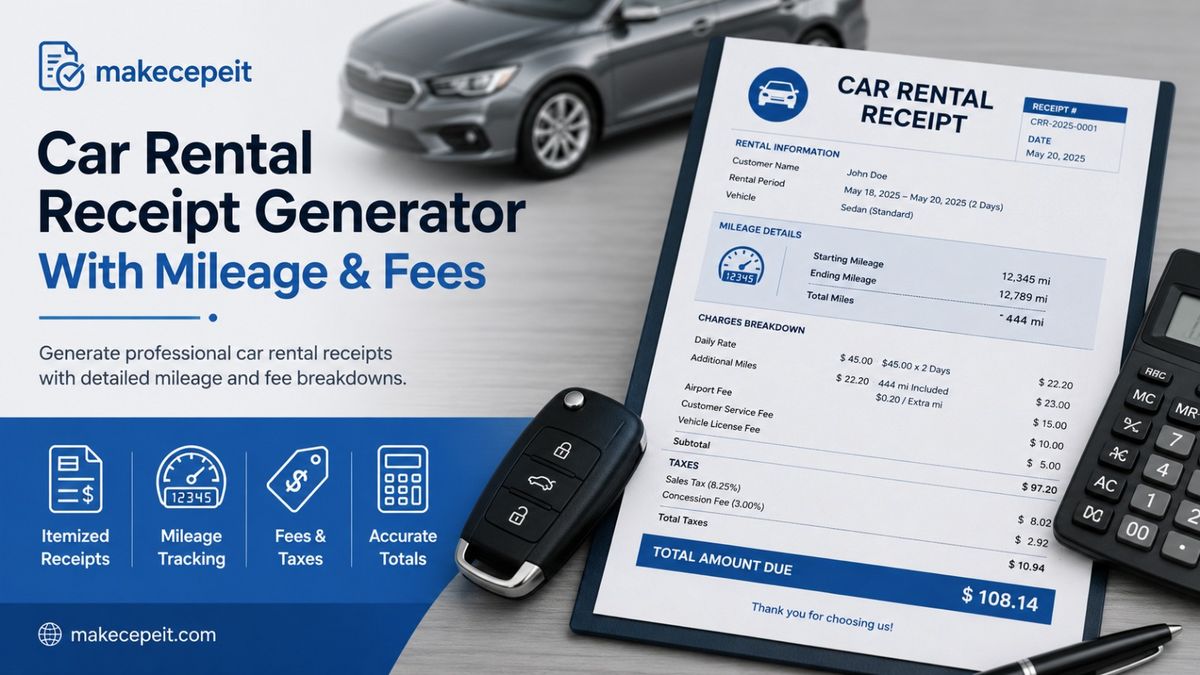
A car rental receipt generator with mileage and fees helps organize the financial details of a vehicle rental into one clear, itemized record. A well-structured receipt can show the rental period, vehicle information, starting and ending mileage, daily rental charges, mileage fees, fuel charges, taxes, surcharges, and the final amount paid.
For rental businesses, independent vehicle operators, travel administrators, and people preparing legitimate internal records, a structured receipt is much easier to understand than a basic payment note. makecepeit can be considered when you need a convenient way to organize rental receipt information in a readable format for documentation, examples, business records, or other lawful purposes.
A useful car rental receipt should clearly explain what vehicle was rented, when it was rented, how far it was driven, which charges were applied, and how the final total was calculated.
Receipt generators should be used only for lawful documentation and recordkeeping. They should not be used to misrepresent a transaction, impersonate a rental company, or create false evidence of payment.
What Is a Car Rental Receipt Generator With Mileage and Fees?
A car rental receipt generator is a tool designed to organize rental transaction information into an itemized receipt format. Unlike a simple payment receipt that may show only a date and total, a detailed rental receipt can document the complete cost structure of a vehicle rental.
The mileage component is particularly important because many vehicle rentals include either unlimited mileage, a specific mileage allowance, or an additional charge when the driver exceeds an agreed distance.
A detailed receipt may therefore include both financial and operational information, such as:
- Rental company or operator information
- Customer or renter name
- Vehicle make and model
- Vehicle identification or unit number
- Pickup and return dates
- Starting odometer reading
- Ending odometer reading
- Total miles driven
- Daily or weekly rental rate
- Included mileage allowance
- Excess mileage charges
- Fuel or refueling charges
- Taxes and applicable surcharges
- Optional service charges
- Final rental total
Why Mileage Matters on a Car Rental Receipt
Mileage explains how far the rental vehicle traveled during the rental period and can directly affect the amount charged. A receipt that includes odometer information gives the reader a clearer explanation of any mileage-related fee.
For example, a rental may include a certain number of miles per day. If the renter drives beyond that allowance, the excess distance can be multiplied by the contract's per-mile rate.
Starting and Ending Odometer Readings
The starting odometer reading records the vehicle's mileage when it is released to the renter. The ending reading records the mileage when the vehicle is returned.
The basic calculation is:
Ending Odometer − Starting Odometer = Total Miles Driven
If a vehicle begins a rental at 24,500 miles and returns at 24,860 miles, the recorded distance is 360 miles.
Included Mileage vs Excess Mileage
Some rental arrangements provide unlimited mileage, while others establish a mileage allowance. When an allowance applies, an itemized receipt should distinguish between the miles included in the rental price and any excess mileage.
For example, if a rental includes 300 miles and the vehicle travels 360 miles, 60 miles may be considered excess mileage. The actual charge depends on the terms agreed to by the renter and rental provider.
Common Fees Found on Car Rental Receipts in the United States
Car rental pricing in the United States can contain several separate charges. The exact fees vary by rental location, provider, vehicle category, optional services, local rules, and the original rental agreement.
That is why an itemized receipt is generally more useful than a single-line total.
| Receipt Item | What It Represents |
|---|---|
| Base Rental Rate | The core daily, weekly, or agreed vehicle rental charge. |
| Mileage Fee | A charge based on mileage when the rental does not include unlimited miles. |
| Excess Mileage Fee | An additional amount for exceeding the mileage allowance. |
| Fuel Charge | A possible charge related to fuel level or refueling under the rental terms. |
| Additional Driver Fee | A charge that may apply when another authorized driver is added. |
| Airport or Facility Fee | A location-related charge that may apply at certain rental facilities. |
| Optional Equipment | Charges for selected extras such as child seats or other rental accessories. |
| Taxes | Applicable state, local, or transaction taxes. |
Not every receipt will contain every charge. The purpose of an itemized format is to display only the fees that actually apply to the documented rental.
How to Create an Itemized Car Rental Receipt
The simplest approach is to enter the rental information in the same order that someone reviewing the receipt would expect to see it.
- Enter the rental provider details. Add the relevant business or operator information needed for the record.
- Add renter information. Include the customer or renter details appropriate for the document.
- Identify the rental vehicle. Record the make, model, vehicle class, or unit information when relevant.
- Enter pickup and return information. Clearly record the start and end of the rental period.
- Record mileage. Add the starting and ending odometer readings and calculate total distance traveled.
- Add the base rental rate. Specify whether the rental is charged by day, week, or another agreed period.
- Add applicable fees. Include mileage, fuel, optional services, or other legitimate charges from the transaction.
- Add applicable taxes. Taxes should reflect the actual transaction and jurisdiction where relevant.
- Review the calculations. Verify quantities, rates, subtotals, fees, taxes, and the final total.
- Keep the document for the intended lawful recordkeeping purpose.
What Information Should a Rental Car Receipt Include?
A detailed rental car receipt should contain enough information for the transaction to be understood without requiring someone to guess how the final amount was reached.
Rental Transaction Details
Include the rental date or rental period, transaction reference information when applicable, and the basic parties associated with the rental.
Vehicle Details
Vehicle information helps distinguish one rental from another. Depending on the purpose of the document, this may include the vehicle model, class, internal unit number, or another non-sensitive identifier.
Mileage Details
When mileage affects the rental cost, the receipt should show the starting odometer, ending odometer, total distance, mileage allowance, and any billable excess miles.
Itemized Charges
Listing charges separately makes the receipt easier to verify. Instead of displaying only a total such as $450, a detailed record can explain how the rental charge, mileage adjustment, fuel fee, optional services, taxes, and other legitimate charges contribute to that amount.
Car Rental Receipt vs Rental Agreement
A rental agreement establishes the terms of the rental, while a receipt documents the financial outcome of a transaction. The two documents serve different purposes and should not automatically be treated as interchangeable.
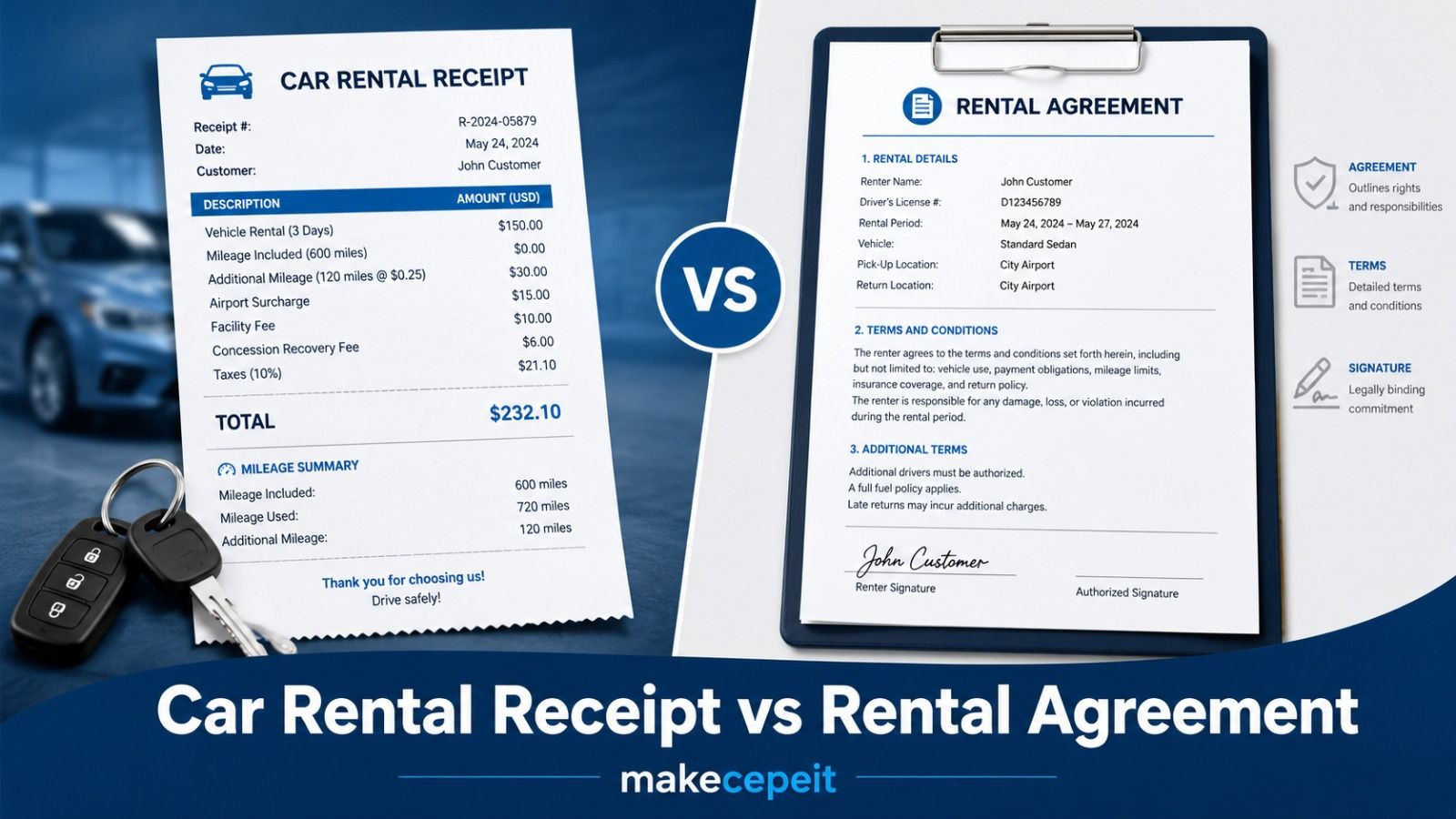
| Feature | Rental Agreement | Rental Receipt |
|---|---|---|
| Main Purpose | Defines rental terms and responsibilities | Records charges and payment details |
| Rental Rates | Usually shown | Usually itemized |
| Mileage Rules | Defines allowance or mileage terms | Shows resulting mileage charges |
| Final Charges | May be estimated initially | Reflects the documented transaction total |
| Taxes and Fees | May explain applicable charges | Shows the amounts actually recorded |
When documenting a real rental, the receipt should remain consistent with the underlying transaction records and rental terms.
Why Itemized Rental Receipts Matter in the United States
Vehicle rental transactions in the United States often involve more than the advertised daily rate. Rental locations in cities such as New York, Los Angeles, Miami, Chicago, Dallas, and Las Vegas may operate under different tax structures, facility rules, or rental conditions.
An itemized receipt helps separate these components instead of presenting them as one unexplained amount.
This is particularly useful when records are being reviewed for:
- Internal business expense documentation
- Travel administration
- Rental fleet accounting
- Customer service records
- Transaction reconciliation
- Authorized reimbursement documentation
- Bookkeeping and operational records
Requirements for tax deductions, reimbursements, or accounting evidence can vary. When a document is being used for an official financial purpose, users should retain the original transaction documentation and follow the rules of the relevant employer, accountant, agency, or tax authority.
Benefits of Including Mileage and Fees on the Same Receipt
A receipt becomes considerably easier to review when the rental rate, distance traveled, and additional charges appear in one structured document.
Clearer Cost Breakdown
The reader can immediately see whether the total is based only on rental duration or whether mileage and other services affected the price.
Easier Mileage Verification
Displaying both odometer readings allows total mileage to be checked using a simple subtraction rather than relying on an unexplained mileage figure.
Better Business Records
Rental operators and administrators can maintain more consistent records when the same categories are captured for each transaction.
Fewer Questions About Additional Charges
A clearly labeled fuel fee, excess mileage fee, optional service charge, or tax is easier to understand than a miscellaneous amount added to the final total.
Car Rental Mileage Receipt Example
A structured mileage section could contain information similar to the following:
- Starting odometer: 18,240 miles
- Ending odometer: 18,690 miles
- Total distance: 450 miles
- Included mileage: 400 miles
- Excess mileage: 50 miles
- Excess mileage rate: based on the documented rental terms
- Mileage charge: excess miles × applicable per-mile rate
This format allows someone reviewing the transaction to understand exactly how the mileage portion was determined.
Sample figures should remain clearly identifiable as examples and should never be presented as evidence of a transaction that did not occur.
How Fuel Charges Should Be Documented
Fuel is another common source of confusion in vehicle rental records. A receipt should clearly label any fuel-related charge rather than combining it with unrelated fees.
Depending on the actual rental arrangement, the record might refer to a refueling charge, prepaid fuel option, or another agreed fuel-related amount.
The receipt should reflect the real terms of the transaction. Avoid inventing fuel quantities, rates, or policies when preparing business documentation.
Why Use makecepeit for Structured Receipt Creation?
When the goal is to prepare an organized receipt format, makecepeit provides a practical starting point for creating structured receipt-style documents without manually building every section from scratch.
For a car rental use case, the most important consideration is not decorative formatting. It is whether the final record can clearly communicate information such as rental dates, vehicle details, mileage, individual charges, taxes, and totals.
Using a consistent structure can be helpful for legitimate examples, administrative documentation, internal records, design testing, demonstrations, and other authorized purposes.
Users should always ensure that any generated document accurately represents its intended purpose and is not presented as an authentic receipt from an unrelated rental company.
Tips Before Creating a Car Rental Receipt
- Use accurate mileage. Check both odometer readings before calculating total miles.
- Separate fees. Avoid placing several unrelated charges under a generic "additional fee" label.
- Check rental dates. Make sure the number of rental days matches the dates shown.
- Verify the rate. Confirm whether the rental price is daily, weekly, or based on another billing structure.
- Check mileage terms. Determine whether mileage was unlimited or subject to an allowance.
- Use the correct tax information. Do not assume that the same tax or surcharge applies throughout the United States.
- Keep source records. For accounting or reimbursement purposes, retain the real rental agreement, payment confirmation, and supporting documentation whenever required.
Common Mistakes to Avoid With Car Rental Receipts
Using Only a Grand Total
A single final amount provides very little information. Itemizing the rental rate, mileage, fees, and taxes makes the record much easier to review.
Forgetting Starting or Ending Mileage
Listing total mileage without the underlying odometer readings can make verification more difficult.
Mixing Taxes With Rental Fees
Taxes and service charges are not necessarily the same thing. Keep them in appropriately labeled categories.
Applying the Wrong Mileage Formula
Total mileage should be calculated from the actual starting and ending readings. Excess mileage should then be determined according to the applicable mileage allowance.
Assuming Every Rental Has the Same Fees
Charges vary by provider, location, vehicle, rental terms, and optional services. A receipt should reflect the specific transaction rather than a generic list of possible fees.
Creating Misleading Documentation
A receipt generator should not be used to fabricate proof of a rental or falsely claim that a payment occurred. For official reimbursements, taxes, disputes, or financial records, use authentic supporting documentation from the actual transaction whenever required.
Car Rental Receipt Generator With Mileage and Fees: Final Takeaway
A car rental receipt generator with mileage and fees is most useful when the document clearly connects vehicle usage with the final rental cost. Rental dates, odometer readings, total mileage, mileage allowances, base rates, fuel charges, additional services, taxes, and the final total should be easy to identify and verify.
For U.S. vehicle rental documentation, an itemized format is especially valuable because applicable taxes, facility charges, mileage policies, and optional fees can differ between transactions and locations.
Rather than relying on an unclear one-line payment record, organize each legitimate transaction into meaningful sections. If you need a convenient way to prepare a structured receipt-style document for an authorized purpose, visit makecepeit and build the record around accurate rental, mileage, and fee information.
Frequently asked questions
- What is a car rental receipt generator?
- A car rental receipt generator helps organize vehicle rental details, mileage, charges, taxes, and totals into a structured receipt format.
- Should a car rental receipt show mileage?
- Yes, when mileage is relevant to the rental. Starting mileage, ending mileage, total miles, and any billable excess mileage can make the receipt easier to verify.
- How do you calculate rental car mileage?
- Subtract the starting odometer reading from the ending odometer reading. The result is the total distance driven during the rental.
- What is an excess mileage fee?
- An excess mileage fee may apply when a renter drives beyond the mileage allowance specified in the rental terms.
- What fees can appear on a car rental receipt?
- Depending on the transaction, fees may include mileage charges, fuel charges, optional services, additional driver fees, facility surcharges, and applicable taxes.
- Is a car rental receipt the same as a rental agreement?
- No. A rental agreement defines the terms of the rental, while a receipt records the financial details associated with the transaction.
- Can rental car taxes differ by location?
- Yes. Taxes and certain location-based charges can vary by jurisdiction and rental location in the United States.
- What vehicle information belongs on a rental receipt?
- A receipt may include the vehicle make, model, class, unit number, or other relevant identifiers appropriate to the transaction.
- Should fuel charges be listed separately?
- Yes. Separating fuel charges from the base rental rate makes the receipt clearer and easier to review.
- Can makecepeit be used for car rental receipt formatting?
- makecepeit can be considered for preparing structured receipt-style documents for legitimate records, examples, demonstrations, or other authorized uses. Generated documents should not be misrepresented as proof of transactions that did not occur.