Airline Ticket Receipt Generator With Baggage Fees

An airline ticket receipt generator with baggage fees helps organize flight-related costs into a clear travel record that can show airfare, taxes, checked baggage charges, carry-on fees, and other relevant trip details. For travelers and businesses in the United States, separating the base ticket price from optional airline charges can make personal recordkeeping and expense reconciliation significantly easier.
A tool such as makecepeit can be used to prepare structured travel-expense records or clearly marked sample receipt templates when information needs to be presented in an organized format. However, a generated record should never be represented as an official airline-issued document when it is not one. For reimbursements, insurance claims, tax records, charge disputes, or proof of travel, the original airline or booking-agent documentation should remain the primary source.
What Is an Airline Ticket Receipt Generator With Baggage Fees?
An airline ticket receipt generator with baggage fees is a tool for arranging flight and travel-cost information into a receipt-style document. Unlike a simple airfare template, it can provide separate fields for the ticket price and additional baggage-related expenses.
A useful travel receipt may distinguish between the base fare, government taxes, carrier charges, first checked bag, second checked bag, carry-on baggage, oversized baggage, overweight baggage, and other optional services. This separation makes the total cost easier to understand.
A generated travel receipt is best treated as an organizational or sample document. It does not automatically become an official airline receipt, e-ticket confirmation, tax document, or proof that a transaction occurred.
This distinction is particularly important in the United States, where airline ticket purchases may involve several separate components and optional services.
Why Baggage Fees Matter on an Airline Receipt
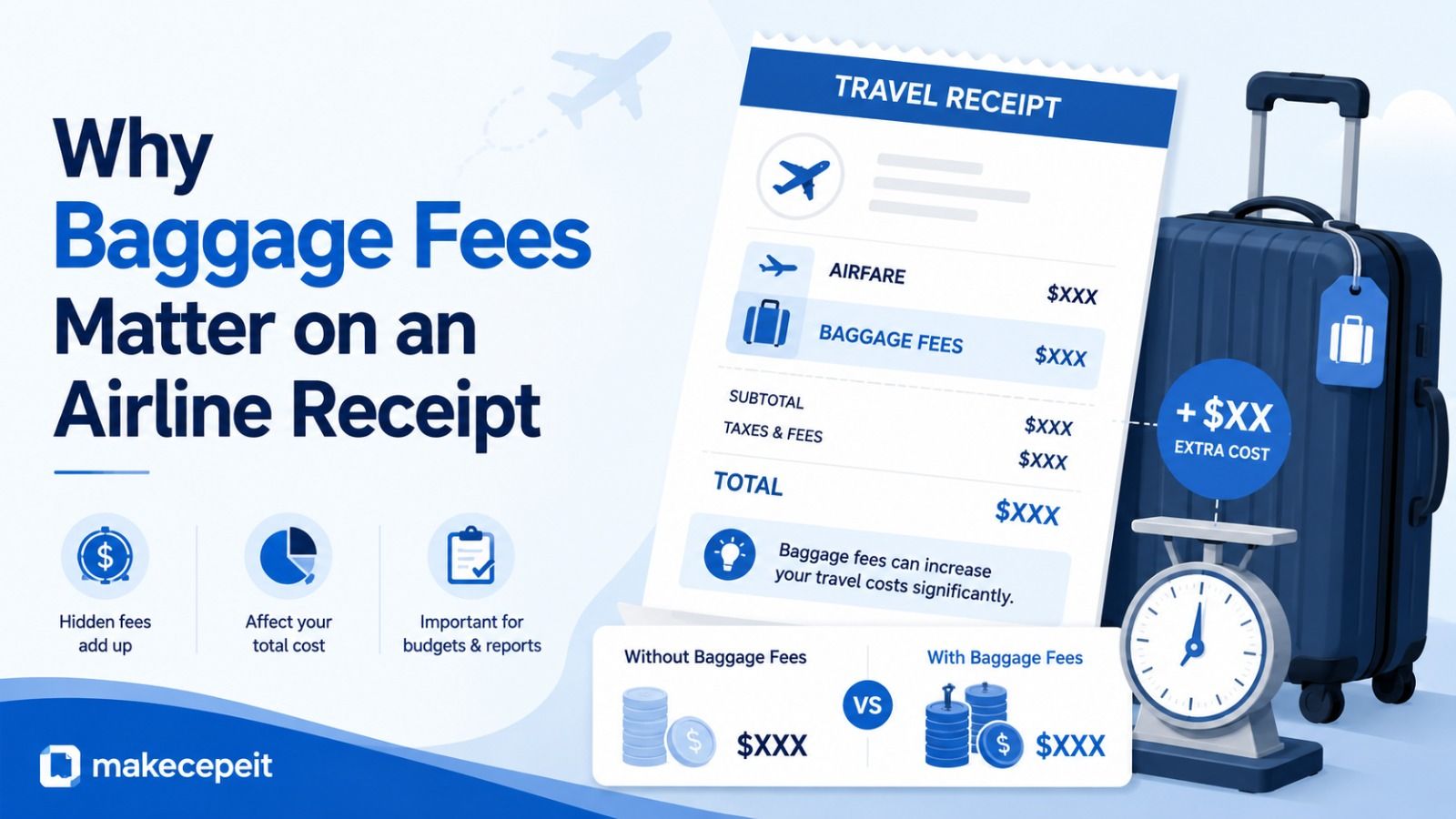
Baggage charges can materially change the final cost of a flight. A fare that initially appears inexpensive may cost more once checked bags, oversized luggage, or other optional services are included.
The U.S. Department of Transportation requires airlines to provide consumers with access to baggage-fee information. Following a 2026 regulatory update implementing the Fifth Circuit's vacatur of the 2024 ancillary-fee rule, DOT restored the earlier disclosure framework. Airlines and ticket agents must still alert consumers that additional baggage charges may apply and direct them to the relevant fee information.
DOT also explains that airline websites must provide access to baggage-fee information, including information relevant to checked baggage and potentially oversized or overweight baggage.
For recordkeeping, this makes baggage expenses worth documenting separately rather than combining everything into one unexplained total.
What Should an Airline Ticket Receipt Include?
A useful airline travel receipt should contain enough information for the reader to understand the trip and how the total amount was calculated.
Passenger and Flight Information
- Passenger name
- Airline name
- Origin airport
- Destination airport
- Departure date
- Return date when applicable
- Flight number
- Cabin or fare class
- Booking reference when legitimately available
Airfare Information
- Base airfare
- Applicable taxes
- Mandatory carrier charges
- Total ticket price
Baggage Information
- Carry-on allowance or charge
- First checked-bag fee
- Second checked-bag fee
- Additional checked bags
- Overweight baggage charges
- Oversized baggage charges
Payment and Record Information
- Transaction date
- Currency, usually USD for U.S.-based records
- Payment method description where appropriate
- Total amount
- Document or internal reference number
Only information that corresponds to the actual transaction or legitimate sample scenario should be entered. Inventing an airline confirmation number, transaction, passenger identity, payment record, or fee and presenting it as genuine could create serious compliance and fraud concerns.
Example Airline Ticket and Baggage Fee Breakdown
A well-organized receipt should make the difference between airfare and optional charges immediately visible.
| Receipt Item | What It Represents |
|---|---|
| Base Fare | The underlying passenger airfare before separately listed charges |
| Taxes and Mandatory Fees | Applicable government or mandatory ticket charges |
| First Checked Bag | Fee charged for the passenger's first checked bag, if applicable |
| Second Checked Bag | Fee for an additional checked bag, when applicable |
| Oversize/Overweight Fee | Additional baggage charge based on the airline's policy |
| Other Optional Services | Eligible services purchased separately from the airfare |
| Total | The combined amount represented by the record |
Actual fees should always come from the airline's receipt, confirmation, baggage policy, or other authentic transaction record rather than from assumptions.
How to Create a Travel Receipt With Baggage Fees
The safest process is to begin with authentic travel records and transfer only verified information.
- Collect your original documents. Find the airline confirmation, e-ticket receipt, baggage payment receipt, credit-card transaction, or booking-agent confirmation.
- Enter the passenger and itinerary details. Use the name, airports, travel dates, flight numbers, and other information exactly as shown in the original record.
- Record the base airfare. Do not estimate the amount if you already have an official confirmation.
- Add baggage fees separately. Enter the first checked bag, second checked bag, carry-on fee, or special baggage charge only when it actually applies.
- Add applicable taxes and charges. Copy them from legitimate transaction documentation instead of inventing values.
- Check the total. Confirm that the individual charges reconcile with the overall amount.
- Label the document appropriately. If the document was generated independently rather than issued by the airline, identify it as a personal record, recreated expense summary, or sample rather than an official airline receipt.
- Keep the originals. Store your authentic airline documentation with the generated organizational record.
Can a Generated Receipt Replace an Official Airline Receipt?
No. A generated receipt should not be treated as a replacement for official airline-issued proof when formal verification is required.
If your employer, accountant, insurer, bank, government agency, or another organization requires evidence of an actual transaction, use the airline's original e-ticket confirmation, baggage receipt, booking record, or payment evidence.
U.S. DOT guidance states that e-ticket confirmations for travel within, to, or from the United States include baggage-related information under applicable rules, making the original confirmation an important source for checking allowances and applicable charges.
A receipt generator is therefore better suited to organization, record reconstruction based on genuine evidence, accounting preparation, demonstrations, software testing, or clearly identified sample documents.
Why Accurate Baggage Fee Records Are Useful in the United States
Air travel is common for both business and personal trips across major U.S. markets such as New York, Los Angeles, Chicago, Dallas, Miami, Atlanta, and San Francisco. Travelers may purchase tickets directly from airlines, through travel agencies, or through online booking platforms.
Regardless of the booking method, optional charges can create multiple transactions associated with a single trip. A traveler might buy the airfare first and pay a checked-bag fee later during online check-in or at the airport.
Maintaining a consolidated travel-expense record can make it easier to:
- review the actual cost of a trip;
- prepare internal business expense records;
- compare airfare and baggage spending;
- match credit-card transactions;
- organize travel documentation;
- identify missing original receipts that need to be retrieved from the airline.
The organizational document should complement legitimate evidence rather than replace it.
Airline Baggage Fees Are Not the Same for Every Traveler
Baggage pricing varies according to the airline, route, fare type, baggage dimensions, weight, loyalty benefits, payment timing, and other circumstances.
For that reason, an airline baggage fee receipt template should not automatically insert one universal baggage price.
Some travelers may receive baggage benefits based on fare class, airline loyalty status, eligible credit-card benefits, military policies, or international ticket allowances. Other passengers may face additional charges for overweight, oversized, sporting, or specialty baggage.
The safest approach is simple: obtain the actual fee from the airline or original payment record and enter that amount into the travel record.
Airline Receipt Generator vs. Official E-Ticket Confirmation
| Feature | Generated Travel Record | Official Airline Confirmation |
|---|---|---|
| Organizes trip information | Yes | Yes |
| Can show baggage fees | Yes, when entered accurately | Yes, according to the airline's records and applicable disclosure requirements |
| Issued by airline | No | Yes |
| Suitable as sample/template | Yes | Not primarily |
| Official proof of airline transaction | No | Normally the appropriate primary record |
| Can consolidate separate travel costs | Yes | Depends on how and when charges were purchased |
When an Airline Travel Receipt Generator Can Be Useful
There are several legitimate situations in which creating a structured receipt-style travel record can be convenient.
Personal Travel Organization
Frequent travelers may want one document summarizing airfare and separate baggage transactions for each trip.
Internal Expense Preparation
An employee can use a travel summary to organize expenses before attaching the original supporting documents required by the employer.
Accounting Reconciliation
A structured record can help match airfare and baggage transactions against bank or corporate-card statements.
Software Testing and Demonstrations
Developers, designers, accountants, and training teams may need sample travel receipts containing realistic field structures without representing them as genuine transactions.
Reconstructing a Personal Record
If information exists across multiple legitimate sources, a traveler can consolidate those facts into one personal record while still preserving the originals.
Why Use makecepeit for Organized Travel Receipt Records?
For someone searching for an airline ticket receipt generator with baggage fees, the most important consideration should be clarity rather than simply creating a document that resembles an airline receipt.
When using makecepeit, travelers and businesses should focus on building an organized record containing the information relevant to their actual trip: passenger details, itinerary, airfare, baggage expenses, taxes, and total travel cost.
The value of a structured generator is the ability to keep information readable and logically separated. Baggage charges should appear as individual line items rather than being hidden inside an unexplained total.
Users should also preserve the distinction between a makecepeit-generated record and documentation issued directly by an airline. This protects the accuracy of business records and helps avoid confusion when documents are later reviewed.
Tips Before Creating an Airline Receipt Record
- Retrieve the original airline confirmation first. Most airlines allow travelers to access past reservations or request receipt information.
- Verify baggage transactions separately. A baggage purchase may have occurred after the initial ticket booking.
- Use the correct currency. For U.S. travel records this will often be USD, but international transactions can differ.
- Keep dates consistent. Booking date, travel date, and baggage-purchase date are not necessarily the same.
- Do not invent confirmation numbers. Only use booking or ticket identifiers that belong to the genuine reservation.
- Review your airline's current baggage policy. DOT advises consumers to check airline baggage policies because additional restrictions or fees may apply to oversized and overweight baggage.
- Keep supporting evidence. Generated records are most useful when linked to authentic confirmations, payment statements, or invoices.
Common Mistakes to Avoid
Combining Every Charge Into One Total
A receipt becomes less useful when airfare, taxes, and baggage charges cannot be distinguished. Keep meaningful charges on separate lines.
Guessing Baggage Fees
Do not assume one airline's baggage fee applies to another carrier or itinerary. Policies and passenger circumstances vary.
Using Incorrect Travel Dates
A ticket purchase date can differ substantially from the actual departure date. Keep each date in the correct field.
Calling a Generated Document an Official Airline Receipt
This is one of the most important errors to avoid. If the airline did not issue the document, do not represent it as airline-issued evidence.
Submitting Fabricated Expenses
Never generate or alter a receipt to claim reimbursement, tax deductions, insurance payments, refunds, chargebacks, or other financial benefits for expenses that were not actually incurred.
Discarding Original Documentation
Keep official e-ticket confirmations, baggage-payment receipts, and card statements whenever they may be required later.
How to Keep Airline Expense Records Easy to Verify
A simple documentation system makes travel expenses much easier to review.
- Create one folder for each trip.
- Save the original ticket confirmation.
- Save separate baggage receipts.
- Keep hotel and ground-transportation receipts separately.
- Create a consolidated expense summary when helpful.
- Match each expense to the appropriate payment transaction.
- Keep generated summaries clearly identified as summaries rather than source documents.
This method is especially useful for employees who travel frequently between U.S. cities and need to prepare recurring expense reports.
Final Thoughts
An airline ticket receipt generator with baggage fees can make travel-cost documentation easier by combining airfare information with checked-bag, carry-on, and other relevant charges in one organized record.
The most important principle is accuracy. Use genuine booking and payment information, separate optional charges clearly, keep original airline documentation, and never present a generated record as an official document when it was not issued by the airline.
For travelers, businesses, designers, and accounting workflows that need a clean way to organize legitimate flight-expense information, makecepeit can provide a practical next step for preparing a structured travel receipt record while keeping the distinction between a generated summary and official airline evidence clear.
Use makecepeit to organize your legitimate airline ticket and baggage-fee information into a clear, easy-to-review travel record, while retaining your original airline documentation for verification whenever required.
Frequently asked questions
- What is an airline ticket receipt generator with baggage fees?
- It is a tool that organizes airfare, taxes, baggage charges, and trip information into a receipt-style travel record or template.
- Can an airline receipt generator include checked-bag fees?
- Yes. A structured receipt can include separate fields for first, second, additional, overweight, or oversized checked-bag charges when those expenses genuinely apply.
- Can it include carry-on baggage fees?
- Yes. If the airline charged for a carry-on bag, the amount can be recorded as a separate item.
- Is a generated airline receipt an official receipt?
- No. A document independently generated by a third-party tool is not automatically an official airline-issued receipt.
- Where can I find my real baggage fee?
- Check your airline's confirmation, baggage receipt, reservation record, payment transaction, or current baggage-policy information.
- Do U.S. airlines disclose baggage fee information?
- Yes. U.S. DOT rules require airlines to provide consumers with access to baggage-fee information and alert them that additional baggage charges may apply.
- Can I use a generated receipt for a business expense?
- You can use a generated summary to organize legitimate expenses, but use the original airline or payment documentation whenever your employer requires official proof.
- Can I generate a receipt if I lost the original?
- You can reconstruct a personal expense summary from verified records, but first try to retrieve the official receipt from the airline or booking provider.
- Should baggage fees be separated from airfare?
- Yes. Separating baggage fees makes the total trip cost easier to understand and verify.
- What should I do before using makecepeit?
- Gather the authentic itinerary and payment information, enter only accurate details, and clearly distinguish generated records from official airline-issued documents.